
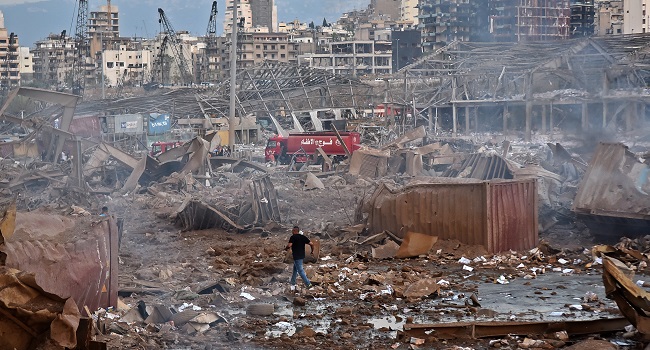
A picture shows the scene of an explosion near the port in the
Lebanese capital Beirut on August 4, 2020.(Photo by STR /
AFP)
For at least six years, hundreds of tonnes of ammonium
nitrate, which Lebanese authorities say caused Tuesday’s massive
blast, were negligently stored in a Beirut port warehouse, waiting
for disaster to strike.
The odourless crystalline substance commonly used as a
fertiliser has caused numerous industrial explosions over the
decades — including the massive one in Beirut that killed at least
113 people, wounded thousands, and left 300,000 homeless.
A security source said the explosive power of the stored
ammonium nitrate was equivalent to at least 1,200 tonnes of TNT —
explaining how the earthquake-strength blast destroyed or damaged
so much of the city.
Lebanese port authorities and customs officials knew the
chemical was being stored in the port, and one of the country’s top
security agencies had called for it to be relocated after launching
a probe last year, several security officials told AFP.
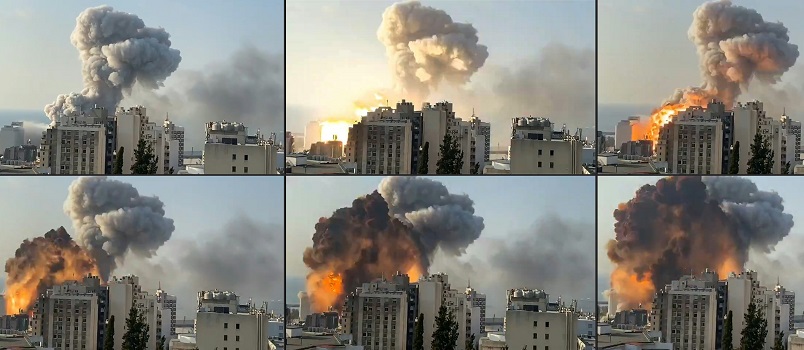
created from UGC footage taken on August 4, 2020 and filmed from a
highrise shows a fireball exploding while smoke is billowing at the
port of the Lebanese capital Beirut. -(Photos by Mouafac HARB /
MOUAFAC HARB / AFP)
But authorities did not heed the warning. Only on the day after
the massive blast left much of the capital in ruins did the
government say it was seeking house arrest for all officials
involved in storing the highly-explosive substance.
With Tuesday’s blast damage extending across half the Lebanese
capital, the burning questions on everyone’s mind are: how did so
much ammonium nitrate get to Beirut in the first place and why was
it stored at the port for so long?
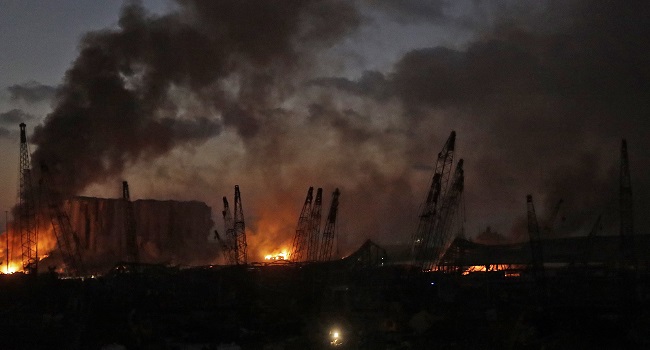
This picture taken on August 4, 2020 shows a view of the port of
Lebanon’s capital Beirut with its cranes in the aftermath of a
massive explosion. (Photo by JOSEPH EID / AFP)
Shady shipment
In 2013, around 2,750 tonnes of ammonium nitrate came into
Lebanon on board the Rhosus ship, sailing from Georgia and bound
for Mozambique, a security official told AFP, asking not to be
named because he is not authorised to speak on the issue.
Marine Traffic, a ship tracking platform, said the
Moldova-flagged vessel first arrived in Beirut’s port, the
country’s busiest, on November 20, 2013 and never left.
According to Lebanese law firm Baroudi & Associates, which
represents the vessel’s crew, the Rhosus ship had faced “technical
problems”.
“Upon inspection of the vessel by port state control, the vessel
was forbidden from sailing,” the firm said in a statement.
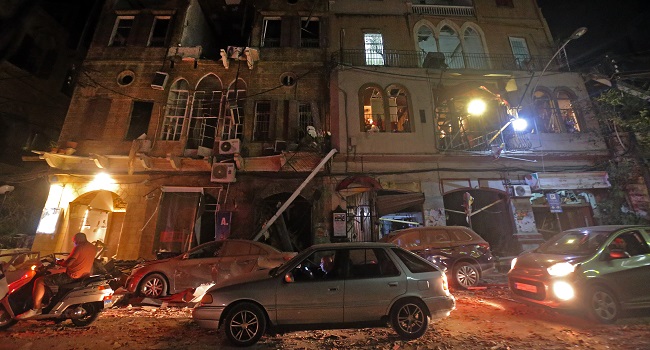
This picture taken on August 4, 2020 shows a general view of
destruction along a street in the centre of Lebanon’s capital
Beirut, following a massive explosion at the nearby port of Beirut.
(Photo by STR / AFP)
(adsbygoogle = window.adsbygoogle || []).push({});
Several security officials told AFP that it temporarily docked
at the port but was later seized by authorities following a
lawsuit filed by a Lebanese company against the shipowner.
Port authorities unloaded the ammonium nitrate and stored it in
a rundown port warehouse with cracks in its walls, and the ship
sank some time later because of damage, the officials said.
The warehouse started to exude a strange odour, which led
security forces to launch a 2019 investigation that concluded that
the “dangerous” chemicals needed to be removed from the
premises.
The agency also noted the walls of the warehouse were unsound,
urging the port authorities to repair them.
It was not until this week that workers were dispatched and
began repair works, in what might have possibly triggered the
blast.
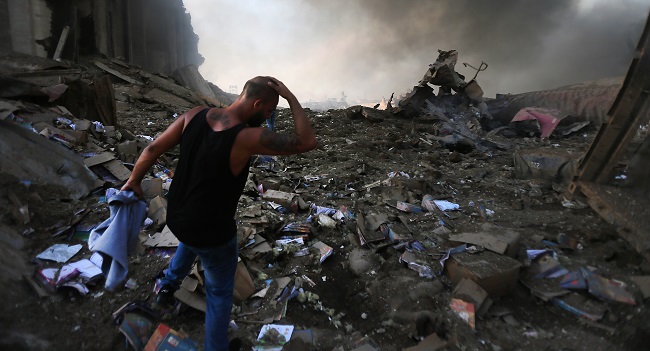
A picture shows the scene of an explosion at the port in the
Lebanese capital Beirut on August 4, 2020. (Photo by STR /
AFP)
Gross negligence
Shortly after Tuesday’s blast, the director of customs at the
port, Badri Daher, published a letter he said he had sent in
December 2017 to a Lebanese prosecutor, claiming it was one of many
he had sent to the judiciary over the stored chemicals.
In the 2017 letter, he allegedly requested the dangerous
chemicals be exported or sold to a local Lebanese company after the
army had said it had no use for them, but neither suggestion
materialised.
A judicial source said prosecutors were only involved in ruling
whether or not the ammonium nitrate-carrying vessel should be
released and were not involved in issues pertaining to the
substance’s storage.
Riad Kobaissi, an investigative reporter who specialises in port
corruption, charged that Daher was only trying to deflect blame by
publishing the letter.
He said what has happened shows “the extent of corruption in
Lebanese port customs, which is among the main bodies that bear
responsibility” for the blast.
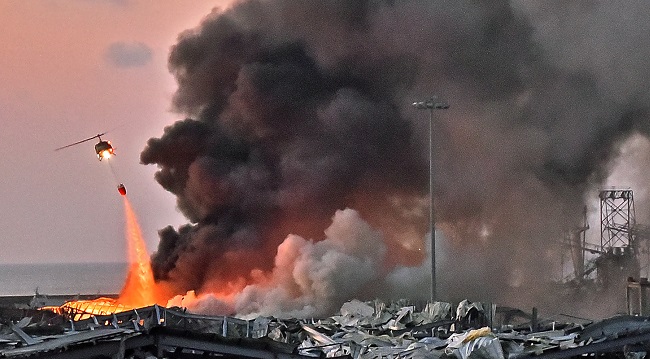
A helicopter puts out a fire at the scene of an explosion at the
port of Lebanon’s capital Beirut on August 4, 2020. (Photo by STR /
AFP)
Among many, the disaster has only fuelled anger at a government
already widely seen as inept, corrupt, and beholden to sectarian
interests.
On Twitter, users blamed authorities, using the hashtag “hang
them from the gallows”.
One user posted a photo showing several prominent Lebanese
politicians with the caption: “You have to pay for burning the
hearts of mothers and the future of the youth and terrorising
children.”
-AFP