
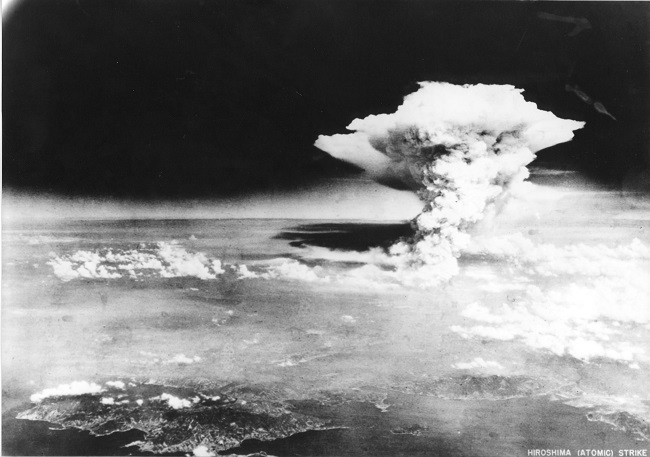
picture taken on August 6, 1945 by the US Army and released via the
Hiroshima Peace Memorial Museum shows a mushroom cloud of the
atomic bomb dropped by the B-29 bomber Enola Gay over the city of
Hiroshima. (Photo by Handout / various sources /
AFP)
Japan on Thursday marks 75 years since the world’s first
atomic bomb attack, with the coronavirus pandemic forcing a scaling
back of ceremonies to commemorate the victims.
Survivors, relatives and a handful of foreign dignitaries will
attend this year’s main event in Hiroshima to pray for the victims
and call for world peace.
But the general public will be kept away, with the ceremony
instead broadcast online.

whose mother was pregnant with him in Hiroshima when the atomic
bomb struck in 1945, points at the hypocentre of the bombing and
the Hiroshima Peace Memorial (Genbaku Dome) on a map. (Photo by
Behrouz MEHRI / AFP)
Other events, including a gathering to float lanterns along the
Motoyasu River, have been cancelled as coronavirus cases spike in
parts of Japan.
The annual commemoration is “Hiroshima’s mission of calling on
people across the world to work towards peace”, mayor Kazumi Matsui
told reporters.
Participants will offer a silent prayer at 8:15 am (2315 GMT
Wednesday), the exact time the first nuclear weapon deployed in
wartime hit the city.
Around 140,000 people were killed, many of them instantly, with
others perishing in the weeks and months that followed, suffering
radiation sickness, devastating burns and other injuries.
Three days later the United States dropped a second atomic bomb
on Nagasaki, where 74,000 people were killed.

ruins of the Hiroshima Prefectural Industrial Promotion Hall, now
commonly known as the atomic bomb dome, is seen lit up in The
evening in Hiroshima on August 5, 2020. (Photo by Philip FONG
/ AFP)
‘Unspeakable horror’
The historical assessment of the bombings remains subject to
some controversy. The United States has never apologised for the
bombings, which many in the US see as having ended the war.
Japan announced its surrender just days later on August 15,
1945, and some historians argue the bombings ultimately saved lives
by avoiding a land invasion that might have been significantly more
deadly.
But in Japan, the attacks are widely regarded as war crimes
because they targeted civilians indiscriminately and caused
unprecedented destruction.
In 2016, Barack Obama became the first sitting US president to
visit Hiroshima, where he offered no apology but embraced survivors
and called for a world free of nuclear weapons.
(adsbygoogle = window.adsbygoogle || []).push({});
Hiroshima and Nagasaki were key stops on Pope Francis’s first
trip to Japan last year, where he denounced the “unspeakable
horror” of the attacks.
At Thursday’s ceremony, Hiroshima’s mayor and a representative
of bereaved families will deliver remarks in front of a cenotaph
inscribed with the names of victims.
Volunteers will then livestream a tour of buildings affected by
the bombing, and share testimonies by two atomic bomb survivors as
part of efforts to mark the anniversary despite the virus.
The pandemic stalking the globe carries an all-too-familiar fear
for some survivors, including 83-year-old Keiko Ogura, who lived
through the Hiroshima bombing.
With the outbreak of the virus, “I recall the fear I felt right
after the bombing,” she told journalists last month.
“No one can escape.”

whose mother was pregnant with him in Hiroshima when the atomic
bomb struck in 1945, poses next to a painting by Yoshiki Inada,
bearing a fetus (Jiro Hamasumi) and the Hiroshima Peace Memorial.
(Genbaku Dome. (Photo by Behrouz MEHRI / AFP)
‘Solidarity among mankind’
The global nature of the threat requires a global solution, she
said.
“Whether it’s the coronavirus or nuclear weapons, the way to
overcome it is through solidarity among mankind.”
The landmark anniversary this year underscores the dwindling
number of bomb survivors, known in Japan as “hibakusha”.
Those who remain were mostly infants or young children at the
time, and their work to keep the memory of the bombings alive and
call for a ban on nuclear weapons has taken on increasing urgency
as they age.
Activists and survivors have created archives of everything from
the recorded testimony of hibakusha to their poems and
drawings.
But many fear interest in the bombings is fading as they recede
beyond the horizon of lived experience and into history.
“Just storing a pile of records… is meaningless,” said Kazuhisa
Ito, the secretary general of the Hibakusha Assembly of Memory
Heritage, an NGO that compiles records and documents from
survivors.
“What we want is to engage young people with this issue and
exchange views with them, globally,” he told AFP.
-AFP
Read more https://swordpress.com.ng/2020/08/06/japan-marks-75th-anniversary-of-hiroshima-atomic-bomb/