
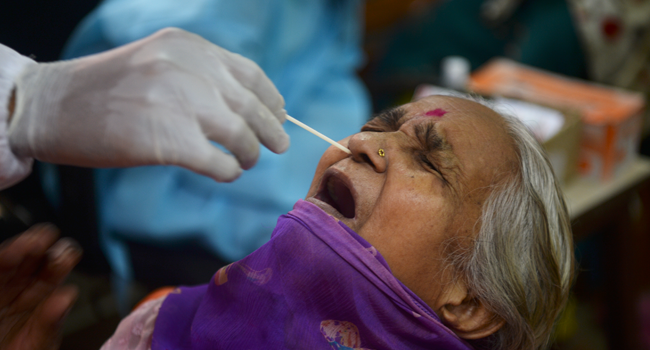
sample of a resident to test for COVID-19 coronavirus, at a
screening camp in Mumbai on August 17, 2020. Indranil MUKHERJEE /
AFP
India’s official coronavirus death toll soared past
50,000 on Monday as the pandemic rages through smaller cities and
rural areas where health care is feeble and stigmatisation
rife.
Many experts say the real numbers may be far higher due to low
testing rates and because deaths are often not properly recorded in
the vast and impoverished nation of 1.3 billion people.
India last week overtook Britain with the world’s fourth-highest
number of fatalities, behind the United States, Brazil and Mexico,
and as of Monday had recorded 50,921 deaths, according to the
health ministry.
With some of the world’s biggest megacities and slums, India is
already the third-most infected nation behind the US and Brazil
with 2.65 million infections.
Despite the rising death toll, the health ministry said on
Sunday that India’s virus mortality rate of 1.92 percent was “one
of the lowest globally”.
“Successful implementation of testing aggressively, tracking
comprehensively and treating efficiently through a plethora of
measures have contributed to the existing high level of
recoveries,” the ministry said.
According to tracking website Worldometer, the United States,
with 170,000 deaths, has a death rate of 3.11 percent while Brazil,
with almost 110,000 fatalities, sees 3.22 percent of those who test
positive die.
According to the Indian health ministry, the US “crossed 50,000
deaths in 23 days, Brazil in 95 days and Mexico in 141 days. India
took 156 days to reach this national figure.”
Possible reasons that have been suggested include India’s
relatively young population, its climate and greater exposure to
pathogens that cause tuberculosis than elsewhere.
But experts say India’s testing rates per million inhabitants
are far lower than other countries, and that too few deaths are
properly recorded — even in normal times.
“(A) couple of studies have indicated that… only one in four
deaths is certified and a cause of death is established,” Lalit
Kant, former head of epidemiology and communicable diseases at the
Indian Council of Medical Research, told AFP.
(adsbygoogle = window.adsbygoogle || []).push({});
In addition, many of the tests being done — up to 30 percent
nationally — are the less reliable rapid antigen tests where “false
negatives” can be reported in up to half of cases, according to
media reports.
Lockdown misery
Prime Minister Narendra Modi’s government imposed in March one
of the world’s strictest lockdowns.
It dealt a heavy blow to Asia’s third-biggest economy and caused
misery for the country’s poor, with tens of millions of migrant
workers left jobless almost overnight.

Protective Equipments (PPE) check the temperature and the oxygen
level of an elderly resident during a COVID-19 coronavirus
screening in the Dharavi slum, in Mumbai on August 11, 2020. (Photo
by INDRANIL MUKHERJEE / AFP)
Vast numbers trudged back penniless to their home villages from
cities including New Delhi, Mumbai and Ahmedabad, many of them on
foot. Some died on the way.
The lockdown has since been steadily eased but many sectors
complain that they are severely short of workers.
State and local governments across the country have meanwhile
reimposed lockdown measures as the virus has spread to smaller
cities and rural areas, where around 70 percent of Indians
live.
In many rural regions however, anecdotal evidence suggests that
measures to stop the spread such as masks and distancing are widely
ignored.
In addition, a lack of public awareness has contributed to those
with the virus being ostracised, making people more reluctant to
get tested.
Health care facilities outside the major cities are also
severely stretched.
“In smaller cities and towns and rural areas tests of COVID-19
may not be available,” Lalit said.
“Patients with COVID-like symptoms are often turned away from
heath care facilities, some may die without a test being done.”
AFP
Read more https://swordpress.com.ng/2020/08/17/indias-covid-19-death-toll-hits-50000/