
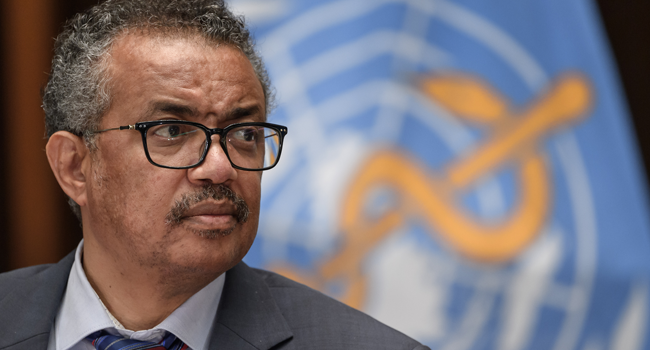
Organization (WHO) Director-General Tedros Adhanom Ghebreyesus
attends a press conference organised by the Geneva Association of
United Nations Correspondents (ACANU) amid the COVID-19 outbreak,
caused by the novel coronavirus, on July 3, 2020 at the WHO
headquarters in Geneva. Fabrice COFFRINI / POOL / AFP
The world should be able to rein in the coronavirus
pandemic in less than two years, the World Health Organization said
on Friday, as millions of Lebanese wearily entered a new lockdown
following a spike in coronavirus infections.
Western Europe was also enduring the kind of infection levels
not seen in many months, particularly in Germany, France, Spain and
Italy — sparking fears of a full-fledged second wave.
In the Spanish capital Madrid, officials recommended people in
the most affected areas stay at home to help curb the spread as the
country registered more than 8,000 new cases in 24 hours.
But WHO chief Tedros Adhanom Ghebreyesus sought to draw
favourable comparisons with the notorious flu pandemic of 1918.
“We have a disadvantage of globalisation, closeness,
connectedness, but an advantage of better technology, so we hope to
finish this pandemic before less than two years,” he told
reporters.
By “utilising the available tools to the maximum and hoping that
we can have additional tools like vaccines, I think we can finish
it in a shorter time than the 1918 flu”, he said.
With no usable vaccine yet available, the most prominent tool
governments have at their disposal is to confine their
populations.
Lebanon is the latest country to reintroduce severe
restrictions, beginning two weeks of measures on Friday including
nighttime curfews to tamp down a rise in infections, which comes as
the country is still dealing with the shock from a huge explosion
in the capital Beirut that killed dozens earlier this month.
“What now? On top of this disaster, a coronavirus catastrophe?”
said 55-year-old Roxane Moukarzel in Beirut.
The capital’s streets largely emptied of cars at the start of
the curfew, but some locals were unenthusiastic.
“There’s no point in this lockdown,” said Samer Harmoush,
running along the Beirut seafront. “Some shops are complying
completely, while others aren’t at all.”
Officials fear Lebanon’s fragile health system would struggle to
cope with a further spike in COVID-19 cases, especially after
some hospitals near the port were damaged in the explosion.
‘We lead the world in deaths’
The Americas has borne the brunt of the virus in health terms,
accounting for more than half of the world’s fatalities.
“We lead the world in deaths,” said Joe Biden while accepting
the Democratic nomination for the US presidential election late on
Thursday.

candidate and former Vice President Joe Biden speaks at a “Build
Back Better” Clean Energy event on July 14, 2020 at the Chase
Center in Wilmington, Delaware.Olivier DOULIERY / AFP
He said he would implement a national plan to fight the pandemic
on his first day in office if elected in November.
“We’ll take the muzzle off our experts so the public gets the
information they need and deserve — honest, unvarnished truth,” he
said.
(adsbygoogle = window.adsbygoogle || []).push({});
Further south, Latin American countries were counting the wider
costs of the pandemic — the region not only suffering the most
deaths, but also an expansion of criminal activity and rising
poverty.
Without an effective political reaction, “at a regional level we
can talk about a regression of up to 10 years in the levels of
multidimensional poverty”, Luis Felipe Lopez-Calva of the UN
Development Programme told AFP.
His warning came after World Bank President David Malpass said
on Thursday that the virus may have driven as many as 100 million
people back into extreme poverty.
‘No apres-ski’
Economies around the globe have been ravaged by the pandemic,
which has infected more than 22 million and killed nearly 800,000
since it emerged in China late last year.
New financial figures laid bear the huge cost of the pandemic in
Britain, where government debt soared past £2 trillion ($2.6
trillion) for the first time in the UK after a massive programme of
state borrowing for furlough schemes and other measures designed to
prop up the economy.
“Without that support things would have been far worse,” said
finance minister Rishi Sunak.
Even Germany, famed for its financial prudence, was waking up to
a new reality with Finance Minister Olaf Scholz conceding his
country would need to continue borrowing at a high level next year
to deal with the virus fallout.
Western European politicians are also beginning to ramp up
restrictions to tackle infections that are rising to levels not
seen for months.
While Spain has responded with confinement measures and Germany
with updated travel guidelines, the UK is now watching clusters in
northern England and suggesting some towns could soon face
lockdown.
“To prevent a second peak and keep Covid-19 under control, we
need robust, targeted intervention where we see a spike in cases,”
said health secretary Matt Hancock in a statement.
Irish politicians, meanwhile, fell foul of their own updated
rules this week.
Two politicians resigned after attending a restrictions-busting
anniversary dinner of parliament’s own golf society that involved
more than 80 guests, including lawmakers and a supreme court
judge.
The virus thrives in confined areas where people are in close
contact, meaning many sports have suffered mass cancellations.
One of Austria’s most virulent outbreaks was in a ski resort in
the west — although the finger of blame was pointed at the
socialising rather than the skiing in Ischgl, known as the “Ibiza
of the Alps”.
With the ski season rapidly approaching, the region’s tourism
association had a clear message: “There won’t be any apres-ski
partying as we know it next season.”
AFP
Read more https://swordpress.com.ng/2020/08/22/who-hopes-to-end-covid-19-pandemic-in-less-than-two-years/