
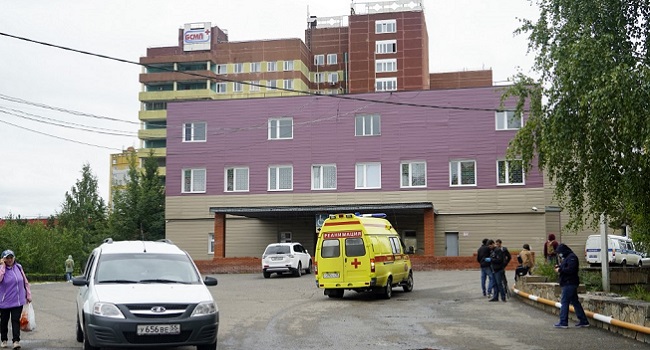
on August 20, 2020 shows a general view of Omsk Emergency Hospital
No 1 where Russian opposition leader Alexei Navalny was admitted
after he fell ill in what his spokeswoman said was a suspected
poisoning. – Tests carried out on Russian opposition leader Alexei
Navalny provide clear proof that he was poisoned by a chemical
nerve agent, the German government said Wednesday, September 2,
2020, demanding explanations from Moscow. Yelena LATYPOVA /
AFP.
Germany, the current head of the European Union,
will discuss possible sanctions against Russia over the poisoning
of Alexei Navalny if the Kremlin does not provide an explanation
soon, its foreign minister said Sunday.
Russian opposition leader and anti-corruption campaigner Navalny
fell ill on a flight last month and was treated in a Siberian
hospital before being evacuated to Berlin.
Germany said last week there was “unequivocal evidence” that
President Vladimir Putin’s top foe had been poisoned using
Soviet-era nerve agent Novichok.
“We have high expectations of the Russian government to solve
this serious crime,” Heiko Maas told German daily Bild. “If the
government has nothing to do with the attack, then it is in its own
interest to back this up with facts.”
If Russia does not help clarify what happened “in the coming
days”, Germany will be compelled to “discuss a response with our
allies,” Maas said.
The crime against Navalny was a violation of the international
Chemical Weapons Convention and there must be an appropriate
response, he said. “When we think about sanctions, they should be
as targeted as possible.”
Western leaders and many Russians have expressed horror at what
Navalny’s allies say is the first known use of chemical weapons
against a high-profile opposition leader on Russian soil.
READ ALSO: UK Says Russian State Link Likely In
Navalny Poisoning
The Kremlin has denied responsibility for the attack and Foreign
Minister Sergei Lavrov has said that Germany is yet to share any
findings with Moscow’s prosecutors.
Foreign ministry spokeswoman Maria Zakharova on Sunday accused
Germany of stalling efforts to probe the Navalny case.
“Berlin is stalling the process of investigation for which it’s
calling. On purpose?” she said on Facebook.
– ‘Several indications’ –
Maas said there were “several indications” that Russia was
behind the poisoning, in the strongest accusations yet from
Germany.
(adsbygoogle = window.adsbygoogle || []).push({});
“The deadly substance with which Navalny was poisoned has in the
past been found in the hands of Russian authorities.
“Only a small number of people have access to Novichok and this
poison was used by Russian secret services in the attack against
former agent Sergei Skripal,” he said, referring to a 2018 attack
on the former double agent and his daughter in the English city of
Salisbury.
The Skripals spent days in a coma before recovering but local
resident Dawn Sturgess died after picking up a discarded perfume
bottle allegedly used to carry the poison.
The Navalny case is only the latest in what Berlin has seen as a
series of provocations by Putin that have damaged ties and called
future cooperation into question.
The poisoning comes a year after the murder in broad daylight of
a former Chechen rebel commander in a Berlin park, which German
prosecutors believe was ordered by Russia.
– Nord Stream 2 –
German Chancellor Angela Merkel also revealed in May that Russia
had targeted her in hacking attacks, saying she had concrete proof
of the “outrageous” spying attempts.
On the subject of which sanctions could be discussed by the EU,
Maas did not rule out action relating to Nord Stream 2, a
multi-billion-euro Russian-German gas pipeline nearing completion
that has drawn the ire of US and European partners alike.
“I hope… that the Russians do not force us to change our
position on Nord Stream,” Maas said, adding that the consequences
of any potential cancellation of the project would also need to be
weighed, and that the debate on sanctions should not be “reduced”
to one point.
The controversial pipeline is meant to deliver Russian gas to
Europe, but the German government has faced growing calls to
abandon it as tensions with Russia escalate.
Bild slammed Merkel last week for comments that Nord Stream 2
should be judged independently from Moscow’s actions.
“Vladimir Putin views the gas pipeline as an important strategic
weapon against Europe and as a vital source of funding for his war
against his own people,” it said.
AFP