
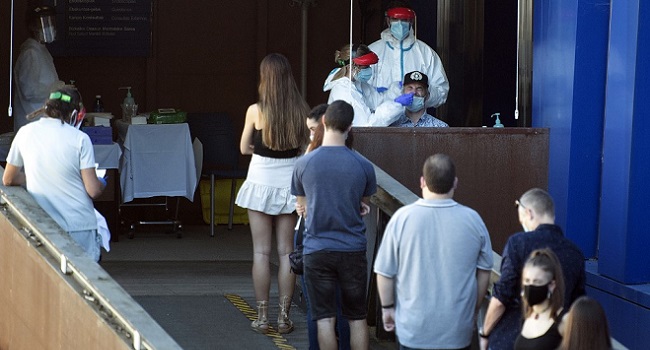
temporary testing centre for the novel coronavirus in the Spanish
Basque city of Gernika, on August 25, 2020. (Photo by ANDER
GILLENEA / AFP)
Spain’s health minister on Tuesday called on
residents of Madrid to limit their movements and social contacts to
the “essential” to put the brakes on a surge in COVID-19
infections, a day after new restrictions came into effect in part
of the region.
Spain is struggling to contain a second wave of the virus, which
has already infected over 670,000 people and claimed over 30,000
lives, one of Europe’s highest tolls.
Madrid has become the epicentre of the contagion with a rate of
infection of nearly 700 cases per 100,000 inhabitants in the last
two weeks — nearly three times the national average.
“I would recommend residents of Madrid to limit to the maximum
their movements, that they scrupulously respect the measures
dictated by the health authorities in the region and minimise their
movements to what is essential and their contacts to those closest
to them,” Health Minister Salvador Illa said during an interview
with radio Cadena Ser.
His comments come a day after a partial lockdown came into
effect on some 850,000 people in the Madrid region — mostly in
densely populated, low-income districts in the south — who account
for 13 percent of the region’s population of 6.6 million but 24
percent of virus infections.
(adsbygoogle = window.adsbygoogle || []).push({});
The restrictions which came into force on Monday prevent people
from entering or leaving the affected areas, except for work,
education or to seek medical care but they can move around freely
within their zone.
The affected areas have all counted more than Covid-19 cases per
100,000 inhabitants — around five times the national average, which
in itself is the highest in the European Union.
The regional government of Madrid, which is responsible for
health care, also reduced the maximum size of permitted social
gatherings across the entire region from ten to six.
Many epidemiologists have expressed doubts about the
effectiveness of Madrid’s new measures but Illa said he believed
they could help control the spread of the virus and that it would
not be necessary to declare a state of emergency in the region, a
step which would allow the government to confine people to their
homes.
Since the central government ended its state of emergency on
June 21, lifting all national lockdown restrictions, responsibility
for public healthcare, and managing the pandemic has been left in
the hands of Spain’s 17 autonomous regions.
AFP