
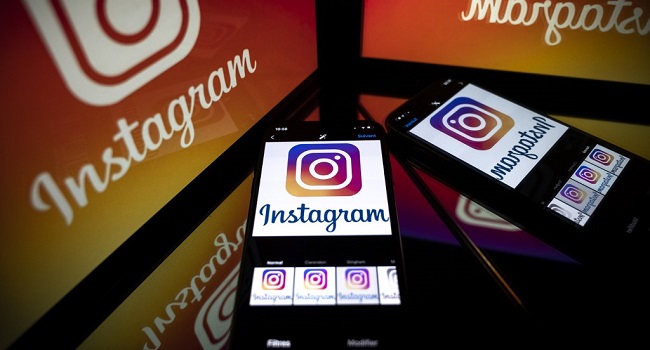
28, 2020 shows the logo of the social network Instagram on a
smartphone and a tablet screen in Toulouse, southwestern France. –
The Instagram group will, in early October 2020, celebrate its
ten-year anniversary. (Photo by Lionel BONAVENTURE /
AFP)
#Foodporn, #nofilter, and #TBT: Little known to the
general public a decade ago, Instagram has weaved its way into the
daily lives of a billion people, changing the way we eat, travel,
and consume.
On October 6, 2010, two Americans, Kevin Systrom and Mike
Krieger, launched Instagram as a social network dedicated to photo
sharing. The novelty? The app offered filters to adjust brightness,
contrast, and colour to create the perfect photo in an instant.
It had immediate success. The app was bought by Facebook two
years after its launch, and by that time it had become the world’s
most popular platform for uploading endless streams of selfies and
had its own stars, Instagirls such as fashion blogger Chiara
Ferragni with 21 million followers and Kylie Jenner of the
Kardashian clan with 196 million followers.
Exhibitions, dinners, people on public transport, or on
vacation, every corner had become a backdrop for capturing a
self-portrait for public consumption.
“We have entered the era of ‘the internet reality’ where one can
only exist through what one publishes on social networks. I selfie,
therefore I am,” said Michael Stora, psychologist and president of
the French research collective Observatory of Digital Worlds in
Humanities (OMNSH).
Ten years on from its launch, Instagram has evolved far beyond
selfies, as it redefines “experiences” and blurs the lines between
reality and someone’s carefully curated personal brand.
Virtual storefronts
The success of Instagram and selfies didn’t escape the notice of
brands. One of the top selfies of the 2014 Oscars including a
beaming Ellen DeGeneres, Jennifer Lawrence, and Brad Pitt was taken
on a smartphone made by event sponsor Samsung.
The app has become the preferred platform for luxury brands,
particularly fast-fashion labels which have developed powerful
digital marketing strategies to attract millions of users on the
platform.
A shopping function introduced last year has turned Instagram
into an e-commerce site, allowing companies to use their profiles
as virtual storefronts so users can shop and pay without ever
leaving the app.
It has also launched countless careers of digital “influencers”
who churn out daily content to their loyal followers, striking
endorsement deals along the way.
“They send me the product and I provide all the service around
it… Brands no longer need to call on an advertising agency. We take
care of everything,” said Pauline Privez, a 36-year-old fashion and
beauty influencer since 2009.
(adsbygoogle = window.adsbygoogle || []).push({});
Instagram has also made luxury brands more accessible, as they
are able to interact daily with users through their own accounts,
said fashion historian Audrey Millet.
“By freely publishing content they open up to everyone, shedding
the image of snobbery that has been attached to them,” Millet
said.
Travel guides
The application has also revolutionised the dining
experience.
Restaurateurs can count on carefully staged photos of their
dishes, or moody shots within their cosy interiors to attract new
clients. It is even possible to reserve a table at some restaurants
directly through the app.
Instagram has become a place to search for inspiration in the
kitchen, where anyone can access the recipes of famous chefs who
have invested heavily in the platform, such as Jamie Oliver who is
followed by 8.3 million people and posts new recipes daily.
Maelle Bourras, a Parisian in her 30s, follows “about 15 chefs”
including Alain Passard, who has half a million subscribers, and
Cyril Lignac, with 2.5 million.
“On weekends I try to reproduce some of their creations. It’s
free and accessible, and allows me to vary from the usual dishes,”
Bourras said.
Others use Instagram to choose their next vacation, and tourist
offices rely heavily on content creators to promote their
destinations.
Digital influencers like Privez publish their “experiences” and
in return are paid, in addition to the free trips.
Privez, who has 140,000 subscribers, makes between six and seven
“sponsored trips” per year, “not counting the two-day press trips”,
she said.
Around the world, museums and pop-up “experiences” are
increasingly offering interactive installations solely for visitors
to take selfies and post them on Instagram and other social media
platforms.
Pressure for perfection
Not all social media celebrities are in it for the money.
Sylvain Hawawini, known as Dr Shawa Vet to his 107,000 followers,
poses with animals in hundreds of photos from locations around the
world, so that others can “discover landscapes or places still
little known”.
The insatiable quest for Instagram “likes” has made the platform
addictive for some, and can have devastating effects, particularly
for younger people, said psychologist Stora.
Instagram gives teenagers a false sense of reality and
pressure for perfection “that they cannot live up to”, he said.
Influencers can feel the pressure as well.
“I am forced to stay with it for my professional life, but in my
personal life, I am becoming more and more detached from it,”
Privez said.
Read more https://swordpress.com.ng/2020/10/02/i-selfie-therefore-i-am-instagram-10-years-on/