
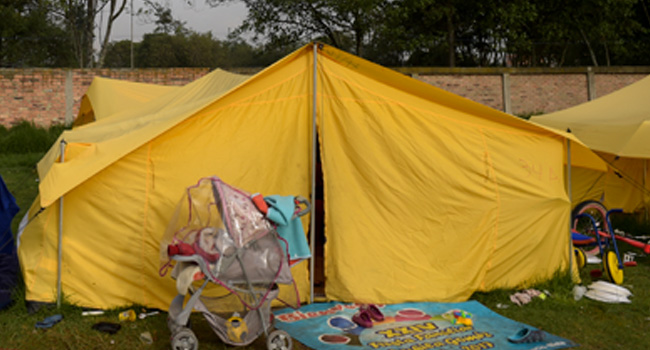
pictured in a humanitarian camp in Bogota
The humanitarian world has pledged to combat the scourge
of sexual abuse within its ranks following shock revelations of
alleged exploitation in the Democratic Republic of
Congo.
In a report published this week, more than 50 women levelled
accusations against aid workers from the World Health Organization
(WHO), other UN agencies and major non-governmental organisations
during the 2018-2020 Ebola crisis in the volatile eastern DR
Congo.
A year-long investigation by the Thomson Reuters Foundation and
The New Humanitarian contained allegations of sexual exploitation,
including propositioning women, forcing them to have sex in
exchange for a job, or terminating contracts when they refused.
“The largest number of accusations — made by 30 women — involved
men who identified themselves as being with the WHO,” the report
said.
The WHO insisted Friday it was taking the “horrific” allegations
“deadly seriously” and had launched an investigation.
The other UN agencies accused — the International Organization
for Migration and the UN Children’s Fund UNICEF — plus NGOs cited
have done likewise.
– ‘Of a certain morality’ – The Congolese authorities and civil
society have joined the chorus of outrage.
“On behalf of the government, I condemn this kind of attitude,”
said government spokesman David Jolino Makelele.
“We are going to strengthen our control over these kinds of
missions,” he told Top Congo radio.
“We want them to send to us people of a certain morality.”
Congolese 2018 Nobel Peace Prize winner Denis Mukwege urged
victims to file complaints.
“We have very courageous jurists and lawyers. I do not think
they will back down in the face of international organisations,”
said the gynaecologist, who defends female victims of sexual
violence.
The UN says it has learned from previous sexual abuse scandals,
such as that involving peacekeepers in the Central African Republic
in 2014 and 2015.
“We have now at the UN secretariat a database to which the
agencies report in real time any abuse allegation,” Alessandra
Vellucci, spokeswoman for the UN in Geneva, told reporters on
Friday.
UN Secretary-General Antonio Guterres has “a zero tolerance
policy”, she stressed.
– Failing alert system – Jens Laerke, spokesman for the UN
Office for the Coordination of Humanitarian Affairs (OCHA), said
the system to help people to come forward clearly “doesn’t seem to
have worked”.
(adsbygoogle = window.adsbygoogle || []).push({});
“It is very, very painful for everybody involved with the best
intentions in humanitarian assistance to see these cases emerge,”
he said.
“No-one receiving humanitarian assistance anywhere in the world
should ever be subjected to that.”
A UN executive contacted by AFP said donors, OCHA, the main UN
agencies and NGOs “should sit down together and say ‘we have a
serious problem here’.”
“The humanitarian world has yet to confront the problem
squarely,” the official said.
The WHO played a leading role in the response to the 2018-2020
Ebola crisis, which was declared over on June 25.
Nearly 2,300 were killed — the highest Ebola outbreak death toll
in the DRC’s history and the second-highest ever in the world.
WHO director-general Tedros Adhanom Ghebreyesus told a virtual
press briefing in Geneva on Friday that he was “outraged” by the
revelations.
“We come to save lives and spread hope. The betrayal of people
in the communities we serve is reprehensible. We will not tolerate
behaviour like this,” he said, adding that perpetrators would face
“serious consequences”.
– Lure of money, jobs – “Horrified but not surprised,” a leading
witness told AFP, on condition of anonymity, following the
allegations in the report.
“All the ingredients came together,” the witness said, citing
concerns “from day one”.
Among those ingredients was an influx of money and generally
well-paid humanitarian workers into the poor region around the
afflicted towns of Beni and Butembo.
A billion dollars poured in to tackle the outbreak, funding the
activities of UN agencies and NGOs under the auspices of the DR
Congo’s health ministry.
For poor locals, the influx represented a rare chance to find
decent work as drivers, security guards and housekeepers with the
anti-Ebola response teams.
“We are here to look for a job, so that we can have something to
eat,” a woman called Salome told AFP in March 2019 as she waited
with dozens of others outside an Ebola treatment centre in
Butembo.
-AFP
Read more https://swordpress.com.ng/2020/10/03/un-ngos-shaken-by-dr-congo-sex-abuse-claims/