whales can be far heavier without collapsing on themselves.
A 100-foot-long blue whale can weigh 150 tons or more, three
times heavier than a dinosaur of the same size. …
Disregarding tonnage, the largest sauropods and whales both
reached lengths of about 100 feet.
Blue whales are the largest animals ever known to exist.
Bigger than dinosaurs, bigger than mastodons,
a blue whale can reach up to almost 100 feet long and have
been weighed at as much as 191 tons.
Mamenchisaurus and other sauropods are some of the
largest dinosaurs known.
Photo by Junko Kimura/Getty Images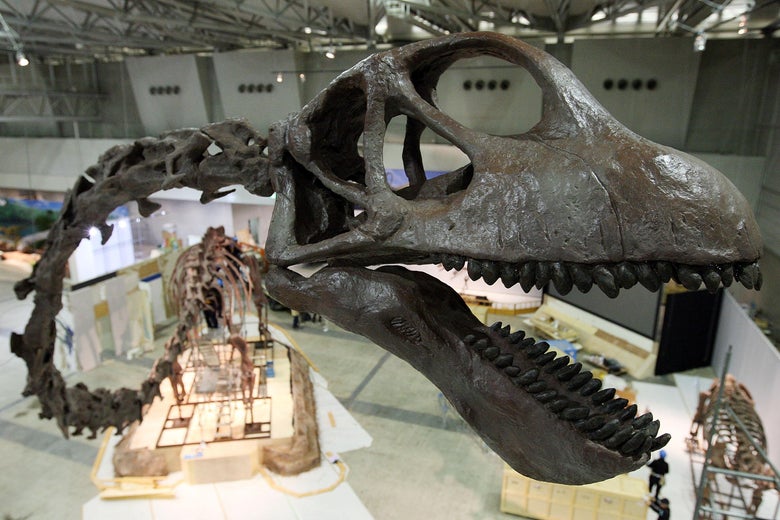
In 1841, in the early days of paleontology, the notoriously
cantankerous anatomist Richard Owen, the man who would later coin
the term “dinosaur,” stood before his colleagues at the Geological
Society of London to announce the discovery of an enormous extinct
reptile. The monster was represented by only a smattering of
fossilized bone, but Owen nevertheless ascertained that the
animal’s tail bones “equaled in dimensions a middle caudal vertebra
of a full-sized whale.”
Owen’s name for the creature—Cetiosaurus, the “whale
lizard”—played up the creature’s gargantuan size, and scientific
showman that he sometimes was, Owen left the assembled scientists
with the idea “that the surpassing bulk and strength of the
Cetiosaurus were probably assigned to it with carnivorous habits,
that it might keep in check the Crocodilians and Plesiosauri” that
swam the same Jurassic seas.
Owen was almost totally wrong in his initial description, but I
can’t blame him. The more-complete skeletons that would show
Cetiosaurus to be a one of the long-necked, herbivorous,
heavy-bodied sauropods hadn’t yet been found. At least the name is
still on the mark. An adult Cetiosaurus was as long as a mature
male sperm whale, around 52 feet.
Other sauropods grew even larger than that. Supersaurus,
Argentinosaurus, and Diplodocus were the largest creatures to ever
walk the Earth, stretching more than 100 feet from their
pencil-like teeth to their sinuous tails. But that “walked the
Earth” clause is important. While no terrestrial creatures ever
approached these sizes, the largest whales can make sauropods look
rather skinny. When it comes down to it, who can rightfully lay
claim to the title of the largest animals of all time: dinosaurs or
whales?
Prehistory fan that I am, I’d love to see sauropods to go home
with the title. With 45 feet of neck alone, a 110-foot-long
Supersaurus would seem to be a clear winner, and there are rumors
of dinosaur specimens that push the size limit even further. But
the sad truth is that two factors might keep sauropods from winning
out over the whales.
Fossilization was not very kind to the biggest dinosaurs. All of
the heavyweight contenders are known from partial skeletons.
Argentinosaurus—often cited as the largest known sauropod—is known
from little more than a few vertebrae, ribs, and leg bones.
Likewise, the biggest Diplodocus is a collection of vertebrae and
hip bones, and Supersaurus fares only a little better with the most
complete specimen consisting of vertebrae, some limb bones, and
parts of the hips. And don’t even get me started on Amphicoelias—a
sauropod represented by a single piece of vertebra that disappeared
over a century ago but that may have belonged to a dinosaur 190
feet long. Nothing more of Amphicoelias has ever been found.
All of those sauropod sizes are extrapolations based on smaller
species known from more complete fossils. But even if Diplodocus
and company really were as long as estimated, they would have been
light for their size.
A series of air sacs extending from the lungs infiltrated the
bones of these dinosaurs, helping to keep them light without
sacrificing strength. While an estimated weight of 45 tons for
Supersaurus sounds like a lot—especially when translated into about
seven African elephants, a traditional unit of measurement for
dinosaur size—that’s trim for such an enormous animal. That gives
whales the advantage.
The blue whale is the largest animal alive on Earth
today, although the exact maximum size is something of a moving
target in the literature. This prodigious species is thought to be
capable of reaching 110 feet in length, and the largest
scientifically verified individuals on record are 89 to 98 feet
long. (If you’re wondering why we don’t have more exact lengths for
this living species, consider the difficulties in measuring a blue
whale. A tape measure isn’t going to be much help.) That’s getting
awfully close to the estimated lengths of the biggest
dinosaurs.
(adsbygoogle = window.adsbygoogle || []).push({});
Weight makes all the difference. Living exclusively at sea for
more than 40 million years has freed whales from the evolutionary
engineering constraints that land creatures—including
dinosaurs—suffered. Thanks to water’s buoyancy, whales can be far
heavier without collapsing on themselves. A 100-foot-long blue
whale can weigh 150 tons or more, three times heavier than a
dinosaur of the same size.
Much as it pains me to do it, I have to hand the title
of “Largest Animal of All Time” to Team Cetacea.
But if we look beyond the superlative, the close call between
dinosaurs and whales highlights an underlying pattern in what
giants can achieve.
Disregarding tonnage, the largest sauropods and whales both
reached lengths of about 100 feet. Rather than being evolutionary
coincidence, this might mark an evolutionary upper bound that
animals may not be able to circumvent without drastic alterations
to their biology.
In a 2012 study, paleontologist Mathew Wedel pointed out that,
much like the blue whale, sauropods such as Supersaurus likely had
sensory nerves that stretched all the way from their brainstems to
the tips of their tails. Such long neurons would have meant
relatively long transit times for impulses traveling between brain
and tail. A particularly efficient conduction speed along neurons
is about 300 feet per second, which means long animals would have
pretty slow reaction times. The upper limit on size could be a
sign, Wedel writes, “of animals approaching the real physical and
chemical limits on living systems.”
Whales might have run into such limits. Even if life at
sea could support the weight of super-whales, the constraints of
biology—from nerve connections to simply acquiring enough
food—might make them impossible. After five million generations and
a 5,000-fold increase in size, whales may be about as big as it’s
possible to be. I can only hope that someone uncovers an
astoundingly huge sauropod that makes us revise what we thought we
knew and puts the dinosaurs back in the running for the
title.
We May Finally Know Why Blue Whales Are So
Enormous
Follow the krill. By David Grossman
Blue whales are the largest animals ever known to exist. Bigger
than dinosaurs, bigger than mastodons, a blue whale can reach up to
almost 100 feet long and have been weighed at as much as 191 tons.
Members of the baleen family of whale, blue whales have a size that
feels prehistoric. Now, scientists have developed a new theory of
how modern day animals got that big. It has to do with climate
change.
All baleen whales eat tiny krill, crustaceans found in all the
world’s oceans. However, changes in warming waters moved the krill
into more concentrated areas, allowing a few whales eat way more
krill than others. But while that basic theory offers a framework
for increased whale size, it doesn’t give an exact timeline for
what happened, says Jeffrey Goldbogen, who runs a lab at Stanford
studying baleen whales. “Baleen evolved about 20 million years
ago,” he tells NPR, “and we didn’t see the evolution of gigantism
until about very recently, about 3 million to 5 million years
ago.”
Goldbogen, in a new paper, looks at how quickly the whales were
able to grow, from 10 tons to 100 tons in just a few million years.
It allows him to speculate that the ice age, which took place
around 2.6 million years ago, had something to do with the
gigantism. At the time, wind began pushing surface waters
off-shore, forcing deeper ocean waters underneath surface waters to
replace it. This is called upwelling and essentially fertilizes
ocean waters. More from Popular Mechanics
Read more https://swordpress.com.ng/2020/10/13/whales-vs-dinosaurs-whats-the-biggest-animal-of-all-time/