
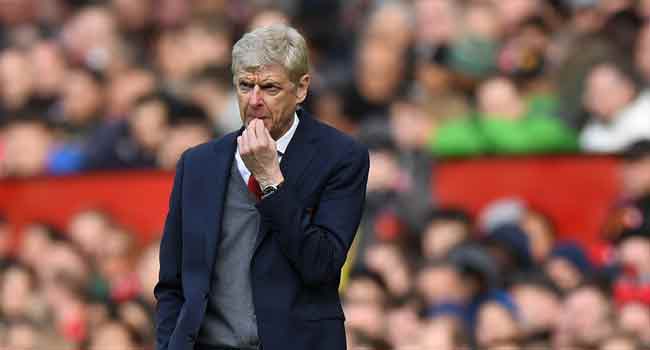
Wenger gestures on the touchline during the English Premier League
football match between Manchester United and Arsenal at Old
Trafford in Manchester, north west England, on April 29, 2018.
Arsene Wenger is unsure of the welcome he will receive on his final
visit to Old Trafford as Arsenal boss on Sunday after many “great
battles” against Manchester United during his two decades in
charge.Paul ELLIS / AFP
For Arsene Wenger management is a drug and, even at
nearly 71, he cannot accept that he might never return to coaching
“because it would hurt so much”.
Speaking in the French city of Strasbourg at the launch of his
autobiography, “My Life in Red and White”, Wenger looked back on a
coaching career that started in 1984, long before his arrival in
1996 at Arsenal, where he went on to spend 22 years in charge.
His time in north London was often glorious, and yet many
Arsenal fans were happy to see him depart, feeling his best days
were long behind him.
Wenger is now focused on his role as FIFA’s chief of global
football development but does not rule out returning to
coaching.
“I refuse to say never again because it would hurt so much,” he
told AFP and other media in Strasbourg in his native region of
Alsace.
“I think the wise thing to say is that I survived so much stress
for so long and so maybe it’s best not to tempt fate. But the
passion tells you: ‘As long as you are alive, live your passion to
the max.”
Looking back on a career that started at Nancy and saw him win
the league with Monaco before a stint in Japan at Nagoya Grampus
and then his arrival at Arsenal, Wenger admits that he “misses it
so much”.
“I was drugged for 36 years and you can’t rid yourself of it
overnight,” he said.
“It is not easy but there came a point where I had to reason
with myself. Have I not already had one fight too many?
(adsbygoogle = window.adsbygoogle || []).push({});
“When you reach 70, your horizons become narrower. I had offers
from UEFA and FIFA to participate in football development in a
different way. In the end I opted for FIFA because there is a
massive gulf between Europe and the rest of the world.”
While European clubs and national federations are facing
difficulties due to the economic downturn caused by the coronavirus
pandemic, Wenger’s focus in his role with the world game’s
governing body is therefore on helping the rest of the world catch
up.
After all, the last four World Cups have been won by European
nations.
“A World Cup is practically a European Championship with Brazil
and Argentina. All the others have no chance of winning it. Since
2002 Brazil have not won a knockout match against a European
team.
“The gulf has grown so much between Europe and the rest of the
world and FIFA has an educational responsibility to help countries
structure themselves.”
Among Wenger’s proposals is for UEFA to abandon its recently
inaugurated Nations League, played every two years.
Curiously, while FIFA president Gianni Infantino has pushed for
a new, expanded Club World Cup in an ever more dense calendar,
Wenger believes there should be fewer tournaments.
“If you take 10 people who really know football, not many will
be able to tell you what the point is”, he says of the Nations
League.
“Maybe we need to organise fewer competitions. Playing major
tournaments every four years lends them a certain prestige but when
it is every two years it corresponds more with the rhythm of our
society today.
“People no longer have the patience to wait and they want to see
the best all the time.”
-AFP