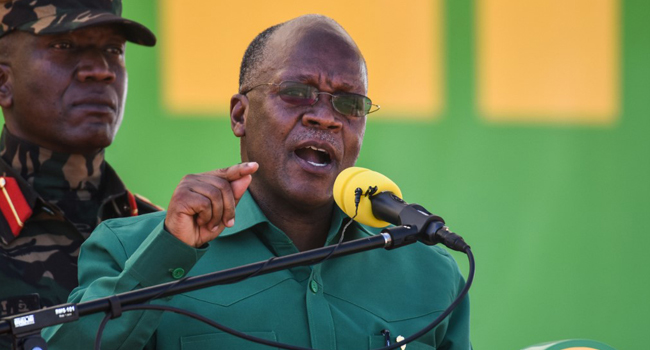
August 29, 2020 Tanzania’s incumbent President and presidential
candidate of ruling party Chama Cha Mapinduzi (CCM) John Magufuli
(R) speaks during the official launch of the party’s campaign for
the October general election at the Jamhuri stadium in Dodoma,
Tanzania. ERICKY BONIPHACE / AFP
Tanzanian President John Magufuli, 61, came to power in
2015 as a blunt-talking man of the people, attacking corruption as
promised in his first term but triggering accusations of a slide
into authoritarianism.
2015: Zealous Clean-Up
After his October election Magufuli quickly gets to work, making
wildly popular decisions such as scrapping lavish independence day
celebrations in favour of a street clean-up.
He bans unnecessary foreign travel for government officials.
Dozens implicated in corruption are suspended.
A Twitter hashtag #WhatWouldMagufuliDo spreads across the
continent, where many tired of corruption scandals, ineffective
civil services and government waste become enamoured of Magufuli’s
“Bulldozer” style.
2016: Crackdown on media, Gays
Opposition leaders accuse Magufuli of throttling democracy after
he bans political rallies and halts live coverage of parliament
sessions.
In mid-2016 authorities begin what Human Rights Watch calls an
“unprecedented crackdown” on the rights of the LGBT community, with
a rise in arrests, threats, and the shutting of clinics providing
AIDS-related services.
In November, the country passes the Media Services Act, with
tough penalties for offences such as defamation, sedition and
publishing false statements.
In December Maxence Melo, co-founder of the Jamii Forums
whistleblowing website is arrested after refusing to comply with a
2015 law requiring him to reveal the site’s contributors.
2017: Mining Shakeup
A government commission says fraud in the mining sector has cost
Tanzania $84 billion (75 billion euros) over 19 years, accusing
foreign companies of failing to declare revenues.
Tanzania accuses gold mining company Acacia Mining, owned by
Barrick Gold of Canada, of owing $190 billion in unpaid taxes and
shuts down its right to export gold ore concentrate. Tanzania and
Barrick later agree to a $300 million payment to resolve the tax
demand.
In July, Tanzania passes new mining laws giving the state 16 per
cent of equity in mining projects, allowing it to renegotiate
contracts and increasing royalties on exports of gold, copper,
silver, platinum and uranium.
Magufuli orders the army to build a wall around the country’s
tanzanite mines to prevent smuggling and better control exports of
the unique blue and violet gems.
In September, after a total of six arrests in 2017, current
presidential candidate for the Chadema opposition party, Tundu
Lissu, is shot 16 times in what his party says in an assassination
attempt.
(adsbygoogle = window.adsbygoogle || []).push({});
2018: Concern Grows
The country’s Catholic Church accuses Magufuli of violating
democratic norms.
The European Union and United States issue statements
criticising attacks on civil liberties and human rights.
Denmark announces the withdrawal of $10 million in aid owing to
“unacceptable homophobic remarks”.
One local leader from Chadema is found beaten to death, while
another is found hacked to death at his home. A female university
student is shot dead as police disperse an opposition protest.
In March, an online content law imposes a stiff fee on bloggers
and imposes fines for content considered “indecent, obscene (or)
hate speech”, or even just for causing “annoyance”.
In July, Magufuli vows his ruling party will be “in power
forever, for eternity”.
2019: Elections Boycott
In August, journalist Erick Kabendera is arrested. He is
initially detained for questioning over his citizenship, then
charged with publishing “false and seditious information”. These
charges are then replaced with tax evasion and money laundering. He
is freed seven months later after pleading guilty.
In November, Magufuli’s ruling party wins local elections with
99 per cent after an opposition boycott.
Rights activist Tito Magoti is arrested and charged with money
laundering.
2020: Coronavirus Denial
In March Tanzania confirms its first case of coronavirus.
In April, Magufuli calls for three days of prayer, urging
citizens to “continue praying to God and not depending on face
masks.”
As cases shoot up at one of the fastest rates in East Africa,
Magufuli accuses the health ministry of “creating panic” and April
29 becomes the last time the country gives official case
numbers.
Chadema chairman Freeman Mbowe slams a “state of denial” in
government.
By July Magufuli is insisting there is no more Covid-19 in the
country.
In June, Mbowe is hospitalised after being beaten up, and his
leg broken, in what his party claimed was a “politically-motivated”
attack.
The US accuses Tanzania of seeking to “stifle democratic norms”
ahead of general elections, after the arrests of opposition members
and the closure of a newspaper.
In July, Magufuli is nominated to seek re-election.
Lissu returns from three years in exile, having recovered, to
run for president.
Read more https://swordpress.com.ng/2020/10/28/tanzania-five-years-under-president-magufuli/