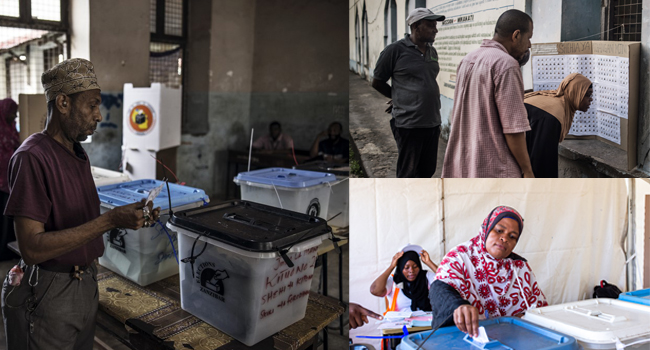
at a polling station, some begin to cast their votes on October 28,
2020. AFP
Tanzanians began casting their ballots Wednesday morning
in an election overshadowed by opposition fears the vote will not
be free and fair after years of repression under President John
Magufuli, who is seeking a second term in office.
In semi-autonomous Zanzibar hundreds of men and women formed
separate queues from before dawn in Garagara neighbourhood outside
the capital Stone Town, where on Tuesday police fired teargas, live
rounds and beat up civilians in the neighbourhood.
Long deemed a haven of stability in East Africa, observers say
Tanzania has seen the stifling of democracy and a crackdown on
freedom of speech under the 60-year-old Magufuli and his Chama Cha
Mapinduzi (CCM) party, which has been in power since 1961.
In the days leading up to the polls, the opposition said 10
people have died in violence in Zanzibar, while major social media
networks — such as WhatsApp and Twitter — have been blocked across
Tanzania.
Mnao Haji, 48, queuing to vote in Garagara, said she hoped the
election “will be peaceful” despite a history of contested
polls.
“During the clashes with police teargas fell inside my house. I
screamed, crying, I was helpless,” she said as heavily armed
officers and soldiers looked on.
On mainland Tanzania, Magufuli’s main challenger among 15
presidential candidates is Tundu Lissu, 52, of the Chadema
opposition party.
He returned to the country in July after three years abroad
recovering from 16 bullet wounds sustained in what he believes was
a politically-motivated assassination attempt.
Lissu’s return has reinvigorated an opposition demoralised by a
ban on political rallies outside of election time, multiple arrests
and attacks.
He expressed fears during the campaign that the polls would be
rigged, leading to a seven day ban of his rallies for “seditious”
language.
“I have witnessed through the campaign that Tanzanians are ready
for changes and I believe they will turn out to vote tomorrow,” he
said at his final rally Tuesday.
In Tanzania’s capital Dodoma, voters began casting their votes
at Jamhuri Secondary School.
“It’s one of my important activities today. I don’t want to miss
voting at all,” said Omary Msongolo.
In the northern town of Moshi, near Africa’s highest peak of
Kilimanjaro, Nestor Shoo urged the electoral commission to show
“impartiality, so that there can be peace”.
(adsbygoogle = window.adsbygoogle || []).push({});
The opposition and analysts have expressed serious concerns
about the fairness of the election, pointing in particular to a
polls body comprising commissioners personally appointed by
Magufuli.
‘A Farce’
On Zanzibar, citizens vote for their own president and
lawmakers, as well as for the Tanzanian president.
In a boost for the opposition’s chances, Zitto Kabwe, the head
of the popular ACT-Wazalendo party, has endorsed Lissu for the
presidency on the mainland.
In return, Chadema is backing veteran opposition candidate Seif
Sharif Hamad in his sixth bid for the presidency in Zanzibar, this
time against CCM candidate Hussein Ali Hassan Mwinyi.
Zanzibar has a history of tense elections plagued with violence
and irregularities and the opposition has again accused the ruling
party of seeking to steal the vote.
“How can you have an election were you have teargas everywhere
and live ammunition? It is in no case a fair election, it is just a
farce,” said Hamad.
Increasing intolerance
Magufuli, elected in 2015, at first made wildly popular moves
such as curbing foreign travel for government officials or showing
up in person to make sure civil servants were doing their work.
Then, he banned political rallies and became increasingly
intolerant of dissent.
A series of tough media laws were passed, arrests of
journalists, activists and opposition members soared and several
opposition members were killed.
Magufuli touts his expansion of free education, rural
electrification and infrastructure projects such as railways, a
hydropower dam and the revival of the national airline.
However analysts say while the economy grew at an impressive
pre-coronavirus average of six percent, there was little job
creation and aggressive tax collection has hurt the private sector
and made doing business harde. The IMF expects growth to slow to
1.9 percent this year.
The election campaign has taken place with little regard to the
coronavirus pandemic.
Tanzania stopped giving out official data on infections in
April, and Magufuli has declared the country Covid-free, which he
attributes to the power of prayer.
On the mainland, just over 29 million registered voters will
cast their ballots, while some 566,000 will vote in Zanzibar from 7
am (0400 GMT) until 4 pm (1300 GMT).
Read more https://swordpress.com.ng/2020/10/28/tanzania-votes-in-election-marred-by-violence-fears-of-fraud/