
 On
July 28, 1944, a flight of P-51 Mustangs escorting a squadron of
B-17 Bombers on a mission over Merseburg, Germany, spotted
something strange in the distance: a pair of white contrails rising
at tremendous speed into the stratosphere. As the contrails pitched
over and dove onto the bomber stream, the fighters broke formation
to intercept. Seconds later, a pair of tiny egg-shaped aircraft
with short swept-back wings flashed by and plunged back into the
clouds, travelling faster than anything the American pilots had
ever seen. It was the Allied air forces’ first encounter with a new
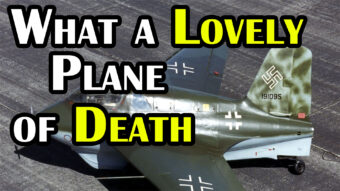
German secret weapon: the rocket-powered Messerschmitt Me-163
Komet, an aircraft so fast its performance would not be
matched for nearly a decade, yet so horrendously dangerous to fly
it would claim the lives of more German pilots in development
and training than Allied aircrew it took down in combat.
Experiments with rocket-powered aircraft have a long history in
Germany. In a series of increasingly audacious publicity stunts,
during the 1920s automobile manufacturer Fritz Opel experimented
with fitting gunpowder rockets to a variety of vehicles from cars
to railway wagons. These experiments culminated in the construction
of the Lippisch Ente, or Duck, which on June 11,
1928 became the first manned aircraft to fly under rocket power.
Later in the 1930s, aircraft manufacturer Ernst Heinkel undertook a
series of experiments to develop a liquid-fuelled rocket engine for
use in aircraft. Heinkel’s first success came in March 1937 when a
modified He-112 propeller-powered fighter flew under rocket power
for 30 seconds. Heinkel next constructed the diminutive He-176,
which on June 20th, 1939, became the first aircraft to take off,
fly, and land solely under rocket power..
But while Heinkel had high hopes for rocket aircraft, the German
Air Ministry was decidedly less enthusiastic. On first being shown
the He-176, Generaloberst Ernst Udet, Director-General of
Equipment for the Luftwaffe, exclaimed: “You want to
fly with that? It has no wings…those are running boards!”
On actually seeing the aircraft fly, Udet reportedly flew into a
rage, declaring: “That is no airplane, leave it alone! I forbid
you to fly it again.”
Even a demonstration in front of top Nazi dignitaries including
Adolf Hitler on July 3 failed to make any impact, and Germany
entered the Second World War with conventional propeller-driven
aircraft. But the realities of War would soon force the High
Command to change its mind. Starting in 1942 the Royal Air Force
and United States Army Air Force began a concerted strategic
bombing campaign against Germany and occupied Europe, pounding
cities, factories, and other targets round-the-clock. The
Luftwaffe, stretched thin by Hitler’s invasion of Russia
and chronically short on men and fuel, was unable to cope, and so
the call went out for a fast, inexpensive rocket-powered
interceptor that could stem the tide of Allied aircraft.
The aircraft that would become the Komet emerged from
the work of two aviation pioneers. The first was Alexander
Lippisch, designer of the pioneering Ente, who, working
with DFS, the German Research Institute for Sailplane Flight, was
attempting to develop a unique high-speed tailless glider. In 1939,
Lippisch left DFS and took his design to aircraft manufacturer
Messerschmitt, who gave it the designation Me-163. Messerschmitt
soon began experimenting with fitting the 163 with a revolutionary
new rocket engine designed by Hellmuth Walter, who had also
designed the engine for Heinkel’s pioneering He-176. Walter’s
R-1-203 ‘cold’ engine, originally developed as a Jet-Assisted
Take-Off or JATO pod for helping overloaded transport aircraft get
off the ground, reacted concentrated Hydrogen Peroxide with Sodium
Permanganate to generate high-pressure steam, producing around 1000
pounds of thrust.
The result was an aircraft of unprecedented performance. On the
2nd of October 1941 test pilot Heinrich ‘Heini’ Dittmar flew the
prototype Me-163A to a record airspeed of 1003.67 mph, becoming the
first pilot to exceed 1000 mph in level flight. Three years later
Dittmar would fly the improved 163B model to 1130 mph – a record
that would not be beaten by a jet aircraft for almost a decade. The
Komet’s climb rate also far exceeded that of any contemporary
aircraft, being able to climb to an altitude of 39,000 feet in less
than four minutes. This in turn required pilots to maintain a
special low-fibre diet to prevent gas from expanding painfully in
their gut too uncomfortably. Even unpowered the Komet displayed
superb handling characteristics, with pilots reporting the aircraft
to be nearly impossible to stall or spin. And so fast was it in
a glide that upon being buzzed by a 163A at 300mph, a
startled Ernst Udet is reported to have exclaimed “What sort of
engine has it?”, to which a presumably smug Alexander Lippisch
replied “None.”
Yet despite this blistering performance, the Komet quickly
revealed itself as an extremely hazardous aircraft to fly. Among
its major flaws was its landing gear. For takeoff the Komet was
fitted with a simple two-wheeled dolly which was jettisoned as soon
as the aircraft left the ground, after which the aircraft landed on
a retractable ventral skid. However, if the pilot forgot to extend
the skid or unlock the skid, the impact of landing could cause
severe injuries. Indeed, during the Komet’s development three of
its main test pilots – Heini Dittmar, Rudy Opitz, and Hannah
Reitsch – suffered serious spinal damage and skull fractures due to
hard landings and spent several months in hospital recovering.
But the greatest danger by far came from the Komet’s engine.
Hellmuth Walter’s HWK 509 “Hot Engine,” which powered the
production Me-163B, ran on a combination of two propellants:
“T-Stoff”, highly concentrated hydrogen peroxide; and
“C-Stoff”, a 30% mixture of Hydrazine Hydrate and Methanol. These
propellants were hypergolic, meaning that when mixed they
immediately and violently exploded. The fact that they were both
colourless liquids meant that handling accidents were common, as in
the case of one unfortunate ground crewman who inadvertently poured
a container of T-Stoff into another containing a small quantity of
C-Stoff. As author William Green recounts: “Before he realized
the magnitude of his mistake his remains had been spread thinly
over the entire test shed.”
This extreme volatility meant that great care had to be taken
when refuelling the Komet, with the propellants being loaded one at
a time and the engine flushed out with water between each flight.
But despite these measures, many Komets and ground crew were lost
to explosions before the aircraft ever left the ground. Even
worse,T-Stoff is highly corrosive and can strip flesh from bones in
seconds. It also tends to react with even the smallest speck of
dirt or organic matter, decomposing violently into scalding steam
and oxygen, meaning it could only be stored in glass or
enamel-lined containers. While Komet pilots were issued with
special acid-proof asbestos flight suits, any landing made with
propellant left in the tanks was likely to end in disaster – as
Mano Ziegler, one of the few Komet pilots to survive the war,
recounts in his memoirs:
A certain Feldwebel Alois Worndl from Aschau, an excellent
fellow and completely reliable flying with the accuracy of a
precision instrument, was chosen from among us pupils to make the
first sharp start in the Komet. “Make it good, Alois!” We shouted,
and then he was off.…As expected, Alois’ rocket motor cut out at about 6000
metres altitude, and he turned back towards the field, as precise
as ever. Then, without warning, “Sideslip!” The shout came from one
of the group. Alois was much too high to touch down anywhere near
the landing cross! “Sideslip, sideslip!” We all shouted as if he
could hear us, but the Komet shot past us and past the landing
cross – too high, too fast!Anxiously we watched the Komet touch down far outside the
airfield perimeter, rebound into the air, drop back again like a
brick, then skid into some rough ground and turn over on its back.
A split second later a blinding white flame shot up, followed by a
mushroom of smoke.
On other occasions pilots suffered a fate worse than an
explosion, as in the case of Oberleutnant Josef Pohs, who on one
flight released his takeoff dolly too early. The dolly bounced off
the ground and struck the aircraft, rupturing a T-Stoff line. Pohs
immediately jettisoned his fuel and banked around to make an
emergency landing, but just like Alois Worndl missed the runway,
touched down on rough ground, and flipped over. To the relief of
his watching comrades his aircraft did not explode, but when they
finally reached him and turned the Komet over they were greeted
with a gruesome sight: T-Stoff leaking from the ruptured line had
dissolved the unconscious Pohs alive.
(adsbygoogle = window.adsbygoogle || []).push({});
Despite these hazards, development of the Komet pressed ahead,
with the first operational squadron, Jagdgeschwader 400,
receiving production Me-163Bs in May 1944. The Model B was larger
and more streamlined than the Model A and equipped with armour
protection for the pilot and a pair of MK 108 30mm cannons with 60
rounds of ammunition each. Due to its limited engine endurance of
only 6 minutes, the Komet served as a point-defence interceptor,
with airfields being located next to strategic targets such as the
Leuna synthetic fuel works near Leipzig. To conserve fuel, the
Komet was towed to the runway by a modified agricultural tractor
before having its propellant tanks filled. The pilot then took off
and climbed to an altitude of 39,000 feet before cutting off the
rocket motor and making a gliding dive onto the approaching bomber
formation. The pilot would make as many attack runs as fuel and
airspeed would allow before breaking off and gliding to a landing
on the ventral skid. The now-immobile Komet would then be retrieved
by another tractor and prepared for its next flight.
The first operational sorties soon revealed yet another of the
Komet’s many flaws: it was too fast. Due to the short
range of its cannons, during a high-speed approach the pilot only
had a window of around 3 seconds in which to aim and fire, making
it impossible for all but the best marksmen to hit their targets.
Engineers attempted to correct this issue by developing a unique
weapon known as the SG 500 Jagdfaust. This consisted of a
set of five 50mm cannon barrels mounted vertically in the wing
roots and connected to a photocell, such that when the Komet pilot
passed into the shadow of a bomber all ten barrels would fire
automatically. Field trials revealed the system to be highly
effective, with Lieutenant Fritz Kelb reporting that the B-17 he
fired upon “simply disintegrated.” However, the War
ended before the weapon could be deployed in large numbers.
Meanwhile, though the Komet’s incredible speed and
maneuverability had initially taken the Allies by surprise, escort
fighter pilots soon learned how to counter them, with Lieutenant
Colonel John Murphy and Lieutenant Cyril Jones of the American
359th Fighter Group shooting down the first Me-163 on August 16,
1944. Allied pilots also discovered the Komet to be most vulnerable
just after landing, and many were destroyed on the ground by roving
fighter-bombers. But in the end what finished off the Komet was the
deteriorating state of the German war economy, and by early 1945 a
shortage of pilots, fuel, and spare parts left the 370 aircraft
produced laying idle on the ground. Only a handful of sorties were
flown before Germany finally surrendered on the 8th of May,
1945.
So what, in the end, did the Komet achieve? While exact figures
are hard to come by, it is believed that between May 1944 and April
1945 Me-163 pilots shot down between 9 and 18 Allied bombers
against a total of 10 Komets lost in combat – with many more
aircraft, pilots, and ground crew were lost to accidents during the
Komet’s long and troubled development. Strategically the Komet was
an abysmal failure which, like so many other German ‘wonder weapon’
projects, consumed vast quantities of resources and manpower
urgently needed elsewhere while contributing little to the final
outcome of the war. Yet despite this, the Komet was an impressive
technical achievement and closely studied by the Allies after the
war. During the late 1940s and early 1950s the United States,
Soviet Union, and United Kingdom all experimented with mixed-power
interceptors propelled by a combination of jet and rocket engines
in order that combined the high speed and climb rate of the Komet
with the greater endurance and range of a regular jet. However, it
was soon realized that the interceptor role was more economically
filled by unmanned surface-to-air missiles, and the rocket-powered
fighter faded into irrelevancy, an impressive but obscure footnote
in the history of aviation.
If you liked this article, you might also enjoy our new popular
podcast, The BrainFood Show (iTunes,
Spotify,
Google Play
Music, Feed), as well
as:
- What is the Best Way to Survive Falling Out of a
Plane with No Parachute? - Has Any Passenger Ever Landed a Commercial Airliner
Like You See in Movies? - What Causes the Smoke Trails Behind Airline Planes
High in the Sky? - The First Person to Die in an Airplane
Crash
Bonus Facts
#1: Only one Allied pilot ever flew the Komet under
power: Royal Navy Captain Eric “Winkle” Brown, who to this day
holds the record for the most different aircraft types flown by a
single person. On May 17, 1945, Brown drove to the Me-163 airfield
at Husum and asked the German ground crew to prepare an aircraft
for him. At first the crew was refused, not only because of the
dangerous nature of the aircraft but because following a series of
incidents in which Allied pilots were killed flying captured German
aircraft, flights like the one Brown was requesting were officially
forbidden. Eventually Brown agreed to sign a disclaimer absolving
the crew of any responsibility, and they helped prepare and
familiarize him with the aircraft. In a 2014 interview, Brown
recounted his experience: “The noise is thunderous, and you are
given a bit of a shake-up on takeoff. The acceleration is
unbelievable. I thought the performance was – there’s only one word
for it – phenomenal [but] I felt that I was flying in a tin coffin
because the chances of bailing out were virtually nil. I took it on
in the full knowledge of what the risk was, but at the end of the
day I felt a tremendous satisfaction in having beaten the
odds.”
After landing safely, Brown and the no doubt relieved ground
crew reportedly celebrated with a well-earned drink.
#2: Another weapon of desperation to emerge from German drawing
boards at the end of WWII was the Bachem Ba-349 Natter, or
Viper – an aircraft that was essentially a manned, semi-disposable
antiaircraft missile. Realizing that taking off and landing from
regular airfields made interceptors like the Komet vulnerable to
attack by Allied aircraft, designer Erich Bachem conceived of an
aircraft that could be launched vertically from a tower, allowing
it to be easily hidden in forests. Built mostly of wood and other
non-strategic materials, the Natter was powered by the same Walter
HWK 109 rocket engine as the Me-163 and armed with a battery of 24
55mm unguided missiles housed in its nose. Upon launch an autopilot
would guide the aircraft to operational altitude, whereupon the
pilot would take over and intercept the incoming bomber formation.
After expending his armament and fuel, the pilot would then
jettison the cockpit section and bail out. The rear section of the
aircraft would descend on its own parachute, allowing it to be
recovered and the engine reused.
While Bachem’s design was rejected by the Air Ministry, it soon
caught the attention of Heinrich Himmler and development began in
October 1944 under the direction of the SS. Following a series of 8
gliding flights and unmanned launches, in April 1945 it was decided
to proceed with a manned launch. On May 1, test pilot Lothar Sieber
climbed into the cockpit and blasted into the air, becoming the
first person to lift off vertically solely under rocket power. The
launch proceeded smoothly until the Natter reached an altitude of
500 feet, whereupon the canopy, which had been insecurely latched,
flew off, knocking Sieber unconscious. The Natter continued to rise
to an altitude of 4,900 feet, whereupon it pitched over, plunged to
the ground, and disintegrated on impact.
Despite this setback, Sieber’s flight was followed by four more
successful manned launches, but the War ended before the Natter
could be used operationally. But based on telemetry gathered his
ill-fated flight, it is likely that just prior to impact Lothar
Sieber achieved yet another first, becoming the first man – albeit
briefly – to break the sound barrier.
Expand for References
Ziegler, Mano, Rocket Fighter, Bantam Books 1989
Green, William, Rocket Fighter, Ballantine Books, NY,
1971
Messerschmitt Me 163 Komet, Aircraft of the World,
International Masters Publishers AB, 1997
Britain’s Greatest Pilot: The Extraordinary Story of Captain
Winkle Brown, BBC 2014 https://www.youtube.com/watch?v=LEe5ul37Q7g
The post The German Rocket Fighter that Dissolved its Pilots
Alive appeared first from online sources and was reposted by the community on Today I Found
Out.
Read more https://swordpress.com.ng/2020/10/28/the-german-rocket-fighter-that-dissolved-its-pilots-alive/