
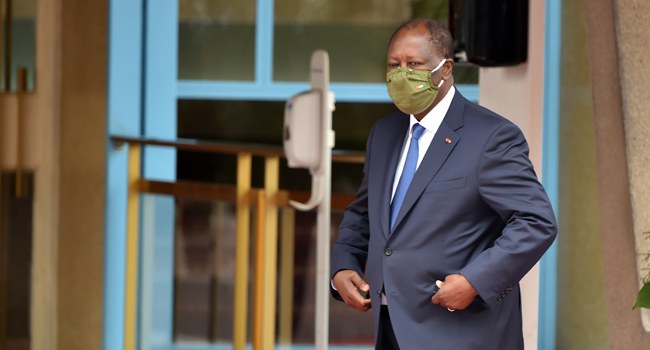
Ouattara wearing a protective mask attends a ceremony to mark the
60th anniversary of the country Independence from France on August
7, 2020, at the presidential palace in Abidjan.SIA KAMBOU /
AFP
Ivory Coast President Alassane Ouattara urged opponents
to give up a campaign of civil disobedience during Saturday’s
election when he is seeking a contested third term that critics
reject as unconstitutional.
At least 30 people have been killed in pre-election clashes
since August, stoking fears of a return to the violence that left
3,000 dead in a crisis a decade ago when then president Laurent
Gbagbo refused to step down.
A former IMF economist in power since 2010, Ouattara is facing
off with veteran opposition leader Henri Konan Bedie in a bitter
rivalry that has marked the West African country’s politics for
decades.
Ouattara’s decision to run again angered opposition leaders who
called for a boycott and civil disobedience over a third mandate
they branded an “electoral coup”.
“I appeal to those who launched this slogan for civil
disobedience which has led to deaths: Stop. Ivory Coast needs
peace,” Ouattara said after he voted in Abidjan.
“I urge young people not to let themselves be manipulated.”
Abidjan was calm, but protesters blocked the main route to the
north, near the central town of Djebonoua, 350 kilometres (220
miles) from the economic capital, local residents said.
Groups of youths also set up makeshift barricades in some
neighbourhoods in and around Daoukro, stronghold of opposition
leader Bedie, an AFP correspondent at the scene said.
“We got up very early to put up barricades to stop the election
and respect the boycott,” said one youth Jean, standing at a
blockade of tree branches.
Electoral material had still not arrived in Daoukro.
In Bouadikro and Bongouanou, a stronghold of another opposition
leader, Pascal Affi N’Guessan, north of Abidjan, polling stations
had not opened, witnesses said.
Roadblocks were erected between the towns, and young protesters
were warning “No vote here”, witnesses said.
More than 35,000 police and security force officials have been
mobilised to secure the election.
“The process has been tense,” said Patrick Allou, 32, waiting to
vote in Abidjan’s Plateau district. “Everyone has their opinion but
you should express it democratically. No one needs to die in an
election.”
Polls close at 1800 GMT, though it is not clear when the results
will be released. Electoral authorities by law have up to five days
to announce the results.
(adsbygoogle = window.adsbygoogle || []).push({});
– Growth, stability – The ballot in French-speaking West
Africa’s economic powerhouse is a crunch test in a region where
Nigeria faces widespread social protests, Mali is emerging from a
coup and jihadist violence wracks the Sahel.
Ouattara, 78, was supposed to step aside after his second term
to make way for a younger generation, but the sudden death of his
chosen successor led to a change in plan.
The Ivorian leader says a constitutional court ruling approved
his third term, allowing him to bypass two-term presidential limits
after a 2016 legal reform.
His supporters expect a strong win, touting his record in
bringing infrastructure projects, economic growth and stability to
the world’s top cocoa producer after a decade of instability.
But Bedie, 86, and opposition leaders accuse the electoral
commission and the constitutional court of favouring the
government, making a fair and transparent vote impossible.
The constitutional court rejected 40 other candidacies,
including those of Gbagbo, 75, and former rebel leader turned prime
minister Guillaume Soro.
Both men are outside the country but retain loyal followings in
their local Ivorian strongholds.
– Appeal for calm – While the UN has called for calm, the
opposition urged supporters to carry out an “active” boycott and a
campaign to block the vote, stoking fears of violence in opposition
strongholds.
“The question is what will the opposition do after November 1?”
said Sylvain N’Guessan, director and political analyst at the
Abidjan Strategies institute.
The weeks before the election saw sporadic clashes in the south
of the country, mainly between local ethnic groups close to the
opposition and Dioula communities seen as loyal to the president,
himself a Muslim from the north.
The country’s political feuds are often closely tied up with its
leaders’ ethnic identities and regional loyalties.
Police fired tear gas on Friday in the political capital
Yamoussoukro to break up fighting between Dioula youth and
opposition-aligned Baoule communities.
A decade ago, Ivory Coast was emerging from civil war and the
country was split in two, the north held by rebels and the south by
forces of then-president Gbagbo.
Ouattara won a long-postponed election in 2010 although Gbagbo
refused to accept defeat. After battles in Abidjan, French forces
intervened to help Ouattara loyalists oust the former
president.