
legislator Starry Lee (C) speaks during a meeting at the
Legislative Council in Hong Kong on November 12, 2020, a day after
pro-democracy lawmakers said they would all quit in protest at the
ousting of four of their colleagues by the city’s pro-Beijing
authorities. Peter PARKS / AFP
China warned Thursday the mass resignations of
pro-democracy lawmakers in Hong Kong were a “blatant challenge” to
its authority over the city.
Fifteen legislators were set to quit the chamber in protest at
the Beijing-sanctioned ousting of four colleagues, leaving the
assembly a muted gathering of government loyalists.
The resignations come with the city’s beleaguered pro-democracy
movement and avenues of dissent already under sustained attack
since Beijing imposed a sweeping national security law this
year.
Half of the group had made good on their pledge by Thursday
afternoon, which sparked a furious response from Beijing’s Hong
Kong and Macau Affairs Office.
“It once again showed their stubborn confrontation against the
central government and a blatant challenge to the power of the
central government. We severely condemn this,” a statement
said.
“We have to tell these opposition lawmakers, that if they want
to use this to advocate a radical fight, and beg for foreign forces
to interfere, and once again drag Hong Kong into chaos, that’s a
wrong calculation.”
Inside the chamber, government loyalists discussed a transport
bill, but without any of the rambunctious debate that has been the
mark of Hong Kong’s semi-democracy in recent years.
“Hong Kongers — prepare for a long, long time where there is
only one voice in society,” pro-democracy lawmaker Lam Cheuk-ting
told reporters outside.
“If you are a dissident, get ready for even more pressure.”
Hong Kong Chief Executive Carrie Lam, a Beijing appointee, on
Wednesday was granted the power to turf out any legislator who she
deems insufficiently patriotic, without recourse to the city’s
courts.
She immediately made use of those powers, kicking out four
lawmakers she said were a threat to national security, and sparking
criticism both at home and abroad, with the United States
threatening further sanctions on regime figures.
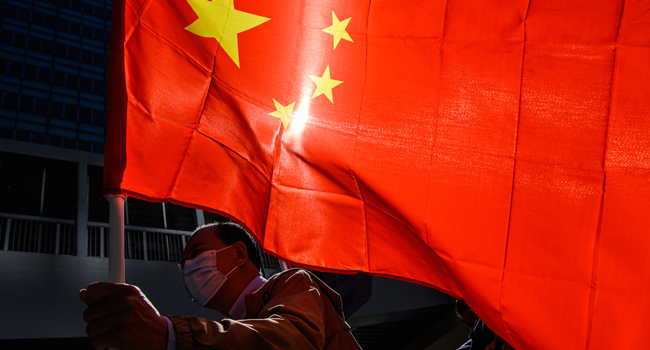
China’s national flag as he and others gather outside the
Legislative Council in Hong Kong on November 12, 2020, a day after
the city’s pro-Beijing authorities ousted four pro-democracy
lawmakers. Anthony WALLACE / AFP
Chris Patten, the city’s last colonial governor, said the move
demonstrated Beijing’s “total hostility to democratic
accountability, and those who wish to stand up for it”.
China’s foreign ministry spokesman Wang Wenbin rejected the
international criticism.
“We urge the relevant people to strictly abide by the basic
norms of international law and international relations, stop any
form of interference into China’s internal affairs, of which Hong
Kong affairs are a part,” he said.
The exodus of opposition lawmakers neuters one of the last
forums for dissent in Hong Kong, as its once-boisterous media reels
under a crackdown unleashed by the national security law and
Beijing loyalists target the legal system that has underpinned the
city’s success as a finance hub.
Restrictions on gatherings, partly because of the coronavirus,
have also put the lid on the kind of huge rallies that roiled the
city last year.
Millions took to the streets in largely peaceful protests
over a lack of political accountability and what demonstrators saw
as overbearing policing.
Violence and vandalism erupted at some demonstrations, and more
than 10,000 people were arrested.
‘Final nail in coffin’
Hong Kong’s leader is chosen by pro-Beijing committees, but half
of the legislature’s 70 seats are directly elected, offering the
city’s 7.5 million residents a rare chance to have their voices
heard at the ballot box.
Scuffles and protests would routinely break out in the chamber,
with the out-gunned pro-democracy minority often resorting to
filibustering and other tactics to try to halt bills they
oppose.
The expulsions and resignations will leave just two legislators
outside the pro-Beijing camp, both of them unaligned with either
bloc.
“It seems that the control of Hong Kong has now been exercised
by the Chinese Communist Party authority in Beijing,” political
analyst Willy Lam said, adding the basic rights enshrined when
Britain handed the city back to China in 1997 were “seriously
jeopardised”.
The move by Beijing “has put the final nail in the coffin,”
Claudia Mo, one of the lawmakers who resigned, told AFP. “It’s rule
by decree.”
“What’s the point of going to work every morning thinking ‘am I
going to be kicked out’?”
AFP
Read more https://swordpress.com.ng/2020/11/12/china-condemns-mass-resignations-in-hong-kong-legislature/