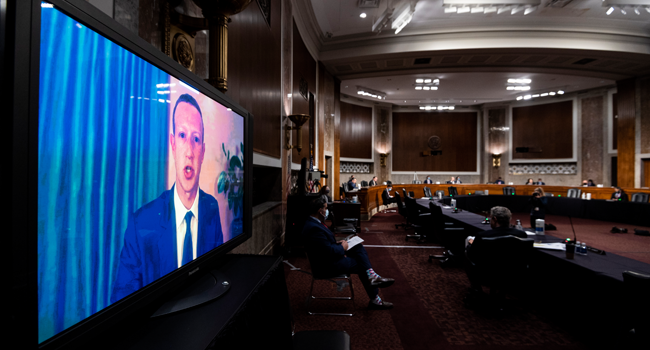
Executive Officer of Facebook, testifies remotely during the Senate
Judiciary Committee hearing on “Breaking the News: Censorship,
Suppression, and the 2020 Election” on November 17, 2020 in
Washington, DC. Photo By Bill Clark-Pool/Getty Image
(adsbygoogle = window.adsbygoogle || []).push({});
Facebook and Twitter defended their handling of US
election misinformation at a heated congressional hearing Tuesday
where one key senator assailed the platforms for being the
“ultimate editor” of political news.
The hearing, the second in less than a month, came with social
media under fire from both the left and the right for their
handling of political content during a bitter US presidential
campaign.
Facebook chief Mark Zuckerberg and Twitter CEO Jack Dorsey
testified remotely to the session, which was called to discuss
“censorship and suppression of news articles” and the “handling of
the 2020 election” by the platforms.
Republican Senator Lindsey Graham, chairing the Judiciary
Committee hearing, warned the CEOs that new regulations are needed
to ensure the social media giants are held responsible for
decisions on removing, filtering or allowing content to remain.
“It seems like you’re the ultimate editor,” Graham said at the
opening as he took aim at decisions by both platforms to limit the
distribution of a New York Post article claiming to expose
malfeasance involving the son of President-elect Joe Biden during
the campaign.
“When you have companies that have the power of governments
(and) have far more power than traditional media outlets, something
has to give.”
Graham said the law known as Section 230 that gives immunity to
online services for content posted by others “needs to be
changed.”
Megaphone for falsehoods
Democratic Senator Richard Blumenthal also called for reform of
Section 230 while rebuking the companies for what he said was
inadequate action against political misinformation by President
Donald Trump.
“The president has used this megaphone to spread vicious
falsehoods in an apparent attempt to overturn the will of voters,”
Blumenthal said.
Blumenthal said the social media firms had “power far exceeding
the robber barons of the last Gilded Age” and have “profited hugely
by strip mining data about our private lives and promoting hate
speech and voter suppression.”
Republican Senator Mike Lee meanwhile denounced what he called
“instances in which your platforms are taking a very distinctively
partisan approach and not a neutral one to election related content
moderation… just days before the election.”
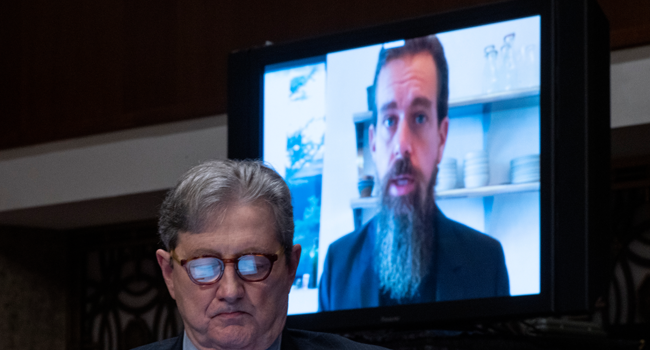
Officer of Twitter, testifies remotely as Senator John Kennedy
(R-LA) looks on during the Senate Judiciary Committee hearing on
‘Breaking the News: Censorship, Suppression, and the 2020 Election’
on Capitol Hill on November 17, 2020 in Washington, DC.Bill Clark /
POOL / AFP
From the other side, Blumenthal said that “Facebook, seems to
have a record of making accommodations and caving to conservative
pressure” on content policies.
Democrat Dianne Feinstein questioned the adequacy of Twitter’s
labeling of unverified tweets such as those of Trump claiming an
election victory.
“Does that label do enough to prevent the tweets harms when the
tweet is still visible and is not accurate?” the California senator
asked.
230 rules
Both Dorsey and Zuckerberg said they were open to reform on
Section 230 but cautioned that the platforms should not be treated
as “publishers” or traditional media.
“We do have to be very careful and thoughtful about changes..
because going one direction might box out new competitors and new
startups,” Dorsey said.
“Going another might create a demand for the possible amount of
resources to handle it. Going yet another might encourage even more
blocking of voices… I believe that we can build upon (Section)
230.”
Defending the filters
Both CEOs defended their efforts to curb harmful misinformation
during the election campaign.
“We strengthened our enforcement against militias, conspiracy
networks, and other groups to help prevent them from using our
platform to organize violence or civil unrest in the period after
the election,” Zuckerberg said.
He said Facebook removed false claims about polling
conditions and displayed warnings on more than 150 million pieces
of content flagged by independent fact-checkers.
Both CEOs said they would study the spread of election
misinformation while allowing independent academics to carry out
similar research.
Dorsey meanwhile said filtering at Twitter was not a result of
bias, despite claims to the contrary by conservatives.
In filtering content, “all decisions are made without using
political viewpoints, party affiliation, or political ideology,”
Dorsey said in his testimony.
“Our Twitter rules are not based on ideology or a particular set
of beliefs. We believe strongly in being impartial, and we strive
to enforce our Twitter rules fairly.”
Both platforms have begun limiting the reach of many of Trump’s
tweets, notably those in which the president rejected his election
defeat or questioned the integrity of the voting process.
Twitter and Facebook have been facing pressure to
remove what many see as harmful misinformation around the
elections, while also fighting claims of suppression of certain
political views.
AFP