
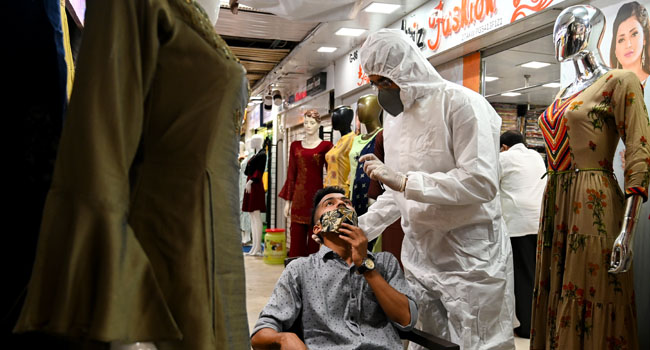
protective gear collects a swab sample from a man during a medical
screening for the Covid-19 coronavirus at a garment wholesale
market in Mumbai on November 20, 2020. India’s coronavirus cases
passed nine million on November 20, health ministry data showed,
the world’s second-highest tally after the US.Punit PARANJPE /
AFP
India’s coronavirus caseload passed nine
million on Friday, as hospitals in the capital New Delhi came under
increasing pressure and graveyards began to fill up.
The world’s second-worst-hit country has now also registered
more than 132,000 deaths from the disease, according to the latest
official figures, which are widely seen as understating the true
scale of infection.
India has seen a drop in daily cases over the past month but it
is still registering about 45,000 new instances on average every
day.
New Delhi, facing the dual scourge of winter pollution
and coronavirus, has seen
infections soar past half a million with a record rise in daily
cases.
On Thursday, the megacity’s government quadrupled fines for not
wearing a mask in an effort to get a grip on the outbreak.
At one of Delhi’s largest cemeteries, burial space is fast
running out, gravedigger Mohammed Shamim told AFP.
“Initially when the virus broke (out), I thought I’ll bury
100-200 people and it’ll be done. But the current situation is
beyond my wildest thoughts,” Shamim said.
“I only have space left for about 50-60 burials. Then what? I
have no idea.”
– Covid fatigue –
India imposed a stringent lockdown in March but restrictions
have been gradually eased as the government seeks to reboot the
economy after the loss of millions of jobs.
Experts say this has helped spread the disease, as has a general
reluctance to wear masks and maintain physical distancing.
But those restrictions are now coming back.
Authorities in the western city of Ahmedabad, have imposed a
complete curfew over the weekend.
“During this period, only shops selling milk and medicines shall
be permitted to remain open,” local official Rajiv Kumar Gupta
said.
(adsbygoogle = window.adsbygoogle || []).push({});
“The increase in numbers of cases is a concern, primarily
because it is driven by people not following the basic protocol of
corona-appropriate behaviour,” said Anand Krishnan, a community
medicine professor at Delhi’s All India Institute of Medical
Sciences.
Hemant Shewade, a Bangalore-based community medicine expert,
said it was likely cases outside major towns and cities were not
being taken into account in the official numbers.
“My guess is that it is spreading slowly and silently in rural
areas,” Shewade told AFP.
In Delhi, the spectre of the virus wreaking havoc has come back
to haunt its 20 million residents, as families scramble to arrange
hospital beds.
Over 90 percent of intensive care beds with ventilators were
occupied as of Thursday, a government mobile app showed.
“My father’s oxygen saturation level dipped to 35 percent
suddenly and we rushed to the nearby hospital but there were no
beds available,” Delhi resident Rajeev Nigam told AFP.
“We ran all night from one hospital to another but it was the
same story everywhere,” he said, blaming the Delhi government for
being “unprepared” and “callous” in its approach.
Distraught families were making fervent pleas on social media,
tagging Chief Minister Arvind Kejriwal for help in securing
beds.
Under pressure to control the new wave, Kejriwal Thursday
announced the addition of 1,400 intensive care beds.
Jeevendra Srivastava, an advertising professional, said Delhi
was paying the price for overcrowding during the ongoing festive
season.
“It’s shocking how a few people still are not taking this deadly
virus seriously,” said Srivastava, 47.
“People are still going to crowded places without masks. It’s
because of this irresponsible behaviour that now almost every
second house has a case of the virus.”
-AFP