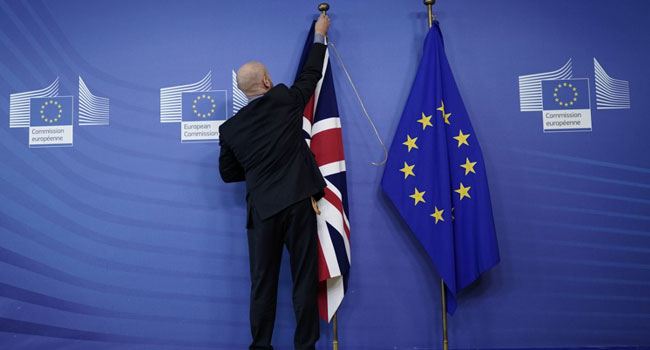
next to an European Union flag at EU Headquarters in Brussels on
October 17, 2019, ahead of a European Union Summit on Brexit.Kenzo
TRIBOUILLARD / AFP
The end of the Brexit transition period on December
31 will introduce new rules for European Union students who want to
study in Britain during the 2020-21 academic
year.
– What is the current situation? –
The situation for an estimated 150,000 EU students has been
unchanged during the transition period to December 31, as the UK
and EU try to agree terms of their new relationship.
Currently, EU students have “home fee status”, which means they
pay the same level of tuition fees as UK counterparts, depending
where the university is.
Education policy is set by devolved governments in Scotland,
Wales and Northern Ireland, with the UK government responsible for
England. As a result, tuition fees vary.
In England, Wales and Northern Ireland, students with home fee
status can be charged up to £9,250 ($12,400, 10,250 euros) per year
for an undergraduate degree.
Scottish or EU undergraduates studying in Scotland are not
charged.
EU students are eligible to apply for a student loan to cover
tuition fees.
Ireland has separate arrangement with the UK under a reciprocal
agreement.
– What happens on January 1? –
All EU citizens have to apply for residency status under the
Settlement Scheme, which grants the right to live and study in UK
when new immigration rules kick in.
Students who start a degree course at some point in the 2020/21
academic year and arrive in the UK by December 31 will still have
home fee status.
New students arriving after this date will need a student visa
that costs about £350 if they are studying in the UK for more than
six months.
(adsbygoogle = window.adsbygoogle || []).push({});
They will also have to pay a surcharge of about £500 per year to
use the state-run National Health Service (NHS).
– What happens in the next academic year?
Across the UK, EU students starting courses after August 1, 2021
look set to pay higher international tuition fees and not be
allowed to get UK student loans.
– How much will they have to pay? –
According to the Times Higher Education (THE) magazine,
undergraduate tuition fees for an international student in 2020
were between £10,000 and £26,000 a year.
A longer undergraduate medical degree can cost foreign students
nearly £59,000.
Undergraduate degrees in the UK typically require three years of
study.
Average student debt was £27,000 this year, according to the
THE, but that does not include repayment of maintenance loans to
cover living costs.
Together, this can total between £35,000 and £40,000.
– What is not known or agreed yet? –
London and Brussels have yet to strike a deal on their future
relationship.
It remains unclear if Britain will continue to participate in EU
academic programmes such as Erasmus+ and Horizon Europe beyond the
end of this academic year.
The UK government has set out guidelines for EU students to
apply for student visas.
But there is uncertainty about whether students who have already
gained settled or pre-settled status in the UK will be able to pay
home status tuition fees for courses starting in 2021-22.
Because of the coronavirus outbreak, which has forced a
suspension of face-to-face tuition and travel restrictions, many
overseas students are studying remotely outside the UK.
If they do not visit the UK this year, it is not clear if they
can still qualify for pre-settled status.
AFP
Read more https://swordpress.com.ng/2020/12/06/what-brexit-means-for-eu-students-at-uk-universities/