
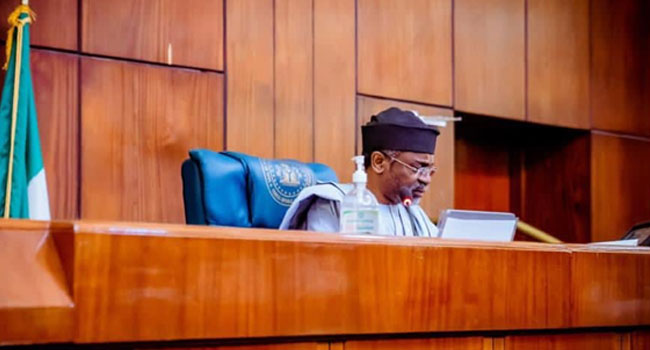
Representatives, Femi Gbajabiamila, presides over plenary at the
lower chamber of the National Assembly in Abuja on November 24,
2020.
In light of the grinding economic impacts of
Covid-19, Nigeria’s Speaker, Rep. Femi Gbajabiamila, has engaged
some international development partners on the Debt Cancellation
Campaign Initiative (DCCI) under the umbrella of Conference of
Speakers and Heads of African Parliaments
(CoSAP).
During a roundtable at the National Assembly organised by the
Office of the Speaker, the international partners expressed
readiness to support the CoSAP debt cancellation drive for African
countries.
Present at the roundtable was the World Bank’s Country Director
in Nigeria, Shubham Chaudhuri, as well as delegations of other
international development agencies operating in Nigeria, including
the European Union; ECOWAS; the United Nations Development
Programmes (UNDP); the FCDO Partnership to Engage, Reform and Learn
(PERL), and the FCDO Engage Citizens Pillar (ECP).
Also in attendance were the Japan International Cooperation
Agency (JICA); Canadian International Development Agency (CIDA);
the United Nations Office for Drugs and Crime (UNODC); Mercy Corps;
GIZ Nigeria, and the National Democratic Institute (NDI).
READ ALSO: Luther King’s Daughter, US Lawmaker,
Others Ask Buhari To Release Jailed Protesters, Journalists
While introducing CoSAP to his guests, Gbajabiamila noted that
foreign debt cancellation for African countries was topmost on the
group’s agenda and solicited their support to make it a
reality.
Gbajabiamila specifically sought the views of the World Bank
Country Director, Chaudhuri, on debt cancellation, considering the
impact of the coronavirus pandemic on African economies.
The speaker, who stressed that foreign debt was strangling
African countries individually and collectively, noted that “we can
all sit here and talk about revamping the economy, develop the
infrastructure in terms of health, education and all of those
things, which are great and wonderful
“But, we may be doing it, and it would be, hopefully not be an
exercise in futility because these things require money and if all
your money is going toward servicing debt, then how are we serious
about this (Legislative) agenda?
“So, one of the main issues we are dealing with in that
association is debt forgiveness in the form of debt cancellation.
In other words, pressing the reset button; we made commitments,
we’ve done a lot, so, we are here to take responsibility in terms
of transparency and accountability. We even signed an
Accountability Pledge in ensuring all freed up resources will be
spent wholly on addressing the social and economic pains our people
bear.
(adsbygoogle = window.adsbygoogle || []).push({});
“We consider this debt forgiveness if we do get it, as money in
hand and we have to channel these towards the development of the
continent.
“So, my question is when I said I want to tap your brains, how
feasible is this, what role can you play in terms of helping us
advocate for debt forgiveness? Not debt relief because debt relief,
as far as I’m concerned, is just basically kicking the can further
down the road; you are still going to go and pick it up later.”
Responding, Chaudhuri expressed that the issue was being pushed
by the World Bank President, David Malpass, before the Group of
Twenty (G20).
He said transparency and accountability had been an issue dating
back to the previous debt cancellation initiative between 1995 and
2005 for highly indebted countries globally.
As such, he said, CoSAP had a major task of convincing the
creditors, especially the bilateral official debt to the
Organisation for Economic Cooperation and Development (OECD)
economies or the Paris Club, on the commitment to transparency and
accountability to the terms of the agreement.
According to him, Africa has been piling up commercial debt,
adding, “What has happened over the last 20 years is that the debt
levels have built up.
“For Nigeria, as you may have known over the issue of financing,
does not have debt problem but for other sub-Saharan African
countries, the debt level has actually gone up again to a very high
level. But this time, a lot of them are commercial debts and
official bilateral debts or a kind of semi-official bilateral
debt.
“So, the G-20 and the World Bank President have put up on the
agenda that that also needs to be approached, especially given the
global crisis.
“The problem is, there is a very different set of creditors that
we are talking about and it will take a lot more work. That’s one
thing that has changed.”
While commending the frank response of the World Bank’s Country
Director on the issue, the Speaker said all hands have to be on
deck to make debt cancellation a reality.
Gbajabiamila disclosed that some members of CoSAP have signed an
Accountability Pledge on the issue that would be shared with them
for a better understanding of the position of the continental
legislative body.
Read more https://swordpress.com.ng/2020/12/11/gbajabiamila-engages-development-partners-on-debt-cancellation/