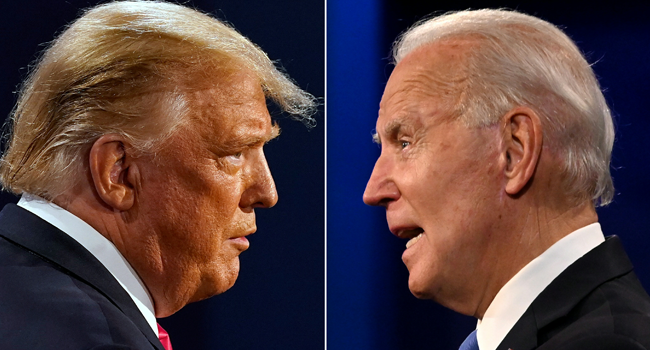
pictures created on October 22, 2020 shows US President Donald
Trump (L) and former Democratic Presidential candidate and former
US Vice President Joe Biden during the final presidential debate at
Belmont University in Nashville, Tennessee, on October 22, 2020.
JIM WATSON, Morry GASH / AFP
Long a mere formality, a vote on Monday by members
of the Electoral College to
formally recognize Joe Biden as the next US president has taken on
unusual import this year with Donald Trump stubbornly refusing to
admit defeat.
The results of the November 3 vote have been certified by each
of the 50 states and the District of Columbia; the Democrat won
with a record 81.3 million votes, or 51.3 percent of those cast, to
74.2 million, and 46.8 percent, for the Republican president.
But in the United States, the occupant of the White House is
chosen by indirect universal suffrage, with each state allocating
its electors — whose numbers are essentially based on population —
to the candidate who carried the state.
The results confirm an easy victory for Biden, with 306 of the
538 electoral votes, to 232 for Trump, with 270 required
for election.
Electoral College members meet Monday to formalize the
process, though the electors actually meet separately in each
state.
READ ALSO: British Spy Thriller Author, John Le
Carre, Is Dead At 89
Biden will then deliver a speech in the evening to celebrate the
latest confirmation of his win and “the strength and resilience” of
US democracy — a clear jab at Trump’s unprecedented stance.
Electors are local political officials or activists, civil
society figures or friends of candidates.
Most are unknown to the wider public, though national
personalities occasionally take part — like Hillary Clinton, who
lost to Trump in the 2016 election but who will vote Monday in New
York to confirm President-elect Biden and Vice President-elect
Kamala Harris.
No Trump concession
Although there have been a few “faithless electors” in past
years — who cast votes for someone other than the candidate who won
their state — there have never been enough to change an election
outcome.
(adsbygoogle = window.adsbygoogle || []).push({});
So Biden’s victory will become all the more official on
Monday.
But Trump, still the legal occupant of the White House until
January 20, has continued to make baseless assertions that the
November vote was the “MOST CORRUPT ELECTION IN U.S. HISTORY,” as
he tweeted yet again on Sunday.
He added: “How do states and politicians confirm an election
where corruption and irregularities are documented throughout?”
In fact, his campaign has not been able to document any
widespread fraud, and its legal challenges to the vote — in dozens
of suits, heard by scores of judges — have virtually all been
dismissed, often in scathing language.
An ultimate humiliation
In an ultimate humiliation, the US Supreme Court — despite
having a conservative majority assured by three Trump appointees —
on Friday bluntly refused to even consider two Republican
challenges to the vote.
Large numbers of Republican lawmakers are on record as backing
Trump’s false claims of fraud.
Some may finally be willing to recognize Biden’s victory once
the Electoral College ratifies it.
But with polls showing that as few as one in four Republican
voters accept the election results as valid, Trump is not expected
to give in anytime soon.
“WE HAVE JUST BEGUN TO FIGHT!!!” he tweeted.
This weekend, when asked on Fox News whether he would attend
Biden’s inauguration on January 20 — as demanded by protocol and
centuries of tradition — the former real estate magnate snapped, “I
don’t want to talk about that.”
The president might yet seek to use America’s drawn-out
transition process in one last attempt to reverse the outcome: some
elected officials allied with Trump have speculated about
contesting the result on January 6 when Congress is to formally
validate the Electoral Congress tally.
Such a maneuver is given virtually no chance of succeeding.
Regardless, Trump’s struggle against a repeatedly confirmed
result seems sure to leave Biden facing a steep challenge with the
country more divided than ever.
AFP