
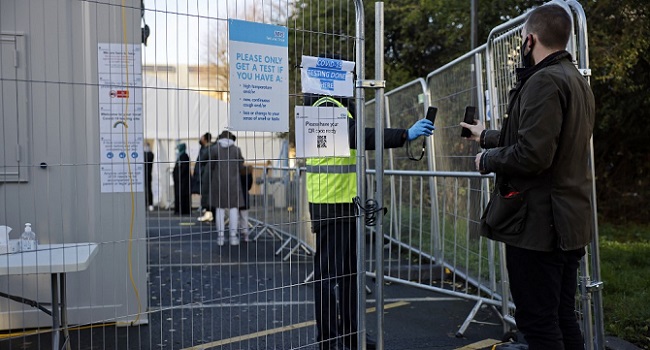
coronavirus COVID-19 walk-in testing centre in Walthamstow in north
east London, on December 15, 2020. (Photo by Tolga Akmen /
AFP)
France and Britain will reopen cross-border travel
Wednesday after a snap 48-hour ban to curb the spread of a new
coronavirus variant threatened UK supply chains.
Much of Europe swiftly banned British travellers and UK freight
entering their nations after the discovery of a more transmissible
variant of Covid-19 in Britain.
On Tuesday, dramatic images showed hundreds of lorries backed up
in Dover, with British Prime Minister Boris Johnson facing growing
pressure to resolve the deadlock even as the post-Brexit trade deal
deadline loomed.
UK Transport Secretary Grant Shapps announced late Tuesday that
Britain and France had settled on a protocol that “will see the
French border reopen to those travelling for urgent reasons,
provided they have a certified negative COVID test.”
However, he urged lorry drivers not to head to the southern
county of Kent in expectations of boarding a ferry or train.
French Transport Minister Jean-Baptiste Djebarri also confirmed
that air travel, boats and Eurostar trains would “resume service as
of tomorrow morning”.
“French nationals, people living in France and those with a
legitimate reason will have to be carrying a negative test,” he
said.
Despite the breakthrough in talks, congestion around the key
southern port of Dover remains unlikely to recede in the short
term.
Late Tuesday, the major British transit hub said it would reopen
from midnight local time (2300 GMT) for travellers with a negative
result.
A handful of passenger vehicles disembarked from two ferries in
Calais early Wednesday, an AFP correspondent said, but port
management said traffic was not expected to pick up until
later.
– Food shortage worries –
The measures imposed on hauliers have caused concern over
shortages of some fresh food products over a Christmas period
already marred by strict coronavirus restrictions.
More than 2,800 lorries remain stranded in the southern English
county of Kent, unable to make the crossing to France, with drivers
having spent a second night sleeping in their cabs.
As night fell on Tuesday, drivers of some 800 trucks parked at a
nearby disused airport sounded their horns for more than half an
hour in protest.
Despite the fresh agreement — which will be reviewed on December
31 — it is unclear when traffic will begin moving again.
The British transport ministry said: “All lorry drivers,
irrespective of nationality, will require a lateral flow test.”
In a statement, they added the test could detect the new
Covid-19 variant “in around 30 minutes, rather than the 24 hours
required after a PCR test”.
The French Ministry of Transport said in a statement that all
travellers from Britain would be required to present a negative
Covid-19 test to their airline, ship or railway company less than
72 hours before departure.
French nationals, EU nationals or French residents who need to
complete essential travel will be allowed to cross the border.
The European Union had called on members to facilitate transit
and to lift other transport bans to avoid supply chain
disruptions.
Johnson, criticised for his management of a pandemic that has
caused nearly 68,000 deaths — one of the highest death tolls in
Europe — has argued that the risk of transmission by lorry drivers
was “really very low”.
According to the World Health Organization, transmission of this
new variant is 40 to 70 percent higher.
AFP