
Dan Alexander
Senior editor at Forbes, covering Donald Trump’s business.
For all the talk about Donald Trump’s debt, most of his loans
are actually in decent shape. They’re pledged against valuable
assets, which throw off big profits. But there are exceptions.
Chief among them: The president owes an estimated $340 million to
Deutsche Bank—all of which is mortgaged against troubled
properties. No wonder the German bank is reportedly eager to sever
ties with the president.
A Deutsche Bank representative declined to comment on the record
for this story. The bank has been in a similar situation with Trump
previously. In 2005, the lender agreed to extend him $640 million
so that he could build a 92-story skyscraper in Chicago. Trump
opened the building in 2009, while the world was still reeling from
the Great Recession. One day before the Deutsche Bank loan matured,
Trump sued the bank for $3 billion in damages, claiming it had
helped cause the financial crisis.
Eventually, the two parties made up, and the bank agreed to loan
Trump more money against the property. As the country now contends
with another crisis, the building appears to be in trouble once
again. So does an estimated $45 million of outstanding Deutsche
Bank debt, which comes due in 2024.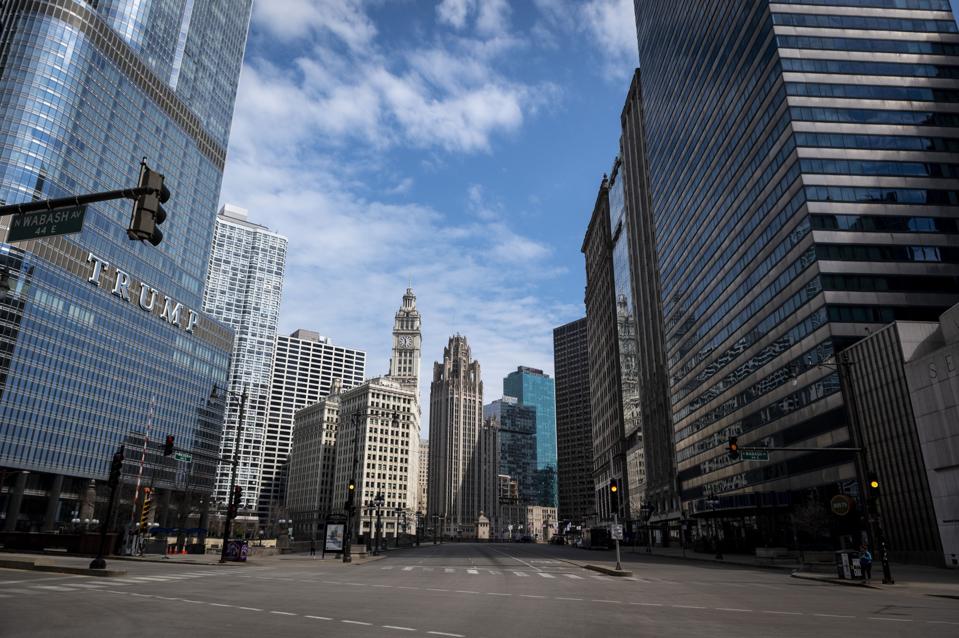
The truth is, a lot of people booking rooms in Chicago don’t
like Trump anymore. In 2015, his Windy City hotel generated $16.6
million of net operating income, according to documents obtained by
the Washington Post. But in 2016, the year Trump won the
presidency, that figure declined to $9 million. By 2018, it had
fallen all the way to $1.8 million. And that was pre-pandemic. At a
meeting earlier this year, the hotel’s managing director sounded
the alarm: “It’s going to be very, very tough to keep the boat
afloat,” he said, according to the Post.
Things don’t appear to be much better at Trump National Doral, a
golf resort in Miami. Trump purchased the property for $150 million
in 2012, borrowing $106 million from Deutsche Bank. He proceeded to
dump a reported $213 million of additional money into the resort.
In 2015, as he was running for president, Trump took out a second
mortgage of $19 million, making his liabilities an estimated $125
million. Given all that he invested into the place, you’d think
Trump would now be generating supersized profits that would make
his interest expenses an afterthought.
But things haven’t gone according to plan. From 2015 to 2017, as
Trump’s political career was blossoming, revenues at Doral fell
from $92 million to $75 million. Net operating income plunged from
$13.8 million to $4.3 million. Trump has a variable interest rate
against the property, which makes it difficult to pin down his
exact interest expenses. But it seems likely that, in 2017, Trump
was barely making enough of an operating profit to cover his
interest, let alone additional expenses that came after it.
Revenues barely moved in 2018 and 2019.
(adsbygoogle = window.adsbygoogle || []).push({});
Again, all those struggles were pre-pandemic. Doral has
643 rooms, which sat empty in early 2020, as the property shut down
amid the coronavirus crisis. Before the resort reopened, Eric Trump
touted the property to his 3.7 million Twitter followers, and
Donald Trump retweeted the message to his 80 million-plus
followers. Even still, only 38 rooms had guests the first day,
according to two front desk agents. Not a good sign for the
property’s 2020 prospects.
Then there’s the Trump International Hotel in Washington, D.C.,
perhaps the president’s most famous property. In 2013, Trump
promised to invest $200 million into the hotel in exchange for the
right to lease it from the government for 60 years. The Obama
administration, which negotiated the deal, seems to have gotten the
best of Trump. An analysis of financial documents connected to the
hotel suggests that it could have produced $5 million or so in
annual operating profits from 2017 to 2019. That does not appear to
be enough to cover the interest expenses on the property. In
September, the New York Times reported that Trump’s tax-return data
showed $55.5 million of losses at the hotel from the time it opened
in 2016 to the end of 2018. The loan comes due in 2024. Things may
improve as the hotel industry recovers from the pandemic, but
there’s little reason to think Trump’s hotel will perform better in
the future than it did from 2016 to 2018.
Despite all of these challenges, a spokesperson for the Trump
Organization struck an optimistic tone on Tuesday. “We have a
wonderful relationship with Deutsche Bank,” the representative said
in a statement. “The majority of our assets are owned free and
clear, and with respect to the properties that do have mortgages,
the debt is a small fraction relative to the value of the
asset.”
That’s not the case with the assets in Chicago, D.C. and Miami,
however. Fortunately for Deutsche Bank, Trump reportedly agreed to
personally guarantee the loans. That means the bank could
theoretically go after the properties—as well as other Trump
assets—to get its money back. Doing so could be complicated, of
course, especially given the litigious nature of the borrower.
Don’t be surprised if this one gets messy.
Read more https://swordpress.com.ng/2020/12/23/trumps-german-bank-deutsche-bank-loans-in-trouble/