
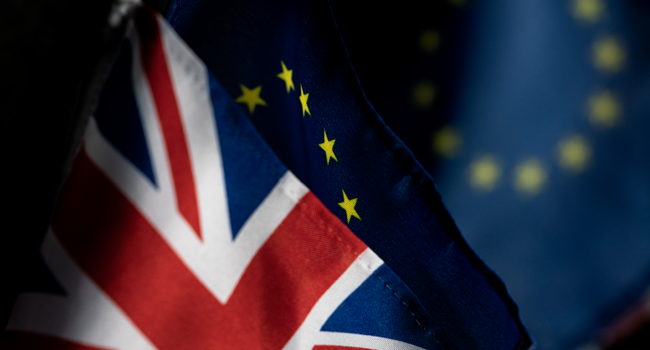
2020 shows the flags of the United Kingdom and the European Union.
According to a British government source a ‘deal is done’ on
post-Brexit trade.
Kenzo TRIBOUILLARD / AFP
From January 1 British and EU citizens will be
confronted with the reality of Brexit as the transition period ends
and borders that were done away with decades ago
return.
From that date, Britons will be treated by the EU as “third
country” nationals, no longer enjoying freedom of movement to work,
study or retire across the European Union.
Britain in turn will process EU nationals at its borders as it
does other non-UK passport holders.
EU citizens proving residence in Britain, or Britons already
living in a European Union country, will theoretically retain their
rights under a Withdrawal Agreement struck in late 2019.
– Tourists –
Tourists will see some immediate changes — apart from the
fluctuating coronavirus restrictions already crimping travel — but
both sides have agreed that travel will be visa-free, as long as
the other side keeps it that way.
But the EU will stop British passports being used in its
automated e-gates, potentially meaning longer queues at manned
passport booths.
READ ALSO: EU Gives Up 25% Of Fish Quota In UK
Waters
Britons must hold passports still valid for at least six months
and will be limited to EU stays of 90 days in a rolling 180-day
period.
They will also need to show travel insurance coverage,
sufficient funds and a return ticket on request.
Europeans entering Britain can use a national ID card until
October, after which only passports will be accepted, for stays of
up to six months.
EU passport holders will be able to continue using British
e-gates under current guidance.
Those with criminal records may be banned and non-European
family members of a European may need a visa, depending on
nationality.
The UK treats Irish citizens separately from other EU nationals
under a bilateral arrangement dating back nearly a century that
allows continued freedom of movement between Britain and
Ireland.
Europeans will be able to keep using EU pet passports as long as
rabies vaccines are up to date. Britons however must see a vet to
prepare their pets for travel a month before their trip to an EU
country.
– Business travellers –
The EU-UK deal reached Thursday has set out the visa
requirements for business travellers, the details of which are yet
to be made public.
In the EU, Britons attending conferences or meetings likely will
be exempt from visas where they do not receive payment or provide
services.
However, for other UK business travellers, including posted
workers and the self-employed, a visa and/or a work permit may be
imposed in line with each individual EU country’s laws.
There will also be tax and social security considerations.
(adsbygoogle = window.adsbygoogle || []).push({});
Certain services or company ownership in those countries may be
off-limits to non-EU citizens or residents or those lacking
national licences, and customs declarations may be needed for goods
brought in.
In Britain, EU citizens with a job offer will be required to
prove English-language skills and a minimum salary, dependent on
whether the position is skilled (26,500 pounds, equivalent to
29,600 euros or $35,000) or a shortage occupation (20,480 pounds,
22,800 euros).
– Students and universities –
From January, EU students going to Britain will need a visa for
courses longer than six months, and will have to pay steeper
tuition fees — four times as much for degrees such as medicine or
MBAs at prestigious universities.
That hefty burden may force many European students to choose EU
institutions — some of which are free — over British ones, which UK
universities fear will blow a big hole in their finances.
They also say they are already being shunned for research
projects led by EU universities.
According to UK parliament research, there were 143,000 EU
students in British universities in the 2018 to 2019 school
year.
International students have made Britain the second-most popular
education destination after the US, and they injected £25.8 billion
(29 billion euros, or $34 billion) into the UK economy in 2015.
British students will be excluded from the Erasmus+ programme
offering subsidised exchanges to EU countries.
British students wanting to go to EU universities will encounter
higher fees in some countries as well as visa requirements that in
many cases will curb their right to work.
– Emigrants –
For the estimated 1.3 million Britons living in the EU and the
more than four million EU citizens living in the UK before the end
of the transition period, their rights to stay are protected under
the 2019 Withdrawal Agreement.
Those wanting to emigrate elsewhere in the EU after January 1
will find a very different situation.
Britons, for example, have long favoured Spain, France, Germany
and Italy to set down new roots as workers or retirees.
But the end of freedom of movement will see them having to jump
through the same hoops as other “third country” nationals, which
often include health insurance, income and language
requirements.
Even Britons settled under the Withdrawal Agreement will no
longer have automatic rights to move to a different EU country, and
will face national immigration laws if they want to do so.
Britain, for its part, is bringing in a points-based system from
2021 that will make it significantly harder for Europeans to move
there.
Age, English language ability, funds and the requirement to pay
a health surcharge will all be evaluated, with caps on some of the
immigration channels.
Read more https://swordpress.com.ng/2020/12/25/post-brexit-borders-to-divide-eu-uk-citizens/

President Muhammadu Buhari has approved the redeployment of nine
permanent secretaries with immediate effect.

This is contained in a circular dated 24th day of December, 2020
issued by the Head of Service of the Federation, Dr. Folashade
Yemi-Esan which was made available to Nairalaw

It reads:
| Name | Current Posting | New Posting. | |
| 1 | Musa Mikfuktur Istifanus | Communication and Digital Economy | Defence |
| 2 | Gabriel Aduda | Youth and Sports Development | Foreign Affairs |
| 3 | Ernest Afolabi Umakhihe | Works and Housing | Agriculture and Rural Development |
| 4 | Engr. Festus Yusuf Narai Daudu | CSO (OHCSF) | Communication and Digital Economy |
| 5 | Engr. Nebolisa Anako | Information and Culture | Youth and Sports Development |
| 6 | Babangia Hussaini | Defence | Works and Housing |
| 7 | Dr. Anthonia Akpabio Ekpa | OHCSF | Women Affairs |
| 8 | Dr. Adaora Ifeoma Anyanwutaku | Women Affairs | Information and Culture |
| 9 | James Sule | OHCSF | Cabinet Affairs Office (OSGF) |