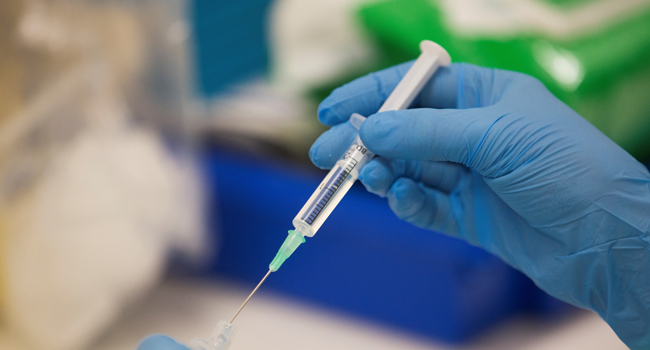
December 8, 2020 a member of staff draws the Pfizer-BioNTech
COVID-19 vaccine out of a phial at the Southmead Hospital, Briston.
The US Food and Drug Adminstration on December 11, 2020 granted the
Pfizer-BioNTech Covid-19 vaccine an emergency use authorization,
paving the way for its imminent rollout across the country.
Graeme Robertson / AFP / POOL
Britain on Wednesday became the first nation to approve
the coronavirus vaccine developed by AstraZeneca and the University
of Oxford, as Germany logged its highest daily death toll with the
pandemic surging worldwide.
Fears have also grown following the detection in Britain of a
new strain of the virus experts suspect is more contagious, and the
variant has been found in a number of other countries, including
the United States and India.
A year after the World Health Organization first mentioned a
pneumonia in China later identified as Covid-19, the virus has
killed more than 1.79 million, devastated the global economy and
driven the race for a vaccine to halt the pandemic.
International efforts helped develop vaccines in record time,
and following Pfizer-BioNTech and Moderna, the AstraZeneca-Oxford
candidate became the third to win approval in the Western
world.
“We will now move to vaccinate as many people as quickly as
possible,” tweeted British Prime Minister Boris Johnson.
Unlike the Pfizer-BioNTech and Moderna vaccines, the one from
AstraZeneca and Oxford does not need to be stored at very low
temperatures.
It can be kept, transported and handled at normal refrigerated
conditions, making it easier and cheaper to administer, which is
particularly important for less wealthy nations.
It is unlikely to get approval from the European Union until at
least a month however.
Noel Walthion, deputy executive director of the European
Medicines Agency told Belgium’s Het Nieuwsblad newspaper that a
possible approval in January was “unlikely,” an agency statement
confirmed.
Russian, Chinese vaccines
Russia and China also claim to have developed Covid-19 vaccines,
and have already started administering them.
Chinese pharma giant Sinopharm on Tuesday said Phase 3 trials of
its candidate had shown 79-percent effectiveness, short of the more
than 90 percent achieved by Pfizer-BioNTech and Moderna. The firm
has applied to China’s drug regulator for approval.
But Beijing has struggled to gain international trust for its
vaccines, hindered by a lack of data transparency as well as
criticism over its handling of the initial outbreak of the virus in
the central Chinese city of Wuhan and its attempts to silence
whistleblowers.
The number of infections in that city may have been 10 times
higher than official figures suggest, according to a study by
China’s Centre for Disease Control.
A leading scientist also criticised the French government for
the slow roll-out of its vaccination programme.
France’s strategy “is not suited to a situation that is so
dangerous,” said Axel Kahn, a prominent geneticist who leads the
National League against Cancer.
New variant worries
Even as vaccinations ramp up in Europe and North America, global
infections have surged to 82 million, with nearly 1.8 million
deaths.
Germany, which had handled the first coronavirus wave relatively
well, has been hit hard by the second. It logged more than 1,000
daily deaths for the first time, authorities said Wednesday.
Germany is under a partial lockdown, with most shops closed
along with schools, restaurants, cultural and leisure
facilities.
But with Chancellor Angela Merkel due to meet senior politicians
to discuss the situation next Tuesday, some are already pressing to
extend the existing lockdown beyond the current January 10
end-date.
Health Minister Jens Spahn told German broadcaster ARD the
country was “nowhere near where we need to be” and “there will
undoubtedly be measures” after January 10.
With England registering record daily figures for infections
after the discovery of a new variant of the virus that experts
believe could be more contagious, that same variant is now turning
up in other countries.
Indian authorities were trying Wednesday to track down tens of
thousands of recent arrivals from Britain as cases of the new
variant more than doubled in 24 hours.
Health workers in the United States and Latin America detected
it on Tuesday for the first time.
The EU health agency has warned the strain carries a high risk
for more hospitalisations and deaths — not because the infections
are more severe but because it spreads more easily.
‘Greatest operational challenge’
In the United States — the worst-hit nation in the world —
President-elect Joe Biden called mass vaccination “the greatest
operational challenge we’ve ever faced as a nation”.
The Trump administration had said that 20 million Americans
would be vaccinated by the end of December, but so far just over
two million have received the first shot of the vaccine, according
to the Centers for Disease Control and Prevention.
Biden, who takes over from Donald Trump on January 20, renewed
his promise to administer 100 million vaccine doses in his first
100 days in office, and confirmed he would invoke a Korean War-era
law to force private industry to step up production.
“The Trump administration’s plan to distribute vaccines is
falling far behind,” Biden said.
“I’m going to move Heaven and Earth to get us going in the right
direction.”
But he warned: “The next few weeks and months are going to be
very tough — a very tough period for our nation, maybe the toughest
during this entire pandemic.”
Read more https://swordpress.com.ng/2020/12/31/uk-approves-use-of-astrazeneca-oxford-covid-19-vaccine/

A Chief Magistrate’s Court in Jigawa State, on Wednesday,
sentenced to prison a social media commentator following his
Facebook comments which accused Governor Muhammadu Badaru of
fraud.

The convict, Sabi’u Chamo, a social media promoter of Sabo
Nakudu, an APC senator for Jigawa Central, accused Governor Badaru
for duping APC aspirants by collecting their money with the promise
to give them party tickets.

Mr Nakudu is the leader of a factional group of the APC in the
state as opposed to the Mr Badaru’s faction of the party.
Earlier, the governor, while inaugurating the state APC
caretaker committee, said “I will remain vigilant watching those of
you going to meeting with the other factional group, you have got
enough of my patience, I will no longer tolerate that again.
The state government earlier on December 24 sued Mr Chamo over
the Facebook statement. However, the court ordered that the police
should effect his arrest and investigate the suspect before
prosecution, which the police did.
Before his arrest, Mr Chamo, earlier on December 20, retracted
his statement on Facebook and apologised to those who might have
been offended, saying ”that I learnt that my write up have offended
many which is why I am apologizing, thank you, he wrote on his
Facebook page in Hausa Language.
The spokesperson for the state’s Ministry of Justice, Zainab
Baba-Santali, in a statement confirmed that Mr Chamo was sentenced
to six months in a correctional facility for his comments which
injured the governor’s reputation.
The court, however, gave the convict an optional fine of
N20,000.
The Chief Magistrate’s Court 1 sitting in Dutse presided over by
Batula Dauda also said the convicted person would receive 20 lashes
of stroke for the comments to serve as a deterrent to others.
During the trial, after the charge was read to the defendant, he
pleaded guilty to the offence after which the court sentenced him
to six (6) months in a correctional center or Twenty thousand Naira
fine (20,000) and 20 strokes of cane to serve as a deterrent to
others.