
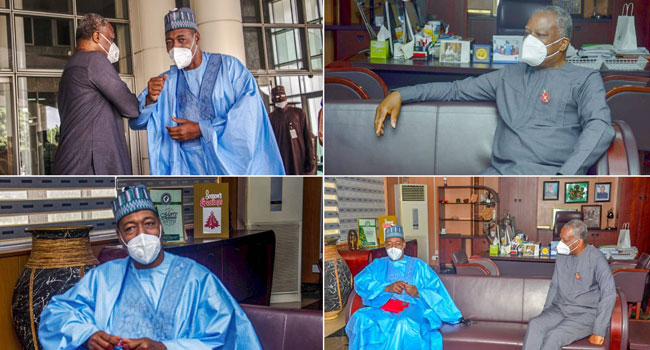
Borno Governor, Professor Babagana Umara Zulum
Thursday met Nigeria’s minister of foreign affairs, Geoffrey
Onyeama to conclude intergovernmental efforts for voluntary
repatriation of thousands of Borno citizens currently taking refuge
in parts of Cameroon, after fleeing from Boko Haram attacks in
batches, within the last six years.
The meeting which held at the federal ministry of foreign
affairs in Abuja was a follow up to Zulum’s series of meetings with
the minister of humanitarian affairs, disaster management, and
social development, Sadiya Umar Farouk, top executives of the
National Commission for refugees, migrants, and internally
displaced persons, the United Nations High Commission for Refugees,
UNHCR, among and other stakeholders.
The Thursday meeting, which held behind closed doors, discussed
the role of the federal ministry of foreign affairs which has the
mandate to facilitate the repatriation through diplomatic channels,
with the hope to undertake it, in January 2021.
READ ALSO: 2021: Buhari Has Not Demonstrated
Capacity To Play His Part – PDP
The meeting was attended by Nigeria’s serving Ambassador to
China, Amb. Baba Ahmad Jidda, who was there as a statesman from
Borno state.
More than 60,000 Nigerian refugees, the majority from Borno and
some from Adamawa states are believed to be in Minwao camp in
Cameroon, which Zulum had visited and supported with social
protection relief.
(adsbygoogle = window.adsbygoogle || []).push({});
The governor has also approved the ongoing construction of
thousands of houses in which repatriated refugees will be
permanently resettled in safe communities.
Zulum was also in the Niger Republic and the republic of chad
where Borno citizens are always there as refugees who fled
insurgent attacks.
In both countries, the governor authorized and supervised the
distribution of food items and cash relief to thousands of
families, some of whom the governor had to cross Lake Chad waters
in order to reach the Baga Sola refugee camp within the Chadian
border territory. N50m was distributed to 5,000 families in the
area less than three weeks ago.
Within that same period, Zulum was in N’Djamena in Chad and was
hosted by President Idris Deby to discuss the repatriation of
thousands of Nigerian refugees, the majority from Borno.
The meeting, held at the presidential palace, was attended by
Nigerian ambassador to Chad, Zannah Umar Bukar Kolo, who
represented Nigeria’s federal ministry of foreign affairs.

Britain on Friday became the latest country to abolish the
so-called “tampon tax,” eliminating sales taxes on women’s sanitary
products.

The move was widely praised by women’s rights advocates as well
as proponents of the country’s departure from the European
Union.

Treasury chief Rishi Sunak had committed to ending the widely
unpopular tax on tampons and sanitary pads in his budget in March
but the change could only take effect Friday after Britain had
finally left the economic orbit of the European Union.
Under EU law, nations cannot reduce the rate of value-added tax
on menstrual products below 5% as they are deemed to be luxury
items and not essentials. Ireland is the only EU country that does
not charge a levy on sanitary products as its zero tax rate was in
place before the EU set its floor.
“Sanitary products are essential, so it’s right that we do not
charge VAT,” said Sunak. “We have already rolled out free sanitary
products in schools, colleges and hospitals and this commitment
takes us another step closer to making them available and
affordable for all women.”
Britain officially left the bloc’s vast single market for
people, goods and services at 11 p.m. London time on Thursday,
giving it greater scope to set its own laws. A new U.K.-EU trade
deal will bring new restrictions and red tape, but for British
Brexit supporters, it means reclaiming national independence from
the EU and its rules. They pointed to the abolition of the tampon
tax as an early positive change from Brexit.
Britain’s treasury has previously estimated the move will save
the average woman nearly 40 pounds ($55) over her lifetime,
“It’s been a long road to reach this point, but at last, the
sexist tax that saw sanitary products classed as nonessential,
luxury items can be consigned to the history books,” said Felicia
Willow, chief of the Fawcett Society, a women’s rights charity.
Many other countries have also eliminated the tampon tax,
including Australia, Canada and India. In the United States,
several states including New York and Florida have also nixed the
tax.
[Associated Press]