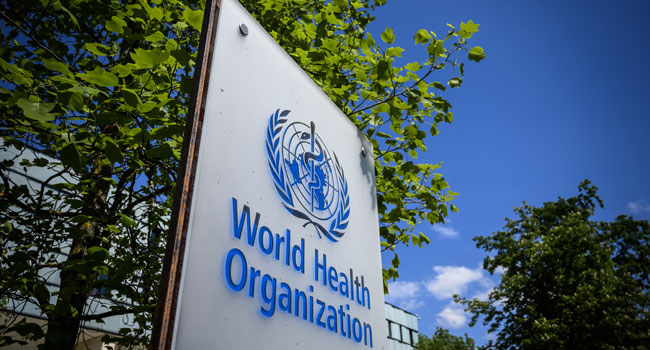
2020 shows a sign of the World Health Organization (WHO) in Geneva
next to their headquarters, amid the COVID-19 outbreak, caused by
the novel coronavirus.
Fabrice COFFRINI / AFP
The world’s poorest countries can expect to start
receiving their first Covid-19 vaccine doses between the end of
January and mid-February, the World Health Organization said
Thursday.
Vaccination is already under way in some of the world’s
wealthiest nations, including the United States, Britain, European
Union countries and Canada.
Covax, the globally-pooled vaccine procurement and distribution
effort, has struck agreements to secure two billion doses — and the
first of those will start rolling out within weeks, said the WHO’s
head of vaccines, Kate O’Brien.
Covax aims to secure vaccines for 20 percent of the population
in each participating country by the end of the year, with funding
covered for the 92 lower- and lower-middle income economies
involved in the scheme.
It is co-led by the WHO, the Gavi vaccine alliance and the
Coalition for Epidemic Preparedness Innovations (CEPI).
Asked how quickly lower-income African nations would get
vaccines, O’Brien told a WHO live social media event: “The facility
has access to over two billion doses of vaccine.
“We will start to deliver those vaccines probably by the end of
January, and, if not, certainly by early February and
mid-February.
“That’s how countries in Africa and South Asia, and other
countries around the world of these 92 that are less able to afford
vaccines, are actually going to get vaccines.”
– Vaccines pipeline –
The WHO granted emergency validation to the Pfizer-BioNTech
vaccine on December 31, paving the way for countries worldwide to
give swift approval to its import and distribution.
According to the WHO’s overview of candidate vaccines, 63 have
been tested on humans, 21 of which reached final-stage mass
testing.
A further 172 candidate vaccines are being developed in
laboratories with a view to eventual human trials.
(adsbygoogle = window.adsbygoogle || []).push({});
“There is a really big pipeline of vaccines that are coming
through,” said O’Brien.
“We are in active review of the data on other vaccines and we do
expect to be emergency-use listing additional vaccines in the
coming weeks and the next months.
“We have 15 manufacturers that have contacted us believing that
they have the data that are required to meet these highest
standards.”
As for the new mutations of the virus detected in Britain and
South Africa, WHO experts have said that while they seem more
transmissible, there is no indication that the current vaccines
would not work against those variants — and the vaccines are easily
adaptable in any case.
“The evaluation about whether the existing vaccines will be
impacted at all is under way,” said O’Brien.
However, “the kinds of changes being seen in these variants are
not felt to be likely to change the impact”, she added.
O’Brien said it was too early to tell how long protection would
last for following vaccination, and the WHO had no data yet to make
any recommendations on receiving doses of different vaccines,
having fully reviewed only the Pfizer-BioNTech jab.
She said prospective recipients should be aware it is not
uncommon to feel unwell or have a sore arm after receiving a
shot.
“Up to a third of people are going to get a headache or not feel
well for perhaps 24 hours; the data says sometimes up to 48 hours,”
she said.
“It is your body’s immune response that is actually turning
on.
“You might not feel at your best for the first couple of days,
but there’s a reason for it: something good is happening in your
body.”
