
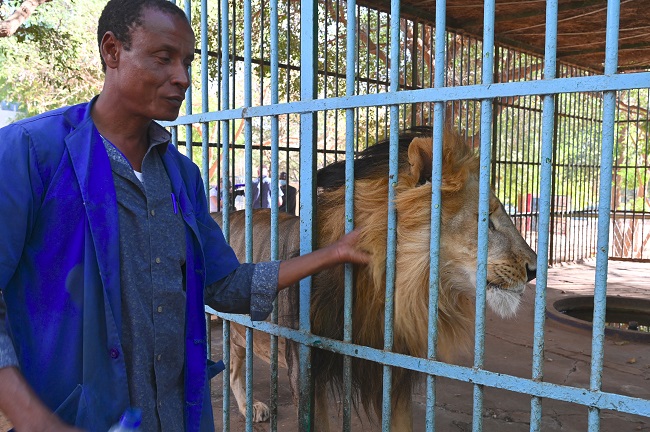
in a cage at the National Museum of Niger (MNN) or Boubou Hama
Museum, which is also a zoo, in Niamey, Niger, on December 29,
2020. (Photo by Issouf SANOGO / AFP)
There can be few museums in the world to rival the
National Museum of Niger.
It has displays covering art, history, dinosaurs, nuclear
energy, craftwork and music as well as live animals, for it is also
a zoo.
Its clientele is similarly diverse, encompassing visitors who
have trekked to the capital Niamey from across the country, school
groups, well-heeled foreign tourists and street urchins.
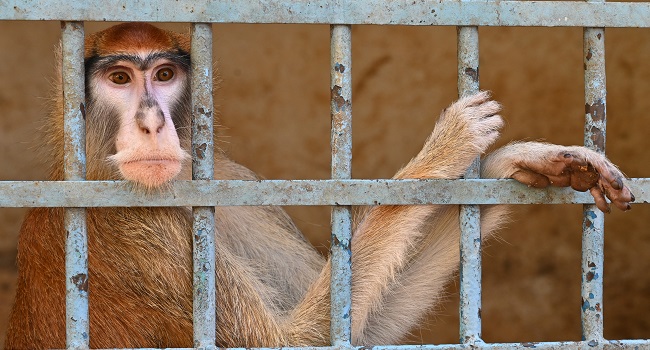
the National Museum of Niger (MNN) or Boubou Hama Museum, which is
also a zoo, in Niamey, Niger, on December 29, 2020. (Photo by
Issouf SANOGO / AFP)
The cultural gem of the world’s poorest country, the 24-hectare
(59-acre) museum survives on a budget that for rich counterparts is
the equivalent to money found down the back of the sofa.
Yet it charges a rock-bottom entrance fee — around 10 US cents —
so that even the most impoverished can walk in and have access to
exceptional things… including wild animals. “Fauna and culture,” as
the museum says.
“It’s Niger’s mirror, its social and cultural reflection,” said
its director, Haladou Mamane, proudly ticking off its strengths in
culture, history, archaeology, palaeontology… not forgetting the
zoo section, “part of a multi-disciplinary tradition.”
“Here, every Nigerien, regardless of their background, can gain
insights about the country,” said Mamane, noting that many people
in Niger have never been to school.
Hot and arid, located in the heart of the Sahel, Niger ranks the
lowest among 189 countries on the UN’s Human Development Index. Per
capita income is just $1,040 (855 euros) per year — just over $2.5
per day, according to the World Bank.
Adding to the burden is a crippling jihadist insurgency. Two, in
fact — one coming from the southeast, from Nigeria, and one from
the southwest, from Mali.
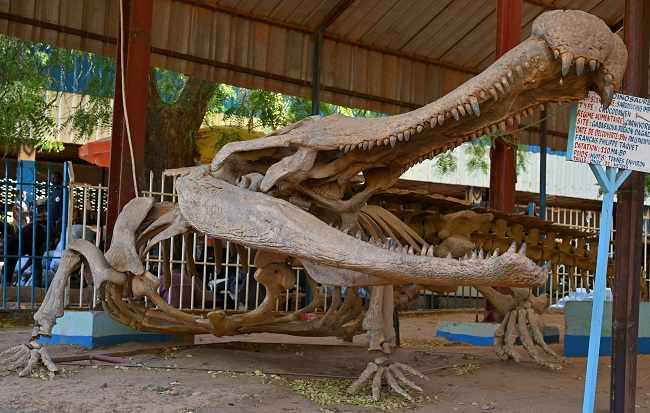
crocodile skeleton at the National Museum of Niger (MNN) or Boubou
Hama Museum, which is also a zoo, in Niamey, Niger, on December 29,
2020. (Photo by Issouf SANOGO / AFP)
(adsbygoogle = window.adsbygoogle || []).push({});
The state provides the museum with an annual subsidy of 327
million CFA francs ($610,000 or 500,000 euros), and income from the
meagre entrance fee of 50 CFA francs covers just about a third of
costs.
– Street kids’ museum –
Before the pandemic, it received more than 100,000 visitors per
year, many of them so-called talibe children.
These are children who are unique to West Africa — their parents
hand them to a type of Islamic school, where they are supposed to
learn the Koran.
But they typically spend their days begging in the dusty streets
with a metal receptacle strung around their neck, and many find the
museum is a wonderful escape.
One such was 12-year-old Ismael Mariama, who after playing on
the slides and seesaws watched a large lion taking an afternoon
nap.
“I came to see the animals. I paid 50 francs,” he said, clad in
worn, grubby clothes.
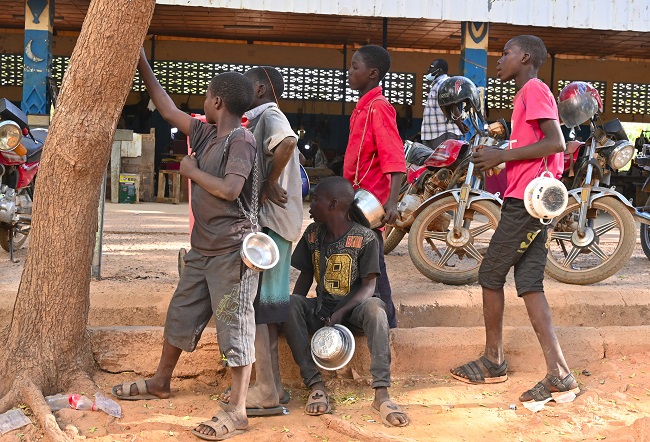
National Museum of Niger (MNN) or Boubou Hama Museum, which is also
a zoo, in Niamey, Niger, on December 29, 2020. (Photo by Issouf
SANOGO / AFP)
“I came from Yantala,” a rundown district in northwestern
Niamey, “to come and see the animals, the monkey, the lions, the
crocodiles,” he said.
“I’ve seen everything,” said the lad, before putting his hand
between the bars of a cage to give a biscuit to the monkeys.
He added that he had been to the museum’s section on Nigerien
craftwork and was interested in the leather shoes.
Mamane said he was especially proud of the craftwork area — a
place that provides a shop window for sculptors, painters, potters
and leatherworkers, who can sell what they produce.
The artisans come from all over this ethnically diverse country
— a sign of “national unity,” said Mamane.
“It’s a bit hard with the coronavirus, but the museum is a good
thing for us,” said Ali Abdoulaye, a leatherworker.
“These days, artisans are losing out to cheaper Chinese products
— but you buy a (Chinese) handbag, and it falls apart after a
couple of days.”

skeleton at the National Museum of Niger (MNN) or Boubou Hama
Museum, which is also a zoo, in Niamey, Niger, on December 29,
2020. (Photo by Issouf SANOGO / AFP)
A few metres (yards) from the museum’s main hall is a star
attraction — the skeletal remains of three monsters from the Age of
the Dinosaurs.
They include Sarcosuchus imperator, an 11m (36-feet) -long
crocodile, whose fossil was discovered in the Agadez region by a
French palaeontologist, Philippe Taquet.
– Makeover –
The museum, founded just before Niger gained independence from
France in 1960, is planning on a refurbishment and an expansion
next year with the help of international donations.
As in many museums around the world, it looks to sponsors for
exhibitions.
A show on uranium, Niger’s outstanding mineral wealth, is funded
by the French company Orano, previously Areva, whose subsidiaries
operate two mines in the south of the country.
Next to it is an exhibition on oil, which has recently been
discovered in Niger. The display, which includes an enormous model
of a refinery in Zinder, southern Niger, has been funded by the
China National Petroleum Corporation (CNPC).
The museum promises that once the building work is complete, the
111 species in the zoo will enjoy “improved living conditions”.
Read more https://swordpress.com.ng/2021/01/12/niger-museum-is-eclectic-national-mirror/

The Academic Staff Union of Universities on Tuesday insisted
Nigerian universities are not ready to re-open in the middle of a
second wave of the coronavirus pandemic.

The National Universities Commission (NUC) had earlier directed
universities to resume academic activities on January 18.

But ASUU is asking the federal government to review the
decision, as more COVID-19 cases continue to be reported across the
country
On Monday, the Nigeria Centre for Disease Control (NCDC)
reported 1,244 new cases and three more deaths.
“Our concern is rooted in the safety of our members,” ASUU’s
National President, Biodun Ogunyemi, said on Sunrise Daily. “What
happens to congested hostels, crowded classrooms? What flexible
arrangements are in place? It is a situation of emergency. I’m not
sure the Universities can cope.
When asked if e-learning was an option for universities, the
ASUU President said the necessary infrastructure was not in
place.
“We are aware that some universities are putting measures in
place, with alternative learning models,” he said. “Some are even
trying blended classes, virtual and physical.
“But these efforts are limited. They get to a point they can’t
go further.
“ASUU has been talking about revitalisation since 2012. These
are some of the areas where the assistance would have helped.
Universities need huge funds to do this.
“People are saying start virtual classes, but more than 60
percent of our students will run into trouble – they can’t afford
data or smartphones.”
ASUU recently called off a ten-month-old strike over demands
related to salary structure and government support for
universities.