in May 2016, scientists reported that 1 trillion species are
estimated to be on Earth currently with only one-thousandth of one
percent described.
retwtr.com and we are still looking for
aliens 


The domesticated chicken (Gallus gallus domesticus), a Galliform,
has an estimated population of 23.7 billion, which is higher than
any other bird.
- There are an estimated 3,500,000,000,000 (3.5
trillion) fish in the ocean no wonder the phrase there is
better fish in the ocean ? right ?
Insects (Insecta)
Recent figures indicate that there are more than 1.4 billion
insects for each human on the planet. An article
in The New York Times claimed that the world holds 300
pounds of insects for every pound of humans.Ants have colonised
almost every landmass on Earth. Their population is estimated as
1016–1017 (10-100 quadrillion)
imagine if the ants could vote ? Democracy would be a JOKE ! or
is it ?
Trees
According to NASA in 2005, there were over 400 billion
trees on our globe.However, more recently, in 2015, using better
methods, the global tree count has been estimated at about 3
trillion. Other studies show that the Amazonian forest alone
yields approximately 430 billion trees. Extrapolations from
data compiled over a period of 10 years suggest that greater
Amazonia, which includes the Amazon Basin and the Guiana Shield,
harbors around 390 billion individual trees.
OK LETS GET SERIOUS not with the ants though
7 BILLION AND COUNTING
Along With Humans, Who Else Is In The 7 Billion Club?
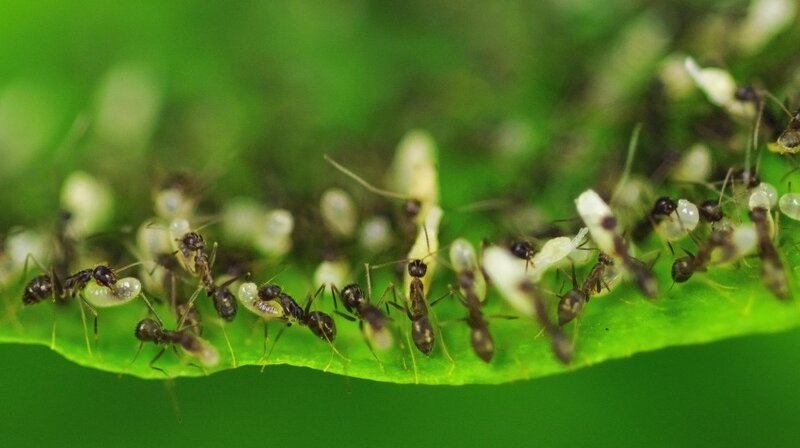
Animal Kings: Ants, like these workers
carrying eggs to a plant’s leaf after rain flooded their nest, have
a combined biomass estimated in the billions of tons.
Gurinder
Osan/AP
The revelation this week that the Earth now holds 7 billion
people, according to the U.N.’s population division, prompted a
question: Who else is in the 7 Billion Club? To find out which
other animals had reached that plateau, we asked wildlife experts —
and they patiently explained why our innocent question was nearly
impossible to answer.
But then the experts gave us some best guesses. And the
consensus was that humans are the largest animals on the planet to
have a population numbering at least 7 billion — but they’re
certainly not the only ones to reach that mark.
More on that in a minute — but first, let’s start with the basic
premise.
It’s very difficult to say with certainty, “Right now, there are
7 billion humans living on Earth.” Because, as our colleague Adam
Cole explained in his video and audio report, for every new
drop in the bucket, there’s always a drop or two leaking out of
it.
In fact, the U.N.’s choice of Oct. 31 as The Day We Hit 7
Billion comes with some caveats — as Mark reported, the margin
of error on the estimate totaled around 56 million.
And the date announced by the U.N. doesn’t match up with what
the U.S. Census Bureau predicts. On its own version of a World
Population tracker, the U.S. agency estimates that humans won’t hit
the 7 billion mark until March 2012.
So, there’s some unavoidable uncertainty here — questions of
scale and logistics make it impossible to count 7 billion people
who are all alive at the same instant.
And if you can’t count humans, then how could you expect to
count rodents or birds? The most challenging of all may be the
fish. Because if a fish holds still long enough for you to count
it, that might be because it has just died — and can no longer be
counted. You see where this is going.
So, the experts do what they do better than anyone: They
estimate — and they calculate biomass.
For those of you who are rusty on your ecology, biomass is
determined by multiplying an estimated population by its members’
average weight. So, for humans, our experts settled on
approximately 350 million tons — or 7 billion x 50 kg (110 pounds).
And if that number seems lighter than you’d think, consider that
the estimate must take children’s lighter weights into account.
(adsbygoogle = window.adsbygoogle || []).push({});
After contacting several experts from the World Wildlife Fund
and David Kidd at London’s Global Population Dynamics Database, here’s the
rough consensus that we came up with:
Among land-based vertebrates, humanity’s closest rivals in terms
of sheer numbers are probably the brown rat (which, everyone
agrees, outnumber us — but no one seems eager to count) and the
domestic chicken (which numbered 18.6 billion in 2009, according to
the Food and Agriculture Organization).
And in terms of animals whose bodies are around the size of a
human’s, WWF International consultant Jonathan Loh, an honorary
research associate at the Zoological Society of London, wrote us to
say:
“No other large mammal comes close to us in terms of numbers.
According to the FAO, there are around 1.4 billion cattle in the
world and about 1.1 billion sheep (in 2009). The total cattle
biomass would be greater than ours (more than 500 million tons),
but sheep biomass would be considerably less (below 100 million
tons).”
Loh was kind enough to provide data for a chart. While it
doesn’t pretend to be an exhaustive survey of species with large
populations, it does give a sense of the range of life on Earth —
and how different populations compare to one another.
| Species | Population | Biomass(million tons) |
|---|---|---|
| Bacteria total | 4 quadrillion quadrillion | 1,000,000 |
| Ants(many species) | 10 billion billion | 3,000 |
| Marine fish(many species) | 800-2,000 | |
| Cattle(Bos taurus) | 1.4 billion | 520 |
| Termites(many species) | 445 | |
| Humans(Homo sapiens) | 7 billion | 350 |
| Antarctic krill(Euphausia suberba) |
500 trillion | 150 |
| Sheep(Ovis aries) | 1.1 billion | 65 |
| Domestic chickens(Gallus gallus domesticus) |
18.6 billion | 40 |
| Great whales(10 species) | 3 million | 20 |
| Elephants(2 species) | 0.5 million | 2 |
Sources: World Atlas of Biodiversity (2002) by B.
Groombridge and M.D. Jenkins; FAOSTAT, United
Nations; “Biomass (ecology),” Wikipedia
Credits: Jonathan Loh / Zoological Society of London – WWF
International; Bill Chappell and Alyson Hurt / NPR
Update at 12:40 p.m. ET: We’ve adjusted
the chart for clarity, because the totals we found for plants and
animals were measured by dry carbon weight. Unlike the above
measurements, they did not include water and other elements. Here
are those totals, in units of million tons:
- Terrestrial plants: 560,000
- Marine plants: 5-10,000
- Terrestrial animals: 5,000
Thank you to the alert readers who pointed out this potential
cause for confusion. Our original post continues:
Among all animals, ants outweigh us in biomass — putting
billions and billions of tons up against humans’ fewer than 500
million. And while they’re both tiny and lacking a
backbone, krill are the champs among animals
worldwide, in terms of numbers, with a population estimated at 500
trillion.
We asked researchers at the World Wildlife Fund in
Washington, D.C., for their opinion — and for details about animals
with large populations. The WWF scientists said that among birds,
the most populous species is believed to be the red-billed
Quelea; among fish, the Peruvian Anchoveta gets at least
one expert’s vote.
“Elephants don’t come close to us: There are about half a
million of them, so they would weigh in at a couple of million
tons” of biomass, Loh says.
So, we’ve got the elephants beat. But lest we humans start
getting full of ourselves for numbering 7 billion, one WWF expert
reminds us, “The passenger pigeon used to number an
estimated 3-5 billion, and look what happened … that should send us
all a warning!”
And to be sure we got the point, another added, “Of course,
within each human there are animals. So, our own parasites must
outnumber us.”

Oh, The Bacteria: A colorized electron
micrograph image from the Centers for Disease Control and
Prevention shows a large grouping of Gram-negative Legionella
pneumophila bacteria. There are quadrillions of bacteria in the
world, far surpassing humanity’s 7 billion.
Janice Haney
Carr/AP