
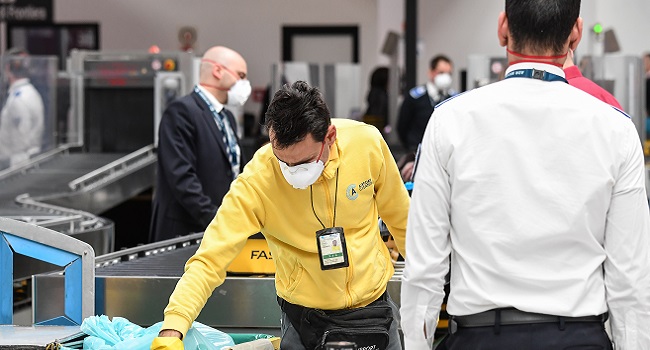
wearing a respiratory mask (C), controls baskets at Rome’s
Fiumicino international airport March 13, 2020.. Andreas SOLARO /
AFP.
“Put your masks on!” repeats the DJ, shouting vainly
into his microphone, but the dancers below, dripping in sweat,
don’t seem to care.
On a recent night at the Kiki nightclub in Ostia, a popular
seaside resort on the outskirts of Rome, the coronavirus threat
seems both distant and yet very present.
During a night for over-50s at this open-air disco on Ostia’s
beachfront, the rules are well known: a mask is mandatory, and
dancing must be done at least one metre from a partner.
“Who cares about all that,” laughed one partygoer, Claudio, his
belly jutting forward and shirt wide open. With his mask in his
pocket, he boogies alone, not to respect social distancing but
because his friends are chatting elsewhere.
Around him, the approximately 200 to 300 party-goers dance to
the blaring electro music, many without masks as they flirt, laugh
and drink gin and tonics in the heat.
It takes the weary insistence of the staff, the calls of the DJ
and a rumour of a possible police raid to get the crowd to comply
begrudgingly and cover their faces.
– Party pooper – While the threat of a second wave of
coronavirus looms nearer in several European countries, such as
Spain, Italy is trying to stem new infections in the middle of
“Ferragosto”, the sacrosanct holiday weekend of August 15.
On Sunday, after a period of arm wrestling between the
government and regions over the thorny issue of discos, Health
Minister Roberto Speranza signed a decree suspending their
operation.
The new rules go into effect on Monday, giving partygoers one
last weekend night to celebrate.
Closed establishments had already been prohibited from operating
but regions had the discretion to decide whether or not to allow
open-air clubs.
Calabria, for one, had ordered the closure of all dance venues
while Sardinia had kept them open. Some, like Veneto to the north,
mandated reduced occupancy.
(adsbygoogle = window.adsbygoogle || []).push({});
Already, traditional rites of summer have been altered. Bonfires
on the beach and a traditional midnight jump into the sea at
Ferragosto were banned this year.
The topic was politically sensitive, as authorities don’t want
to appear to be punishing Italians during well-deserved summer
holidays after a gruelling lockdown that was largely respected.
The sector employs nearly 50,000 people in 3,000 nightclubs
around the country, according to the nightclub operators’ union
(SILB).
– Wild and free? – Images of crowds of young holiday-goers
dancing and drinking at night have been plastered on the front
pages of Italian newspapers.
“The contagion is on the rise but we’re dancing,” proclaimed the
Corriere Della Sera, which slammed Sardinia’s clubs as being
“joyful contagion machines”.
At the establishment Manila Beach in Fregene, on the coast
outside Rome, party organiser Gianluca Skiki said his venue, which
normally welcomes up to 2,000 customers on its beach, had to make
do with 250.
Despite some semblances of a nightclub — a DJ, sequined
miniskirts and high heels worn by some — the experience appeared
odd. Couples were sitting at tables with distance between them to
eat, and were instructed to dance only in front of their
tables.
“If the police come, everyone has to be at their table,” Skiki
explained. “There’s no real nightclub here any more, it’s about the
only thing we’re allowed to organise.”
He acknowledged the experience fell short of the carefree, wild
parties of the past.
AFP
Read more https://swordpress.com.ng/2020/08/17/discos-in-italy-sow-discord-as-partygoers-dance-dance-dance/