
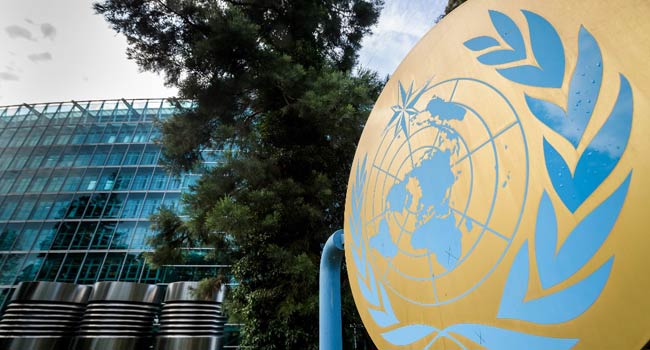
Meteorological Organization (WMO) hosting the 50th session of the
Intergovernmental Panel on Climate Change (IPCC) is seen at the
entrance of the headquarters, on August 2, 2019 in Geneva. PHOTO:
FABRICE COFFRINI / AFP
Long-dormant viruses brought back to life; the
resurgence of deadly and disfiguring smallpox; a dengue or zika
“season” in Europe.
These could be disaster movie storylines, but they are also
serious and increasingly plausible scenarios of epidemics unleashed
by global warming, scientists say.
The COVID-19 pandemic that has swept the globe and claimed over
760,000 lives so far almost certainly came from a wild bat,
highlighting the danger of humanity’s constant encroachment on the
planet’s dwindling wild spaces.
But the expanding ecological footprint of our species could
trigger epidemics in other ways too.
Climate change — already wreaking havoc with one degree Celsius
of warming — is also emerging as a driver of infectious disease,
whether by expanding the footprint of malaria- and dengue-carrying
mosquitos, or defrosting prehistoric pathogens from the Siberian
permafrost.
– ‘Ignorance is our enemy’ –
“In my darkest moments, I see a really horrible future for Homo
sapiens because we are an animal, and when we extend our borders
things will happen to us,” said Birgitta Evengard, a researcher in
clinical microbiology at Umea University in Sweden.
“Our biggest enemy is our own ignorance,” she added. “Nature is
full of microorganisms.”
Think of permafrost, a climate change time bomb spread across
Russia, Canada and Alaska that contains three times the carbon that
has been emitted since the start of industrialisation.
Even if humanity manages to cap global warming at under two
degrees Celsius, the cornerstone goal of the 2015 Paris Agreement,
the permafrost area will decrease by a quarter by 2100, according
to the UN’s climate science panel, the IPCC.
And then there are the permafrost’s hidden treasures.
“Microorganisms can survive in frozen space for a long, long
time,” said Vladimir Romanovsky, a professor of geophysics at the
University of Alaska in Fairbanks.
– An Anthrax comeback? –
As ground thaws, once-frozen soil particles, organic material
and microorganisms that had been locked away for millennia are
carried toward the surface by water flows, he explained.
“That’s how thawing can spread these microorganisms into present
day environments.”
There are already examples of ancient, long-frozen bugs coming
to life.
“When you put a seed into soil that is then frozen for thousands
of years, nothing happens,” said Jean-Michel Claverie, an emeritus
professor of genomics at the School of Medicine of Aix-Marseille
University in France.
“But when you warm the earth, the seed will be able to
germinate,” he added. “That is similar to what happens with a
virus.”
Claverie’s lab has successfully revived Siberian viruses that
are at least 30,000 years old.
These reanimated bugs only attack amoebas, but tens of thousands
of years ago there were certainly others that aimed higher up the
food chain.
“Neanderthals, mammoths, woolly rhinos all got sick, and many
died,” said Claverie. “Some of the viruses that caused their
sicknesses are probably still in the soil.”
The number of bacteria and viruses lurking in the permafrost is
incalculable, but the more important question is how dangerous they
are.
And here, scientists disagree.
“Anthrax shows that bacteria can be resting in permafrost for
hundreds of years and be revived,” said Evengard.
In 2016, a child in Siberia died from the disease, which had
disappeared from the region at least 75 years earlier.
– Two-million-year-old pathogens –
This case has been attributed to the thawing of a long-buried
carcass, but some experts counter that the animal remains in
question may have been in shallow dirt and thus subject to periodic
thawing.
Other pathogens — such as smallpox or the influenza strain that
killed tens of millions in 1917 and 1918 — may also be present in
the sub-Arctic region.
(adsbygoogle = window.adsbygoogle || []).push({});
But they “have probably been inactivated”, Romanovsky concluded
in a study published earlier this year.
For Claverie, however, the return of smallpox — officially
declared eradicated 50 years ago — cannot be excluded. 18th- and
19th-century victims of the disease “buried in cemetaries in
Siberia are totally preserved by the cold,” he noted.
In the unlikely event of a local epidemic, a vaccine is
available.
The real danger, he added, lies in deeper strata where unknown
pathogens that have not seen daylight for two million years or more
may be exposed by global warming.
If there were no hosts for the bugs to infect there would not be
a problem, but climate change — indirectly — has intervened here as
well.
“With the industrial exploitation of the Arctic, all the risk
factors are there — pathogens and the people to carry them,”
Claverie said.
The revival of ancient bacteria or viruses remains speculative,
but climate change has already boosted the spread of diseases that
kill about half a million people every year: malaria, dengue,
chikungunya, zika.
“Mosquitoes moving their range north are now able to overwinter
in some temperate regions,” said Jeanne Fair, deputy group leader
for biosecurity and public health at the Los Alamos National
Laboratory in New Mexico.
“They also have longer breeding periods.”
– ‘Climate change aperitif’ –
Native to southeast Asia, the tiger mosquito (Aedes albopictus)
— which carries dengue and chikungunya — arrived in southern Europe
in the first decade of this century and has been moving rapidly
north ever since, to Paris and beyond.
Meanwhile, another dengue-bearing mosquito, Aedes aegypti, has
also appeared in Europe. Whichever species may be the culprit, the
Europe Centre for Disease Prevention and Control (ECDC) has
registered 40 cases of local transmission of dengue between 2010
and 2019.
“An increase in mean temperature could result in seasonal dengue
transmission in southern Europe if A. aegypti infected with virus
were to be established,” according to the Europe Centre for Disease
Prevention and Control.
As for malaria — a disease that once blighted southern Europe
and the southern United States and for which an effective treatment
exists — the risk of exposure depends in large part on
social-economic conditions.
More than five billion people could be living in
malaria-affected regions by 2050 if climate change continues
unabated, but strong economic growth and social development could
reduce that number to less than two billion, according to a study
cited by the IPCC.
“Recent experience in southern Europe demonstrates how rapidly
the disease may reappear if health services falter,” the IPCC said
in 2013, alluding to a resurgence of cases in Greece in 2008.
In Africa — which saw 228 million cases of malaria in 2018, 94
percent of the world’s total — the disease vector is moving into
new regions, notably the high-altitude plains of Ethiopia and
Kenya.
For the moment, the signals for communicable tropical diseases
“are worrying in terms of expanding vectors, not necessarily
transmission,” said Cyril Caminade, an epidemiologist working on
climate change at the Institute of Infection and Global Health at
the University of Liverpool.
“That said, we’re only tasting the aperitif of climate change so
far,” he added.
AFP
Read more https://swordpress.com.ng/2020/08/16/how-climate-change-could-expose-new-epidemics/