
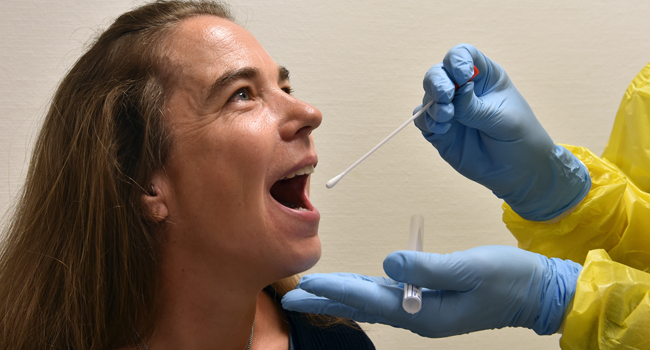
July 10, 2020, patient Heike Abicht poses for a photo of a testing
situation in a corona screening station in the medical centre of
the Franz-Josef-Strauss airport in Munich, southern Germany, amid
the novel coronavirus COVID-19 pandemic. AFP
The number of new coronavirus infections in Germany
topped 2,000 in the past 24 hours, a high not seen since the end of
April, health authorities said Saturday.
The RKI disease control institute said it registered 2,034 new
cases and seven more deaths, taking the total fatalities to 9,267
and confirmed cases to 232,082.
Daily infection counts have increased sharply in recent days,
with authorities suggesting large numbers of returning tourists —
some coming from regions with an elevated risk of transmission —
may be bringing the virus with them.
(adsbygoogle = window.adsbygoogle || []).push({});
Other experts have highlighted a big increase in the number of
tests being carried out.
“The growth we’re presently seeing in the number of cases is
troubling,” Chancellor Angela Merkel’s spokesman Steffen Seibert
said Friday.
“We should be worried,” Seibert added, urging the public to act
“responsibly” by sticking to infection control measures like social
distancing and mask-wearing.
AFP
Read more https://swordpress.com.ng/2020/08/22/germany-records-over-2000-covid-19-cases-in-24-hours/

Sunday Dare
How National Sports Industry Policy will Promote Job
Creation – Dare
The 2020 Draft National Sports Industry Policy has been
generating a lot of interest since it was released to the general
public for review and necessary input. For us in the Ministry,
especially in the light of the Federal Government’s effort to
partner with the private sector in the quest to diversify the
economy and provide a sound footing for the country’s
socio-economic development through investments in non-oil sectors,
we believe this policy is a great step in positioning sports as the
center of development of several ancillary industries associated
with the sector, that will promote sports development and jobs
creation.
It must be emphasized that no development can be meaningful
without outlining government’s statement of intent for the sector,
through a National Policy, and the sports sector cannot be
different. The thrust of the Sports Industrialization Policy is
based on the Concept of the 3Is and 1P – Infrastructure development
based on attracting Incentives backed Investment, all driven by a
robust Policy that sets out how government intends to structure the
process of achieving its objectives of a productive sports
sector.
A structured process to arrive at the policy document was
designed and adopted in collaboration with the private sector as
represented by the NESG. Together we held several engagement
sessions over a 4-month period (November 2019 – March 2020) with
various stakeholders from across sports and non-sports sectors.
The COVID19 pandemic presented challenges on how to harmonise
these sessions into a representation of the goals and objectives of
the stakeholders, but the prevailing reality of non-contact working
protocols meant that the work of drafting the policy had to be done
virtually.
A Road Map was designed and adopted by the Supervising Committee
(Sports Industry Working Group – set up by the Ministry in February
2020 and tasked with several mandates, chief of which was to
deliver a draft National Sports Industry Policy).
The Road Map clearly provided for 6 Phases towards final
approval of the policy by the Federal Government. These processes
are ongoing and will eventually culminate in the presentation of
the Policy for approval by the Federal Executive Council.
It must be noted that this is the first time a draft sports
policy has been made available for the general public for scrutiny
and contribution. On advice of stakeholders, the review period was
extended by 10 days to enable more people to access the document
and send in their views. This stage of the policy development
process ended on Friday 14th August, 2020, and all submitted
reviews are being collated for validation and inclusion into the
draft policy before forwarding to the National Council of Sports
for their input and endorsement.
The Ministry applauds Members of the Supervising Committee as
well as the Policy Drafting Committee for their commitment to the
process and contribution to national development and we are indeed
appreciative of their willingness to serve the nation
selflessly.
While we acknowledge that we may not satisfy the desire of ALL
Nigerians to make a contribution to the policy document, we are
satisfied that the process designed for achieving this draft policy
encompassed stakeholders across the whole spectrum of sports
development.
What we have put in the public domain is a draft and subject to
changes based on constructive feedbacks. The Ministry is committed
to delivering a robust business model for sports industry
development in Nigeria. Sports is an economic activity all over the
world, and Nigeria cannot be different. The process of developing
athletes from raw material to finished product capable of sustained
podium success cannot continue to be a hit or miss affair as we
have done in the past.
The contributions of the private and social enterprise sectors
into developing the sports value chain cannot be ignored any longer
if we are to harness the full potential and power of sports for
both social and economic development.
The new National Sports Industry Policy is a first step towards
achieving this goal. We therefore call on all Stakeholders to
embrace the process and assist in delivering on this objective.
Lere-Adams. A.B.
Director Press.