
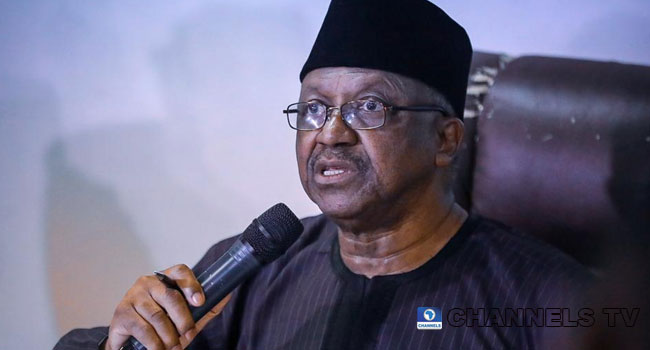
Health, Dr Osagie Ehanire, at a press conference in Abuja. Channels
TV/ Sodiq Adelakun.
The Federal Government has lauded the historic
certification of Nigeria and Africa as a polio-free country and
continent, respectively.
In a statement on Tuesday, the government welcomed the
development as “a glorious day for Nigeria” and fulfilment of
President Muhammadu Buhari’s promise.
It noted that the President had given the assurance that his
administration would provide the necessary resources to strengthen
the health system, routine immunisation, and ensure the country was
certified polio-free.
Reacting to the feat recorded, the Minister of Health, Dr Osagie
Ehanire, described it as the fulfilment of President Buhari’s
promise and the resilient spirit of Nigerians, especially frontline
health workers who gave Nigeria the pride of place in the comity of
nations.
“It is indeed one of the greatest dividends of the present
administration,” he was quoted as saying in a statement by Mohammad
Ohitoto who is the Head of Public Relations Unit at the National
Primary Health Care Development Agency (NPHCDA).
The Executive Director and Chief Executive of NPHCDA, Dr Faisal
Shuaib, could not agree less with the minister on polio eradication
in Nigeria.
“It is one classical example of human resilience, wherein the
face of adversity, in spite of numerous setbacks, over the course
of almost three decades, Nigerians came together, relentlessly
worked hard with our donors and development partners to eradicate
polio,” he stated.
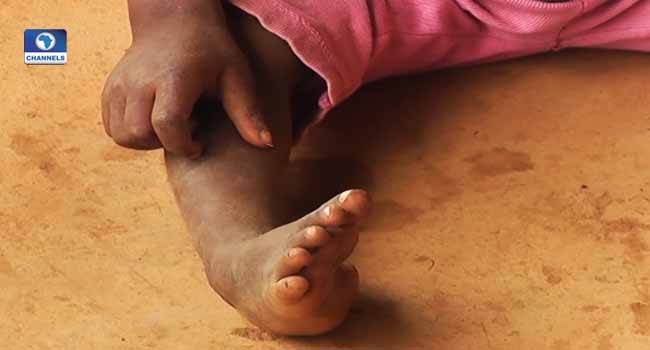
deformed leg.
The NPHCDA boss added that the history of polio eradication in
Nigeria was evidence of how the health system could work
collaboratively with the community and religious leaders to
eradicate any disease.
(adsbygoogle = window.adsbygoogle || []).push({});
He stressed that the use of the polio eradication strategy
contributed immensely to the rapid control of the Ebola virus
outbreak in 2014.
Shuaib, who coordinated the Ebola outbreak response, revealed
that the lessons learned from the success of polio eradication “is
exactly what we’re using with the COVID-19 outbreak response.”
He said the recent feat did not come easy as it has been a long
and arduous journey, with great efforts and investment from the
government, donors, as well as local and international
partners.
The NPHCDA boss listed them to include Rotary International,
Bill and Melinda Gates Foundation, Aliko Dangote Foundation, WHO,
Unicef, CDC, USAID, Gavi, EU, Global Affairs Canada, DFID, World
Bank, JICA, KfW, and the Nigeria Governors’ Forum, to mention a
few.
He pointed out that the major problem the programme faced was
insecurity, saying it affected the effort at achieving polio
eradication.
Shuaib, however, believes the polio programme was able to
surmount this problem and others through the establishment of the
Presidential Task Force on Polio Eradication, the Polio Emergency
Operation Centers (EOC), the Northern Traditional Leaders Committee
on Polio Eradication led by the Sultan of Sokoto, among others.
He attributed the achievement to the leadership provided by
President Buhari, Ehanire, traditional and religious leaders, local
and international partners, all health workers, and the Nigerian
populace.
The NPHCDA also dedicated the certification to the memory of all
those who lost their lives in the cause of polio eradication,
describing them as Polio Heroes.

of Justice
Malami: I need No Power to Supervise EFCC
The Honourable Attorney-General of the Federation and Minister
of Justice, Abubakar Malami, SAN has said that the office of the
AGF does not need the tinkering of the current Economic and
Financial Crime (Establishment) Act 2004 to enable him regulate the
Institution and could therefore not, in any ways, seek to sponsor
any bill for “more powers to control the commission”.
Malami in a statement issued by his Special Assistant
on Media, Dr. Umar Jibrilu Gwandu,
on Tuesday 25th August 2020 , said he requires no
additional powers to effectively regulate agencies under his
supervision.
The statement read: “it is trite to say that by virtue of the
extant laws of the land as well as rules and legislations governing
the conduct of the governmental operations, the Attorney-General of
the Federation has
indisputable statutory powers to regulte the operations of the
commissions without recourse to any additional legislations.
“Section 43 of the EFCC Act has made it abundantly clear that
“the Attorney General of the Federation may make rules or
regulations with respect to the exercise of any of the
duties, functions or powers of the Commission
under this Act”.
“For the avoidance of doubt, the Attorney General of the
Federation and Minister of Justice believes in the doctrines of
separation of powers as an epitome character of the
democratic administration and could
not therefore meddle into the affairs of legislature for
megalomaniac sake”.
“It is a global practice in democratic societies that the
legislature may at their discretion and as deem fit, spearhead the
amendment of existing legislations in order to accommodate certain
exigencies occasioned by contemporary realities and the
need to improve performance to achieve best practices without any
prompting from external organs of the government.
“At the moment, the priority of the Office of the
Attorney-General of
the Federation and Minister of Justice is to see to the effective
execution of its statutory mandates of supervising all the
parastatals under the Federal Ministry of Justice in a way that
make them function in the best interest of the general public,
which constitutional responsibility he is engaged by
President Muhammadu Buhari to discharge”.
Modupe Ogundoro
Deputy Director
25th August, 2020