
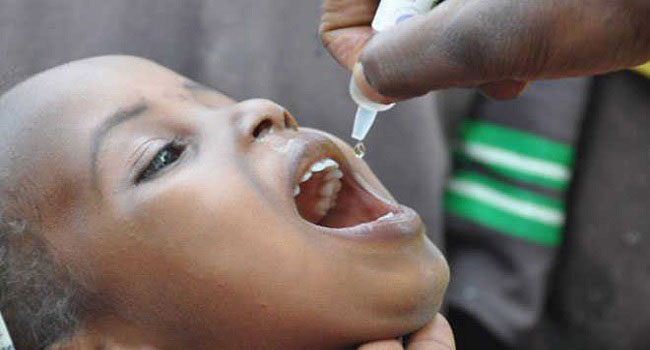
The World Health Organization (WHO) is set to certify on
Tuesday that the African continent is free from wild polio, four
years after the last cases appeared in northeastern
Nigeria.
“Thanks to the relentless efforts by governments, donors,
frontline health workers and communities, up to 1.8 million
children have been saved from the crippling life-long paralysis,”
the WHO said in a statement.
The official announcement is due at 1500 GMT in a
videoconference with WHO director-general Tedros Adhanom
Ghebreyesus and key figures including philanthropist and Microsoft
founder Bill Gates.
“Happiness is an understatement. We’ve been on this marathon for
over 30 years,” said Tunji Funsho, a Nigerian doctor and local
anti-polio coordinator for Rotary International.
He said it marked a crucial step in the total eradication of the
illness at the global level.
“It’s a real achievement, I feel joy and relief at the same
time,” he added.
Poliomyelitis, or “wild polio” is an acutely infectious and
contagious disease which attacks the spinal cord and causes
irreversible paralysis in children.
It was endemic around the world until a vaccine was found in the
1950s, though this remained out of reach for many poorer countries
in Asia and Africa.
As late as 1988, the WHO counted 350,000 cases globally, and in
1996 said there were more than 70,000 cases in Africa alone.
Thanks to a rare instance of collective global effort and
financial backing — some $19 billion over 30 years — only
Afghanistan and Pakistan have recorded cases this year: 87 in
total.
– Trust – Nigeria, a country with 200 million inhabitants, was
still among the trouble-spots in the early 2000s.
In its northern Muslim-majority areas, authorities were forced
to stop vaccination campaigns in 2003 and 2004 by Islamic
extremists who claimed it was a vast conspiracy to sterilise
young Muslims.
It took a huge effort in tandem with traditional chiefs and
religious leaders to convince populations that the vaccine was
safe.
“People trust their local traditional leaders who live with them
more than the political leaders,” said Grema Mundube, a community
leader in the town of Monguno, in the far north of Nigeria.
“Once we spoke to them and they saw us immunising our children
they gradually accepted the vaccine,” he told AFP.
However, the emergence of violent Islamist group Boko Haram in
2009 caused another rupture in the programme. In 2016, four new
cases were discovered in Borno state in the northeast in the heart
of the conflict.
(adsbygoogle = window.adsbygoogle || []).push({});
“At the time, we couldn’t reach two-thirds of the children of
Borno state — 400,000 children couldn’t access the vaccine,” said
Dr Funsho.
– Inaccessible children – The security situation remains highly
volatile in the region, with the jihadists of Boko Haram and a
local Islamic State affiliate controlling vast areas around Lake
Chad and the border with Niger.
“International agencies, local governments, donors — all
partners took the bull by the horns to find new strategies to
manage to reach these children,” said Dr Musa Idowu Audu,
coordinator for the WHO in Borno.
In these “partially accessible” areas, vaccination teams worked
under the protection of the Nigerian army and local self-defence
militias.
For areas fully controlled by the jihadists, the WHO and its
partners sought to intercept people coming in and out along market
and transport routes in a bid to spread medical information and
recruit “health informants” who could tell them about any polio
cases.
“We built a pact of trust with these populations, for instance
by giving them free medical supplies,” said Dr Audu.
Today, it is estimated that only 30,000 children are still
“inaccessible”: a number considered too low by scientists to allow
for an epidemic to break out.
Despite the “extreme happiness and pride” felt by Dr Audu, he
never fails to remember the 20 or more medical staff and volunteers
killed for the cause in northeast Nigeria in recent years.
The challenge now is to ensure that no new polio cases arrive
from Afghanistan or Pakistan and that vaccinations continue to
ensure that children across the continent are protected from this
vicious disease.
“Before we couldn’t sleep at all. Now we will sleep with one eye
open,” said Dr Funsho.
Read more https://swordpress.com.ng/2020/08/25/africa-to-be-declared-polio-free/