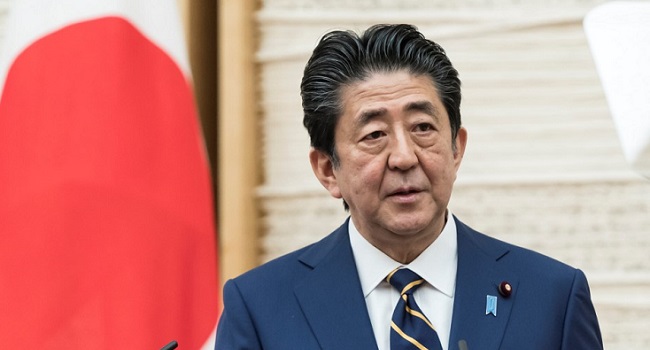
Minister Shinzo Abe speaks during a press conference at the prime
minister’s official residence in Tokyo on April 7, 2020. Tomohiro
Ohsumi / POOL / AFP.
Shinzo Abe has smashed records as Japan’s
longest-serving prime minister, championing ambitious economic
reform while weathering scandals. But he has once again been undone
by his health.
After more than seven years in the job, Abe, 65, said
Friday he would be stepping down because of a recurrence of the
ulcerative colitis that forced him from office during his first
stint as premier.
He had been due to stay on until September 2021, when his party
presidency terms ends, giving him an opportunity to see out one
final event in his historic tenure — the postponed Tokyo 2020
Olympics Games.
A sprightly 52 years old when he first became prime minister in
2006, Abe was the youngest person ever to occupy the job,
and was seen as a symbol of change and youth.
But in a country that sets much store by tradition, he also
brought the pedigree of a third-generation politician groomed from
birth by an elite, conservative family.
His first term was turbulent; shot through with scandals and
discord, and capped by an abrupt resignation that made him the
latest in a succession of short-lived Japanese prime ministers.
After initially suggesting he was stepping down for political
reasons, he subsequently acknowledged he was suffering an ailment
later diagnosed as ulcerative colitis.

Minister Shinzo Abe speaks during a press conference at the prime
minister’s official residence in Tokyo on April 17,
2020./AFP
The debilitating bowel condition necessitated months of
treatment, but was, he said, eventually overcome with the help of
new medication.
The revolving prime ministerial door brought him back to office
in 2012 — and, until Friday, had stayed shut for an unusually long
time.
With Japan still staggering from the effects of the 2011 tsunami
and subsequent nuclear disaster at Fukushima — and with its
inexperienced government lashed for flip-flopping and incompetence
— the wily veteran offered a seemingly safe pair of hands.
He also had a plan. He called it Abenomics.
The scheme to revive Japan’s long-stalled economy — still the
world’s third biggest, but more than two decades into stagnation —
involved vast government spending, massive monetary easing and the
cutting of red tape.
He also sought to boost the country’s flagging birth rate by
making workplaces more friendly to parents, particularly mothers,
and pushed through controversial consumption tax hikes partially
intended to help fund free nursery school places for children, and
plug gaps in Japan’s overstretched social security system.
(adsbygoogle = window.adsbygoogle || []).push({});
While there was some progress with reform, the bigger structural
problems for the economy never really went away. Abenomics was not
enough to right the deflation that has beset Japan for decades, and
growth has remained anaemic.
The economy had swung into reverse even before the coronavirus
crisis wiped out remaining gains.
Abe’s star has waned further in recent months with his pandemic
handling criticised as confused and slow, driving his approval
ratings down to some of the lowest of his tenure.
Mixed record
On the international stage, he has taken a hard line on North
Korea, but sought a peacemaker role between the US and Iran.
He prioritised building a close personal relationship with
Donald Trump in a bid to protect Japan’s key alliance, despite the
US president’s “America First” mantra, and tried to heal ties with
Russia and China.
But here too the scorecard is mixed: Trump is reportedly still
eager to force Japan to pay more for US troops stationed in the
country; Tokyo has failed to make progress in resolving the status
of northern islands disputed with Russia, and a plan to invite Xi
Jinping for a state visit has fallen by the wayside amid growing
domestic discontent with Beijing.
And while Abe has not repeated a 2013 visit to a
controversial war shrine that sparked regional anger and even a US
rebuke, he has pursued a hard line with South Korea over unresolved
wartime disputes and continued to float plans to revise the
country’s pacifist constitution.

Abe (2nd L) and Health Minister Katsunobu Kato (L) attend a meeting
of the new COVID-19 coronavirus infectious disease control
headquarters at the prime minister’s office in Tokyo on February
14, 2020. STR / JIJI PRESS / AFP
Throughout his tenure, he has weathered political storms
including cronyism allegations that have dented his approval
ratings, but done little to affect his power, in part thanks to the
weakness of Japan’s political opposition.
But even faced with a paucity of alternatives, many voters have
tired of Abe.
Speaking to AFP on the streets of Tokyo, Tetsuya Daimon lamented
a litany of scandals, and said it was time for Abe to
go.
“He has been in the prime minister’s office way too long,” said
Daimon.
“I don’t want to see his face, honestly. Seven years and eight
months, too long!”
AFP
Read more https://swordpress.com.ng/2020/08/29/shinzo-abe-political-survivor-dogged-by-health-issues/