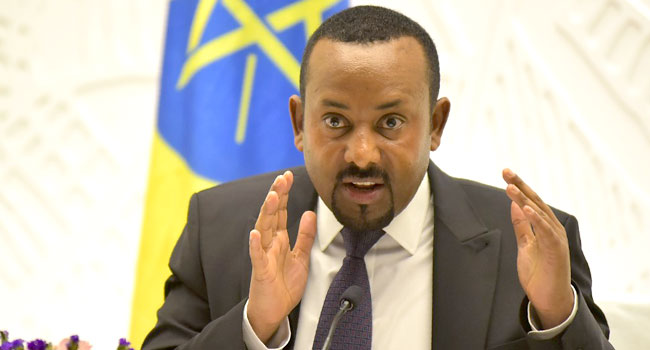
August 01, 2019 Ethiopia’s Prime Minister Abiy Ahmed gives a press
conference at the Prime Minister’s office in the capital, Addis
Ababa. MICHAEL TEWELDE / AFP
Prime Minister Abiy Ahmed on Thursday ordered Ethiopia’s
army to launch a “final” offensive against Tigray’s dissident
leaders in their regional capital Mekele, saying the deadline for
their surrender had expired.
Abiy, the winner of last year’s Nobel Peace Prize, late Sunday
gave the Tigray People’s Liberation Front (TPLF) 72 hours to lay
down their arms.
The ultimatum was rejected by the leaders of the region, whose
forces have been fighting federal troops in the country’s north for
three weeks.
The violence has claimed hundreds of lives and displaced more
than 40,000, with some refugees claiming Thursday that Ethiopia’s
army has blocked a main road to Sudan, preventing those fleeing the
conflict from crossing the border.
Ethiopia’s army — which in recent days said it was advancing on
Mekele with tanks — have been directed “to conclude the third and
final phase” against the TPLF, Abiy said.
“In this final phase, great care will be given to protect
innocent civilians from harm. All efforts will be made to ensure
that the city of Mekele, which was built through the hard work of
our people, will not be severely damaged,” Abiy promised.
He said “thousands” of TPLF militia and special forces had
surrendered to federal forces before the deadline lapsed.
It was not immediately clear how close the army was to the city.
A communications blackout in Tigray and restrictions on reporting
have made verifying claims from both sides difficult.
– ‘Carefully devised’ strategy – Diplomats
briefed on the fighting told AFP on Wednesday that federal forces
were at least 30 kilometres (18 miles) from Mekele to the north and
the south.
The threatened assault and fears for Mekele’s half a million
inhabitants accelerated diplomatic efforts to mediate, with the UN
Security Council holding its first meeting on the crisis on
Tuesday.
READ ALSO: At Least 40 Miners Trapped In Zimbabwe’s Mine
Shaft Collapse
UN Secretary-General Antonio Guterres urged “the leaders of
Ethiopia to do everything possible to protect civilians” as the US,
EU and other international powers encouraged mediation through the
African Union (AU), which is headquartered in Addis Ababa.
Rights groups have warned bombarding Mekele could constitute a
war crime.
“Despite the Ethiopian military’s warnings to residents,
warnings alone do not absolve the government of its oblig ation to
take constant care to protect civilians, particularly when using
airpower and heavy weaponry” in congested urban areas, Human Rights
Watch said.
(adsbygoogle = window.adsbygoogle || []).push({});
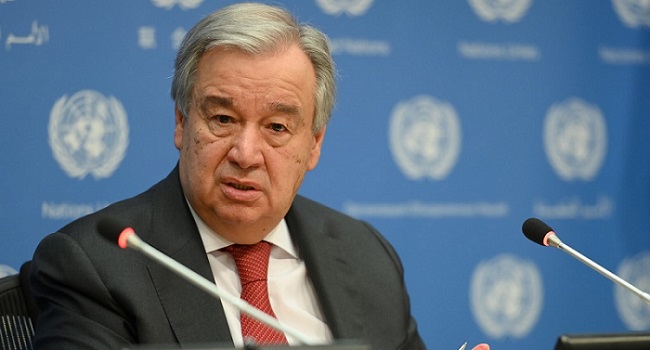
February 4, 2020 United Nations Secretary General Antonio Guterres
speaks during a press briefing at United Nations Headquarters in
New York City. (Photo by Angela Weiss / AFP)
Abiy stressed that Ethiopia’s defence forces had “carefully
devised” a strategy to defeat the TPLF in Mekele without harming
civilians or public property.
“We call on the people of Mekele and its environs to disarm,
stay at home and stay away from military targets” and assist by
handing over TPLF elements in their midst, Abiy said.
– Humanitarian crisis – Abiy ordered troops
into Tigray on November 4 following alleged attacks by TPLF forces
on federal military camps in the region.
He has resisted appeals for talks. His government signalled it
would meet the AU envoys “as a matter of respect”, but flatly
refused to negotiate.
As international pressure mounted this week, Abiy issued a
strongly-worded statement rejecting outside “interference” in what
he labelled an internal “law enforcement” operation.
Since the fighting began, rockets have fallen on the Eritrean
capital Asmara and Ethiopian cities outside Tigray, spurring fears
the conflict could destabilise the wider Horn of Africa region.
Hundreds have reportedly been killed, although an accurate
figure is not known. Ethiopia’s rights watchdog this week said at
least 600 civilians were massacred in the Tigrayan town of
Mai-Kadra alone.
The UN, in its latest crisis report, said shortages of cash and
fuel were “very critical” in Tigray and humanitarians were
struggling to meet needs.
Abiy committed Thursday to opening a humanitarian access route
into Tigray and working with the UN and other aid agencies to help
those in need.
More than 40,000 people have crossed into eastern Sudan, where
the UN says a “full-blown humanitarian crisis is unfolding” in one
of the country’s poorest regions.
“The numbers are way above the state’s capabilities,” Soliman
Ali, the governor of the border state of Gedaref, told AFP.
The number of refugees arriving in Sudan has fallen sharply in
the last week. Refugees arriving in eastern Sudan on Thursday
accused Ethiopia’s army of blocking a road at Humera near the
border.
“Those seeking to reach Sudan must avoid the main road and pass
through fields without being seen by soldiers,” said Tesfai
Burhano, who had just arrived at the Lugdi crossing point.
The TPLF led the overthrow of Mengistu Hailemaria, leader of
Ethiopia’s military Derg regime, in 1991 and dominated the
country’s politics until Abiy became prime minister in 2018.
Since then, TPLF leaders have complained of being sidelined by
Abiy and blamed for the country’s woes, and tensions have flared
between the regional leadership and the federal government in Addis
Ababa.
Read more https://swordpress.com.ng/2020/11/27/ethiopia-pm-orders-final-offensive-against-tigray-leaders/

The Kingdom of Netherlands on Thursday officially presented a
smuggled Ife Terracotta antiquity dated to be at least 600 years
old to Nigeria.


The repatriated antiquity was presented to the Minister of
Information and Culture, Alhaji Lai Mohammed at a ceremony held in
Abuja.

The Minister of Foreign Affairs, Geoffrey Onyema, Netherlands
Ambassador to Nigeria, Harry Van Dijk, Nigeria Charge de Affairs to
Netherlands, Kabiru Musa and the Director-General National
Commission for Museum and Monuments (NCMM) were present at the
event.
Receiving the repatriated object, the minister said it was
smuggled through the airport in Ghana before getting to Europe in
2019.
“The smuggler had obtained forged documents purported to be from
a former Director-General of the National Commission for Museums
and Monuments.
“The smuggler ultimately passed through the airport in Ghana
before getting to Europe in 2019.
“The Dutch Customs at Schiphol Airport suspected that the object
might be illicitly imported and alerted the antiquity protection
office known as the Inspectie, which is the Information and
Heritage Inspectorate of the Netherlands, to give an opinion.
“The Inspectie invited Nigeria to prove her case against the
suspected smuggler,’’ he said.
In proving the case, Mohammed said the NCMM acted swiftly by
dispatching its lawyer, Mr Babatunde Adebiyi, to present evidence
and argue for the return of the object.
He said Nigeria was successful in the case and the claim was
determined in its favour.
Mohammed said after all internal procedures, including the right
of appeal, were exhausted, the Government of the Netherlands handed
over the object to the Nigerian Embassy in Hague on Nov. 2.
He noted that with the repatriation of the “priceless and
timeless’’ artefact the federal government efforts at pursuing the
return of Nigerian antiquities had started yielding fruits.
The minister underscored the need for Nigeria to tap into
tourism and other fields, where Nigeria has comparative advantages,
in order to generate income for the nation and secure jobs for the
youth.
“One way of generating income for the country is if our cultural
properties are exhibited around the world to a fee-paying audience,
on the basis of proper agreement that acknowledges us as owners and
confers the right benefits on us.
“But this is not possible for as long as most of them adorn the
museums and private collections of others, who describe them as
their properties,’’ he said.
The minister reiterated Nigeria commitment to joint
international efforts to put a stop to illicit export and import of
cultural goods.
He said Netherland and Nigeria will make a joint presentation on
the repatriation to the UNESCO Secretariat in Paris, so that other
nations might take a cue from it in finding rapprochement and
common ground concerning the issue of return of antiquities.
On his part, Onyema said it is a happy day for Nigeria because
there are many Nigerian cultural assets around the world which have
become difficult to track.
He said some of the assets were taken out of the country for
over 100 years back and some more recently.
The minister said there is underground illegal market for
cultural asset which has made them difficult to identify, retrieve
and repatriate.
Onyema said the government is committed to the restitution of
all the nation’s cultural assets illegally taken and litter across
the globe
Musa said the repatriation was made possible in compliance with
the 1970 UNESCO Convention on the Prevention of Illegal Trafficking
of Cultural Heritage which Nigeria and Netherlands are
signatories.
He said that the return of the smuggled artefact was significant
considering the fact that it coincided with 50 years-celebration of
the UNESCO Convention.