
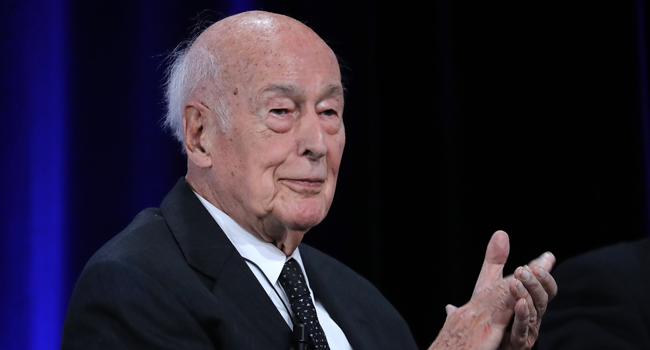
June 20, 2019 Former French President Valery Giscard d’Estaing
applauds at the conference of the 50th anniversary of the election
of Georges Pompidou to the Presidency of the Republic “With Georges
Pompidou, think France: inheritances and perspectives” in Paris.
JACQUES DEMARTHON / AFP
Former French president Valery Giscard d’Estaing, a
leading advocate of European integration who led his country into a
new modern era, has died of Covid-19, his family said. He was
94.
Giscard, who had been in hospital several times in recent months
for heart problems, died late Wednesday “surrounded by his family”
at the family home in the Loire region.
“His state of health had worsened and he died as a consequence
of Covid-19,” the family said in a statement sent to AFP, adding
that his funeral would be strictly private, according to his
wishes.
French President Emmanuel Macron paid tribute to his
predecessor, saying Giscard’s seven-year term had “transformed
France”.
“His death has plunged the French nation into mourning”, Macron
said, describing Giscard as “a servant of the state, a politician
of progress and freedom”.
READ ALSO: 2020 Is One Of The Three Hottest
Years Ever, Says UN
Giscard made one of his last public appearances on September 30
last year for the funeral of another former president, Jacques
Chirac, who had been his prime minister.
He became the 20th century’s youngest president at 48 when in
1974 he beat his Socialist rival Francois Mitterrand, to whom he
then lost after his seven-year term in 1981 in a failed re-election
bid.
His presidency marked a clear break from the Gaullist
conservatism of postwar France, which had been dominated by Charles
de Gaulle and his successor Georges Pompidou.
In France, he is remembered for his radical reform drive, which
included the legalisation of abortion, the liberalisation of
divorce and the lowering of the voting age to 18.
In Europe, he helped drive moves towards a monetary union, in
close cooperation with his German counterpart chancellor Helmut
Schmidt, with whom he became friends and whose leadership years
almost overlapped with his own.
Together they launched the European Monetary System (EMS), a
precursor of today’s single currency, the euro.
“For Valery Giscard d’Estaing, Europe was to be a French
ambition and France a modern nation. Respect,” said Michel Barnier,
the EU’s chief Brexit negotiator.
He “succeeded in modernising political life in France,” added
former French president Nicolas Sarkozy, praising the “great
intelligence” he used to master “even the most complex
international problems”.
(adsbygoogle = window.adsbygoogle || []).push({});
Like Schmidt, Giscard was also a firm believer in strong ties
with the US.
With his death, France “has lost a statesman who chose to open
up to the world”, added Sarkozy’s Socialist successor Francois
Hollande. He hailed a man who was “resolutely European” who helped
strengthen Franco-German unity.
It was at Giscard’s initiative that leaders of the world’s
richest countries first met in 1975, an event that evolved into the
annual summits of the Group of Seven (G7) club.
‘A job unfinished’
With a more relaxed presidential style than his predecessors,
“VGE” was sometimes seen in public playing football or the
accordion.
He also hosted garbage collectors to breakfast and invited
himself to dinner at the homes of ordinary citizens.
Giscard involved his family in his political appearances, had
the blue and red of France’s “tricolore” flag toned down, and the
Marseillaise national anthem slowed.
Giscard was firmly part of the elite.
Tall and slender and with an elegant, aristocratic manner, he
studied at France’s exclusive Ecole Polytechnique and the National
Administration School.
Aged just 18, he joined the French resistance in World War II
and took part in the liberation of Paris from its Nazi
occupiers in 1944. He then served for eight months in Germany and
Austria.
He launched his political career in 1959, becoming finance
minister in 1969.
After his defeat in 1981 — which he said left him with
“frustration at a job unfinished” — he remained active in centrist
politics, first regaining a seat in the French parliament and then
serving in the European Parliament.
In 2001, he was selected by European leaders to lead work on the
bloc’s constitutional treaty — which French voters then
rejected.
After losing his legislative seat, he ended his active political
career in 2004.
The death of Mitterrand in 1996 followed by that of his
successor Chirac in 2019 had left Giscard as France’s oldest
surviving leader by far.
In May 2020, French prosecutors opened an investigation after
claims by a German reporter that he had repeatedly inappropriately
touched her at his Paris office after an interview in 2018.
But Giscard strongly denied the allegations, describing them as
“grotesque”.
AFP
Read more https://swordpress.com.ng/2020/12/03/france-mourns-ex-president-giscard-destaing/