
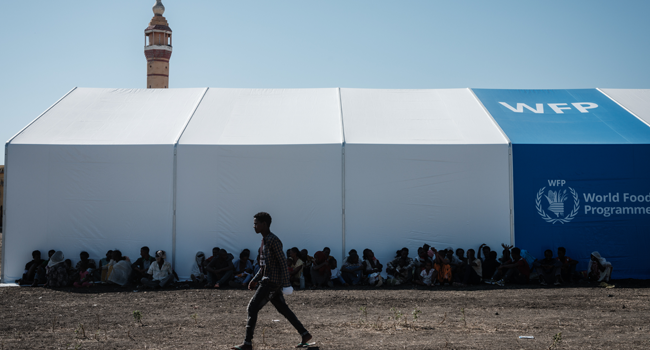
Tigray conflict rest in the shadow of a warehouse erected by the
World Food Programme (WFP) at Village Eight transit centre near the
Ethiopian border in Gedaref, eastern Sudan, on December 2, 2020.
Yasuyoshi CHIBA / AFP
Ethiopia has granted the United Nations access to
deliver aid to the northern region of Tigray, following weeks of
lobbying amid military operations there, according to an agreement
seen by AFP on Wednesday.
The agreement, signed by Ethiopia’s peace minister, comes
four weeks after Prime Minister Abiy Ahmed sent in troops and
warplanes in a campaign targeting leaders of the region’s ruling
party, the Tigray People’s Liberation Front (TPLF).
Thousands have died in subsequent fighting, according to the
International Crisis Group, while tens of thousands have fled into
neighbouring Sudan.
The UN has been warning of a possible humanitarian catastrophe
within Tigray, though a communications blackout has made it
difficult to assess conditions on the ground.
“We signed an agreement giving unconditional access for
humanitarian assistance wherever people are in need” in Tigray, a
senior UN official told AFP Wednesday.
A second senior UN official also said it applied to all of the
region’s roughly six million population.
READ ALSO: Tigray Leader Vows To Fight On After
Abiy Declares Victory
Two assessment missions launched on Wednesday and more are
expected soon, the officials said.
The text of the agreement states that “the UN and humanitarian
partners” can access “vulnerable populations in
(government)-administered areas in Tigray and bordering areas of
Amhara and Afar regions”.
Abiy declared victory on Saturday night, saying that military
operations in Tigray were “completed” — but the TPLF has vowed to
fight on.
Senior Tigrayan official Wondimu Asamnew claimed Wednesday that
federal forces were “encountering low-scale warfare all over
Tigray” and that pro-TPLF fighters would launch a “full-scale
offensive… in the near future”.
Wondimu also said in a statement that the TPLF had carried out a
“strategic retreat” without sustaining heavy losses.
It is unclear if the government has control over the entire
region, raising questions about whether the UN will actually have
full access.
A spokeswoman for Abiy’s office did not respond to a request for
comment Wednesday.
Food running out
Before the fighting began, around 600,000 people living in
Tigray depended on food handouts, among them 96,000 Eritrean
refugees.
(adsbygoogle = window.adsbygoogle || []).push({});
The agreement notes that the region was also home to 42,000
malnourished women and children as well as 100,000 internally
displaced people.
Food, fuel and cash are in short supply, according to the UN
Office for the Coordination of Humanitarian Affairs, while the
International Committee of the Red Cross says basic medical
equipment is lacking.
On Tuesday the UN refugee agency warned that Eritrean refugees
in Tigray were believed to have run out of food, saying concerns
for their welfare were “growing by the hour”.
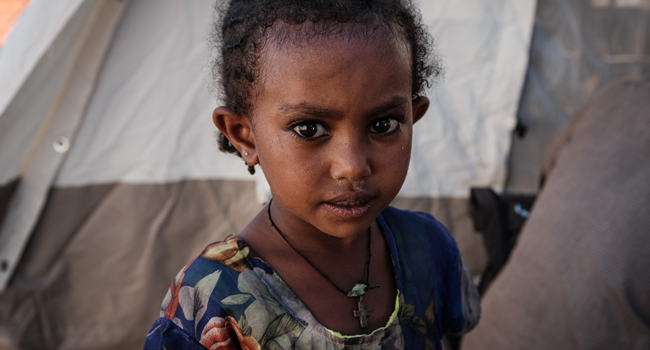
girl poses for a photograph at the Village Eight transit centre
which hosts Ethiopian refugees who fled the Ethiopia’s Tigray
conflict near the Ethiopian border in Gedaref, eastern Sudan, on
December 2, 2020.Yasuyoshi CHIBA / AFP
Meanwhile, communications are returning to parts of Tigray.
Ethio Telecom, the country’s monopoly telecommunications
provider, said Wednesday that services had partially resumed in
cities including Humera, Dansha, Mai-Kadra and Mai-Tsebri.
It said services had fully resumed in the southern Tigray town
of Alamata, and that officials were “working to restore telecom
services in all areas of the region”.
Caretaker administration
Abiy intends to establish a caretaker administration in Tigray
headed by Mulu Nega, formerly a senior official in Ethiopia’s
higher education ministry.
On Wednesday Mulu announced administrators had been installed in
the Tigray town of Shire, according to a report by the
state-affiliated Fana Broadcasting Corporate.
Analysts warn, however, that Mulu’s administration could meet
resistance from the Tigrayan population.
The TPLF dominated Ethiopian politics for nearly three decades
before anti-government protests swept Abiy to power in 2018.
Since then TPLF leaders have complained of being removed from
top positions, targeted in corruption prosecutions and broadly
scapegoated for the country’s woes.
Tensions escalated dramatically after Tigray went ahead with
regional elections in September, defying a nationwide ban on polls
because of the coronavirus pandemic.
Federal officials declared the Tigray elections “illegal”, while
the TPLF dismissed Abiy as an illegitimate ruler.
Ethiopia’s electoral board has said it expects to hold national
elections in mid-2021.
Abiy met on Wednesday with political party and civil society
representatives to discuss those preparations, according to his
office.
Those in attendance discussed issues including “not rushing to
elections without putting the necessary foundations in place” and
“ensuring the primacy of rule of law preceding the elections”.
No details were provided on how these considerations might
affect the timeline.
The delayed elections are seen as a critical milestone for the
democratic reforms Abiy promised to deliver when he took office
AFP
Read more https://swordpress.com.ng/2020/12/03/un-granted-unconditional-aid-access-to-ethiopias-tigray/