
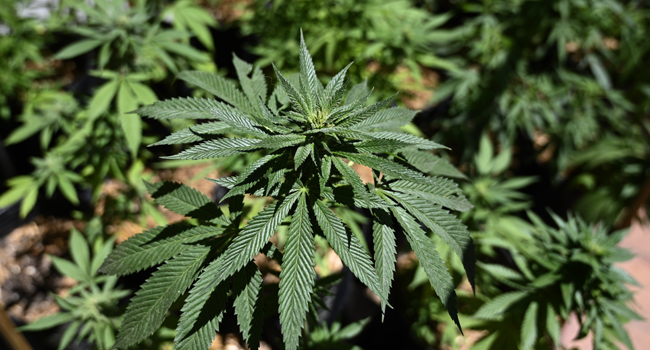
house of Valeria Rivera -a member of the self-managing NGO “Mama
cultiva” (Mom grows)- in Buenos Aires on November 19, 2020. JUAN
MABROMATA / AFP
US House legislators voted for the first time Friday to
decriminalize cannabis, a major step towards bringing federal laws
in line with states and other countries that have freed up use of
the drug.
The House of Representatives, controlled by Democrats, easily
passed the bill by 228 votes to 164. It stands little chance
however in the Senate, which is controlled by Republicans.
The bill would remove marijuana from the federal Controlled
Substances Act, which listed it beside heroin and cocaine as a
dangerous narcotic and mandated tough penalties.
The drug’s inclusion on the list has left the US federal
government out of line with the many states which have legalized
marijuana for medical use and some, like Colorado, which have
completely freed and regulated it for recreational use.
The bill was the culmination of five decades of supporters
lobbying to have the federal government recognize the relatively
low harm inflicted by cannabis usage compared to other drugs, as
well as the failure to stifle the trade while jailing hundreds of
thousands of people for minor offenses.
It would see the records of many people arrested for marijuana
use expunged, and calls for the review of the sentences of those
currently jailed on federal cannabis charges.
And it would let states set their own laws but also launch
federal regulation and taxation of the industry, as it does for
alcohol.
“This is a historic moment,” said Democratic Representative
Tulsi Gabbard, who has pushed the legislation.
Out of step
Democrats argued that Black Americans have suffered legally much
more than whites for arrests and convictions; that federal
decriminalization would allow injured veterans better access to
medical marijuana; and that longstanding federal blocks on
marijuana research would end.
(adsbygoogle = window.adsbygoogle || []).push({});
Democrat Earl Blumenauer noted that marijuana usage tests by
employers and police are poor and not completely reliable.
“We don’t have a good test and the federal prohibition on
research stands in the way of this.”
Some Republicans argued that the bill will encourage usage.
Others said it will create another layer of bureaucracy and
taxation in the Treasury department.
One noted that it will place a federal tax of only five percent
on cannabis, a fraction of that for tobacco.
But California Republican Tom McLintock said he favored the bill
because legalizing and regulating cannabis would take the industry
out of the hands of violent growers and traffickers.
McClintock represents a district covering a large section of the
Sierra Nevada mountains, where illegal marijuana plantations are
relatively common guarded by heavily armed gangs.
“I think marijuana use is a pretty bad idea. My wife and I have
never gone near the stuff,” McClintock said before the vote.
However, he said, “We have to recognize that the prohibition law
has done far more harm. It has spawned a violent underground
economy.”
“Radish farmers don’t kill each other over territory.”
Increasingly the US federal approach is out of line with
international trends.
Northern neighbor Canada fully legalized marijuana in 2018, and
has a number of large companies growing it commercially.
And Mexico also took a step closer to legalizing marijuana for
recreational and medicinal use last month as the Senate approved a
bill aimed at undermining the violent gangs that control supply of
the drug, much of it destined for the United States.
On Wednesday the UN Commission on Narcotic Drugs voted to remove
cannabis from Schedule IV of the 1961 Single Convention on Narcotic
Drugs , where it was included alongside deadly opioids like
heroin.
Read more https://swordpress.com.ng/2020/12/05/us-lawmakers-back-decriminalisation-of-cannabis/