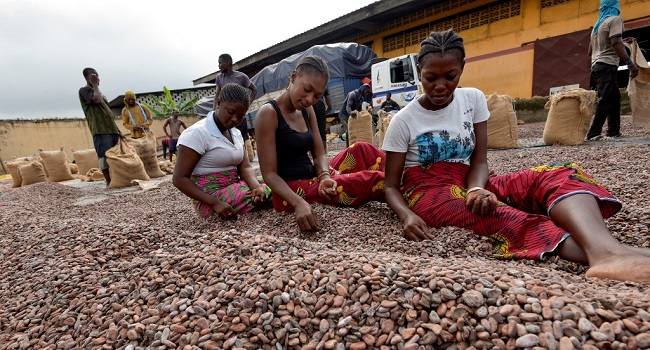
— can be held responsible for forced child labor on cocoa farms in
the Ivory Coast. The case could allow the court to limit liability
for US firms for human rights abuses committed in other countries.
(Photo by Sia KAMBOU / AFP)
Ivory Coast’s cocoa producers have ended their row with
Hershey’s after the US chocolate giant committed to paying a
premium above the market price under an initiative to help lift the
incomes of poor farmers.
Ivory Coast and Ghana, the world’s number one and two cocoa
producers respectively, on Monday accused confectionery giants
Hershey’s and Mars of sidestepping a deal to pay the living income
differential (LID), a bonus of $400 per tonne of cocoa, the raw
material for chocolate.
Millions of small farmers in Ivory Coast and Ghana, which
together grow 60 percent of the world’s cocoa, live in grinding
poverty.
The LID is part of a programme run by the multinationals to
certify that their chocolate is ethically produced — meeting
standards of sustainability and free of child labour — allowing
them to sell it at higher prices to Western consumers.
Ivory Coast’s Coffee Cacao Council said Friday it had lifted the
suspension of Hershey’s sustainability certification programmes
after the firm committed to paying the premium, according to a
letter to the US company.
“This lifting of the suspension follows your final commitment to
pay the LID,” CCC head Yves Kone wrote to Hershey’s.
Hershey’s said on Saturday that it recognised “the importance
and the value of the LID as a means to reach and improve the lives
of farmers across the entire Ivorian and Ghanaian cocoa farming
industry”.
“We were the first chocolate company to publicly support the
LID, and are disappointed that others in the industry have recently
chosen different purchasing routes,” a Hershey’s statement
said.
Ivory Coast and neighbouring Ghana on Monday had launched an
unprecedented media offensive against Hershey’s and Mars, accusing
the chocolate titans of avoiding paying the LID after Hershey’s
reportedly made a large cocoa purchase on the US futures
market.
(adsbygoogle = window.adsbygoogle || []).push({});
The two firms had denied the charges and assured that they
supported the mechanism, imposed by Ivory Coast and Ghana in
2019.
In his letter, Kone indicated that lifting the suspension was
decided following a video interview with Hershey officials on
December 1, the day after the public denunciation.
The CCC hopes that “in the interest of producers, in your own
interests and those of the cocoa sector, our organisation will no
longer have to suspend the Hershey programmes in Ivory Coast
again,” Kone wrote.
It was not immediately known whether Ghana had also lifted its
sanctions.
– ‘Ghana,I.Coast can fix prices’ – The public accusations, which
escalated Thursday as Ivorian cocoa farmers threatened to boycott
multinational chocolate makers, could be costly in terms of image
and sales to the groups, already in the hot seat for several years
over ethical issues.
The world’s chocolate market is estimated to be worth more than
$100 billion, concentrated in a small number of multinational
corporations.
But only six percent of the bonanza trickles down to the farmers
in tropical countries which grow the raw product.
Half of Ivorian growers live below the poverty line, according
to the World Bank.
An Ivorian cocoa trader, speaking on condition of anonymity,
said although Ivory Coast and its neighbour had “won the battle”
Hershey’s had “gained a lot of money by buying 30 to 40,000 tonnes
of cocoa without paying the LID and then got the sanctions lifted
by apologising”.
“The risk is that other multinationals can do the same thing,”
the trader said.
An expert said the episode showed “that when Ghana and Ivory
Coast work together, they can fix cocoa prices.”
Read more https://swordpress.com.ng/2020/12/06/ivory-coast-cocoa-producers-end-chocolate-war-with-hersheys/