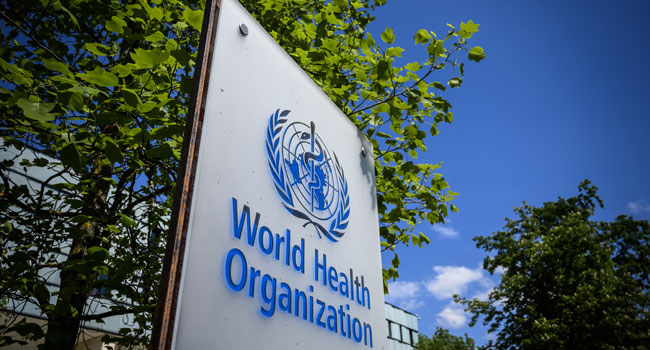
2020 shows a sign of the World Health Organization (WHO) in Geneva
next to their headquarters, amid the COVID-19 outbreak, caused by
the novel coronavirus.Fabrice COFFRINI / AFP
The World Health Organization has warned that vaccines
will be no magic bullet for the coronavirus crisis as nations gear
up for a massive rollout to tackle surging infections.
The word of caution comes as the United States clocked a record
number of Covid-19 cases for a second day in a row, with the
country preparing for what US President-elect Joe Biden has called
a “dark winter”.
America’s Centers for Disease Control and Prevention on Friday
recommended “universal face mask use” indoors and Biden said he
would scale down his January inauguration ceremony to mitigate the
virus risk.
It comes as countries prepare for the approval and rollout of
several vaccines that have proven effective in trials.
The WHO however warned against vaccine complacency on Friday and
what it said was an erroneous belief that the Covid-19 crisis is
over with jabs on the horizon.
“Vaccines do not equal zero Covid,” said WHO emergencies
director Michael Ryan, adding that not everyone will be able to
receive it early next year.
“Vaccination will add a major, major, powerful tool to the tool
kit that we have. But by themselves, they will not do the job.”
WHO Director-General Tedros Adhanom Ghebreyesus said progress on
vaccines signaled “light at the end of the tunnel.”
But he cautioned against the “growing perception that the
pandemic is over” with the virus still spreading fast, putting
enormous pressure on hospitals and health care workers.
– Massive logistical effort –
The WHO says 51 candidate vaccines are currently being tested on
humans, with 13 reaching final-stage mass testing.
Britain on Wednesday became the first Western country to approve
an inoculation, from Pfizer-BioNTech, for general use, piling
pressure on other countries to swiftly follow suit.
The United States is expected to give a green light later this
month.
Belgium, France and Spain have said jabs will begin in January
for the most vulnerable.
With the imminent arrival of vaccines that need storage at
ultra-low temperatures, US companies are preparing for a massive
logistical effort to aid their distribution.
Firms specializing in insulating containers are on a war footing
after Pfizer and BioNTech said their vaccine needs to be stored at
-94 degrees Fahrenheit (-70 Celsius).
(adsbygoogle = window.adsbygoogle || []).push({});
Meat processing giant Smithfield said it was ready to put the
cold rooms at its abattoirs at the disposal of rollout
operations.
And US logistics giant UPS is producing 1,100 pounds (500
kilograms) of dry ice an hour in its depots and has developed
portable freezers capable of storing the vaccines at temperatures
down to -112 Fahrenheit.
– ‘Follow the science’ –
Standing in the way of success are growing signs of vaccine
skepticism, with misinformation and mistrust coloring public
acceptance of inoculation.
Several high-profile figures have pledged to receive the vaccine
in public in an effort to build confidence, including Biden, Tedros
and former US presidents Barack Obama, George W. Bush and Bill
Clinton.
The United States recorded 225,000 new infections on Friday —
the second daily record in a row for the world’s worst-hit
nation.
Biden said the surging number of cases meant he would scale back
his inauguration ceremony set for January.
“We’re going to follow the science and the recommendations of
the experts,” Biden told reporters.
“So it’s highly unlikely there’ll be a million people on the
mall.”
– Christmas spike expected –
More than 65 million people have contracted Covid-19 globally
with the death toll from the disease topping 1.5 million.
British medical chiefs said the arrival of a vaccine should see
deaths reduce “significantly” by early next year but warned social
mixing over Christmas could cause another spike before then.
“By spring the effects of vaccination will begin to be felt in
reducing Covid admissions, attendances and deaths significantly but
there are many weeks before we get to that stage,” they said.
Italy is seeing a dramatic resurgence of infections after it
largely tamped down an earlier outbreak by enforcing a strict
lockdown, while Latin America and the Caribbean has seen an 18
percent spike in cases in a week.
Other countries are unveiling holiday restrictions, with
Switzerland banning Christmas carolling in the streets and Madrid
canceling most New Year events in the city centre.