
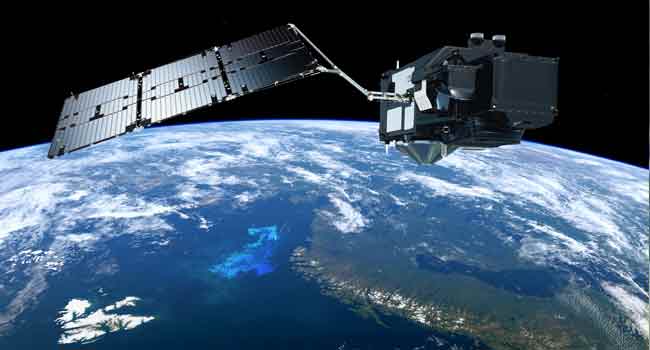
the European Space Agency shows a composite of images of the
Sentinel-3 satellite which is arguably the most comprehensive of
all the Sentinel missions for Europe’s Copernicus programme.
EUROPEAN SPACE AGENCY / AFP
Last month was the hottest November on record as Europe
basked in its highest Autumn temperatures in history, the European
Union’s satellite monitoring service said
Monday.
The Copernicus Climate Change Service (C3S) analysis of surface
and air temperatures found that November 2020 was 0.8C warmer than
the 30-year average of 1981-2010 — more than 0.1C hotter than the
previous record.
For boreal autumn (September-November) temperatures in Europe
were 1.9C above the standard reference period, 0.4C higher than the
average temperature in 2006, which was the previous warmest.
“These records are consistent with the long-term warming trend
of the global climate,” said C3S director Carlo Buontempo.
“All policy-makers who prioritise mitigating climate risks
should see these records as alarm bells and consider more seriously
than ever how to best comply with the international commitments set
out in the 2015 Paris Agreement”.
The landmark deal, which turns five this month, enjoins nations
to limit temperature rises to “well-below” 2C (3.6 Fahrenheit)
above pre-industrial levels.
Last week the World Meteorological Organization said 2020 was on
course to be among the three hottest years ever recorded.
(adsbygoogle = window.adsbygoogle || []).push({});
C3S said that with just one month left to go, 2020 is on par to
match 2016, the current record holder.
With just over 1C of warming so far, Earth is already dealing
with the devastation caused by more frequent and stronger extreme
weather events such as wildfires and tropical storms.
Satellite images analysed by C3S also showed that Arctic sea ice
extent was the second-lowest for November in the database, which
began in 1979.
The largest negative sea ice concentration anomalies were in the
Kara Sea, while there was below-average cover in the eastern
Canadian archipelago and Baffin Bay.
“This trend is concerning and highlights the importance of
comprehensive monitoring of the Arctic, as it is warming faster
than the rest of the world,” said Buontempo.
Temperatures were substantially higher than normal across the
Arctic and much of Siberia last month, and higher than average
across the United States, South America, southern Africa, eastern
Antarctica and most of Australia, C3S said.
The five hottest years in history have all come since 2015.
AFP
Read more https://swordpress.com.ng/2020/12/07/last-november-hottest-on-record-eu/