The audacious attack and occupation of a strategic
port in Mozambique’s gas-rich province days before a summit of
regional leaders will test southern Africa’s counter-insurgency
skills, analysts say.
Extremist fighters attacked the small but key town of Mocimboa
da Praia — the third such attack this year alone — culminating in
the capture of its port on Wednesday.
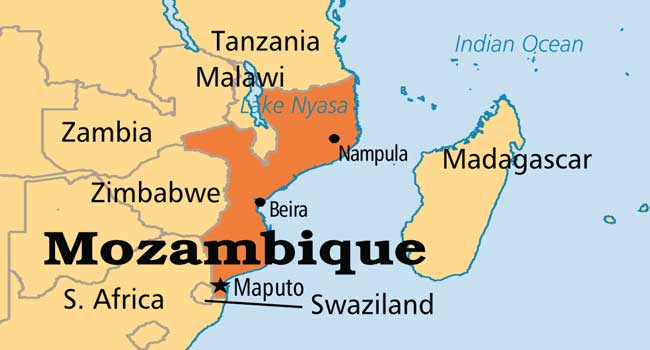
Mozambique’s northernmost province of Cabo Delgado, which
borders Tanzania, has been ravaged by a jihadist insurgency since
October 2017.
But the government waited until April this year to admit the
presence of so-called Islamic State militants in the country.
The jihadists have grown bolder in recent months, escalating
attacks as part of a campaign to establish an Islamist
caliphate.
Analysts hope the violence will be top of the agenda when
leaders from 16 southern African countries meet for a routine
annual summit on Monday.
During the summit — to be held virtually due to coronavirus
travel restrictions — Mozambique takes over the rotating
chairmanship of the Southern African Development Community (SADC)
from Tanzania.
SADC should “urgently assist Mozambique to stem the violent
insurgency” which has killed more than 1,500 people and displaced
at least 250,000, said the Pretoria-based Institute for Security
Studies (ISS) on Thursday.
It said the upcoming summit presents a “crucial opportunity to
take decisive action to help end the crisis”.
– Private military contractors –
In May, SADC’s security unit pledged to help Mozambique tackle
the insurgency — one of the toughest challenges southern Africa has
faced in recent years.
But concrete action has yet to be seen.
“It is really time for SADC to intervene,” said Maputo-based
activist Adriano Nuvunga, director of Mozambique’s Centre for
Democracy and Development.
Struggling to regain control of the strife-torn region, the
Mozambican army has hired private military contractors to help,
including Russia’s Wagner and the South Africa-based Dyck Advisory
Group, according to various researchers.
But analysts say those efforts have been ineffective so far.
“Military action by the Mozambique government, including the
continued use of mercenaries, has not stopped the attacks,” the ISS
said.
In a pre-summit meeting on Thursday, Mozambique’s Foreign
Minister Veronica Macamo spoke of the “need for consultation and
coordination of our actions in combatting terrorism which poses a
major threat to our region”.
“Our region faces a threat… in the form of terrorism and violent
extremism, which if not contained, has the possibility of
spreading” throughout southern Africa, said the minister.
– ‘Regional threat’ –
(adsbygoogle = window.adsbygoogle || []).push({});
SADC set up a standby brigade in 2008 to respond to conflict
situations.
The force was last deployed to restore security in Lesotho in
2017 following the killing of the kingdom’s top army commander.
If sent to Mozambique, it will be the first time it faces
terrorism.
Independent analyst Jasmine Opperman said the Mozambique
insurgency had created a “regional threat” that cannot be
ignored.
“But it does not seem that SADC at this point in time is going
to go beyond window dressing,” she told AFP, noting that SADC
lacked the military and financial might to put boots in Cabo
Delgado.
Regional superpowers that could contribute troops such as South
Africa are focused on militarily enforcing anti-coronavirus
lockdowns.
South Africa also has around 1,000 soldiers serving in a United
Nations mission in the eastern Democratic Republic of Congo.
Even if regional soldiers were deployed, analysts suggest that
would be redundant without tackling local frustrations that fuel
the insurgency.
“If those issues are not addressed in the medium to short-term,
deployment of soldiers will be nothing more than a plaster over an
ulcer that is about to explode,” Opperman warned.
– ‘Gaining momentum’ –
Mozambican security forces have meanwhile been battling to
regain control of the port.
Every attack on Mocimboa da Praia is a hindrance for the
development of a liquefied natural gas (LNG) facility on the Afungi
peninsula.
The project, situated 60 kilometres (40 miles) north of the
town, relies on its port for supplies.
Mozambique’s President Filipe Nyusi insists the multi-million
dollar gas project — one of the biggest single investments in
Africa — is safe.
But the latest attack, according to Nuvunga at Mozambique’s
Centre for Democracy and Development, shows an insurgency that is
“gaining more ground and momentum” and is a “setback” in
development of the gas project.
Experts had hoped the project would turn impoverished Mozambique
into one of the world’s leading LNG exporters, creating an African
version of Qatar.
AFP
Read more https://swordpress.com.ng/2020/08/16/mozambique-insurgency-tests-regions-anti-conflict-resolve/