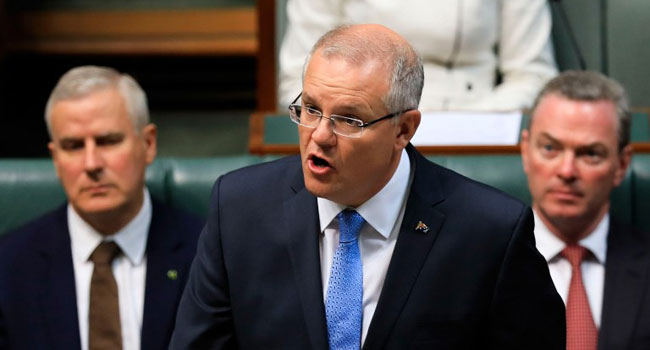
Minister Scott Morrison (C) delivers a national apology to child
sex abuse victims in the House of Representatives in Parliament
House in Canberra on October 22, 2018. Sean Davey /
AFP
Australia’s leader called Wednesday for coronavirus
immunisations to be mandatory, wading into ethical and safety
debates raging around the world as the race to develop a vaccine
gathers pace.
Almost 30 potential vaccines are currently being tested on
humans across the globe in hope of ending a pandemic that has now
killed more than 775,000 people and infected nearly 22 million,
according to an AFP tally.
Prime Minister Scott Morrison said he wants all 25 million
Australians to get the jab after the country secured access to a
vaccine currently under development by AstraZeneca and Oxford
University.
“There are always exemptions for any vaccine on medical grounds,
but that should be the only basis,” he said.
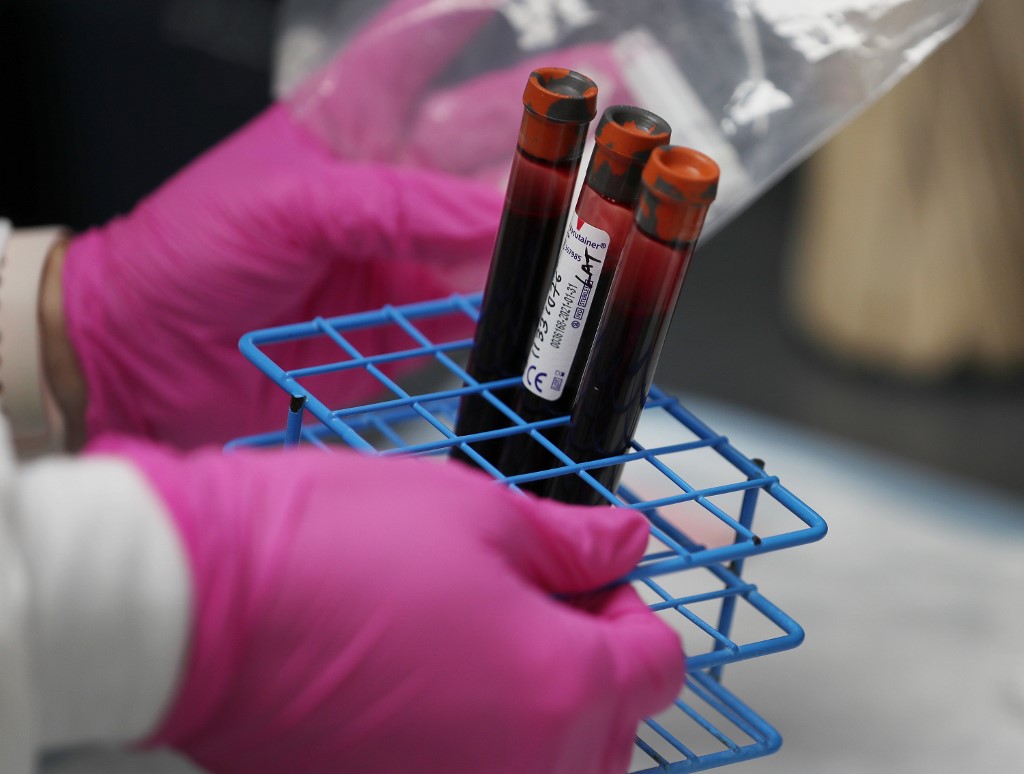
A patients blood samples are seen during a COVID-19 vaccination
study at Research Centers of America on August 07, 2020, in
Hollywood, Florida.Joe Raedle/Getty Images/AFP
Nations are scrambling to develop an immunisation or gain access
to one of a handful of contenders in the final stages of clinical
trials.
Upping the ante, Russia on August 11 said it had developed the
world’s first vaccine offering “sustainable immunity”, and was in
the final stage of human testing.
But the announcement was met with scepticism by the World Health
Organization, which said it still needed a rigorous review, and
scientists say it has been approved without large-scale trials.
Among the competitors, Brazilian health regulators on Tuesday
gave the green light to the final stage of trials on a vaccine by
Johnson & Johnson.
The US pharmaceutical firm will test its drug on 7,000
volunteers in Brazil, authorities said, part of a group of up to
60,000 worldwide.
South Africa, meanwhile, will launch clinical trials of a
US-developed vaccine with 2,900 volunteers this week, the second
such study in the African country worst hit by the disease.
However, the push for a vaccine has coincided with a rise in
anti-vaccine sentiment that could hinder efforts to encourage
widespread uptake.
– ‘Fastest way’ –
The global outbreak has seen a sharp rise in online
misinformation, speculation and opposition — something experts have
dubbed an “infodemic” — with debate raging over whether vaccine
rules impinge on personal freedoms.
The WHO has said the planet’s highest-risk populations must all
be inoculated simultaneously or else it will be impossible to
rebuild the global economy.
It has appealed to countries to join its global shared vaccine
programme rather than go it alone in developing a cure.
(adsbygoogle = window.adsbygoogle || []).push({});
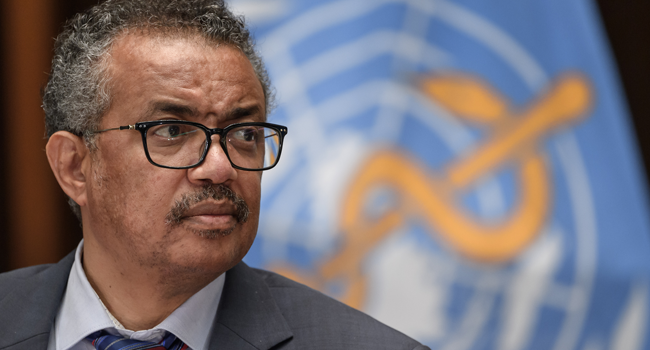
Organization (WHO) Director-General Tedros Adhanom Ghebreyesus
attends a press conference organised by the Geneva Association of
United Nations Correspondents (ACANU) amid the COVID-19 outbreak,
caused by the novel coronavirus, on July 3, 2020, at the WHO
headquarters in Geneva. Fabrice COFFRINI / POOL / AFP
Director-general Tedros Adhanom Ghebreyesus said the most
exposed 20 per cent of each country’s population — including
frontline health workers, adults over 65 and those with
pre-existing conditions — would be vaccinated first in the WHO-led
scheme.
“The fastest way to end this pandemic and to reopen economies is
to start by protecting the highest risk populations everywhere,
rather than the entire populations of just some countries,” he
said.
– New spikes –
His warning comes as the virus refuses to die across large parts
of the globe, with South Korea and Lebanon the latest countries to
witness new spikes.
Seoul ordered nightclubs, museums and buffet restaurants to
close, and banned large gatherings in and around the capital, after
a burst of infections mostly linked to Protestant churches.
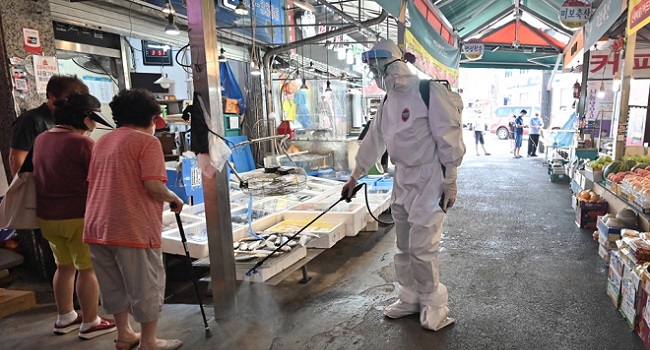
protective gear sprays disinfectant at a market near the Sarang
Jeil Church, a new coronavirus infection cluster, in Seoul on
August 18, 2020. (Photo by Jung Yeon-je / AFP)
The country on Wednesday reported 297 new cases, its sixth
consecutive day of triple-digit increases after several weeks with
numbers generally in the 30s and 40s.
In Lebanon, authorities announced a new lockdown and overnight
curfew to rein in a spike following a colossal chemical explosion
on August 4 that has hampered virus prevention efforts.
In the absence of a vaccine, some people around the world have
been resorting to novel and whacky methods to ward off the
virus.
Namibia’s health minister on Tuesday was forced to warn against
the use of elephant dung, traditionally steamed and inhaled as a
cure for the flu, to ward off COVID-19.
The sparsely populated southern African country has seen
infections double over the past month and many Namibians have
turned to natural remedies.
Dung is widely believed to treat body ailments such as
nosebleeds, headaches and toothaches.
“A desperate person may do a desperate thing,” minister Kalumbi
Shangula said.
AFP
Read more https://swordpress.com.ng/2020/08/19/covid-19-vaccine-should-be-mandatory-says-australia-pm/