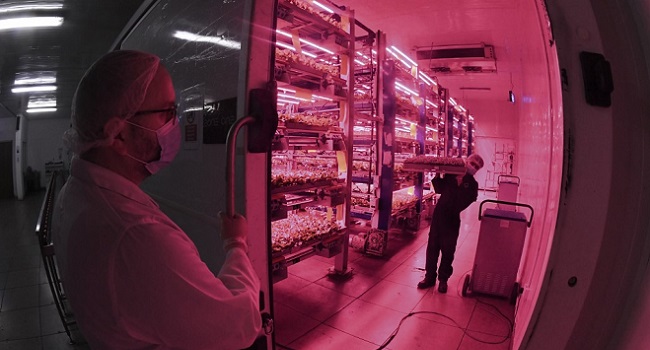
al-Badia Farms in Dubai, an indoor vertical farm using innovative
hydroponic technology to grow fruits and vegetables all year round,
on August 4, 2020. Karim SAHIB / AFP.
The oil-rich United Arab Emirates announced
Wednesday that it has connected its Barakah nuclear power plant to
the national grid in a new first for the Arab
world.
The milestone follows the successful start-up of the plant’s
first reactor at the end of last month and launches the UAE on the
road to meeting 25 percent of its electricity needs from nuclear
power.
“The safe and successful connection of Unit 1 to the UAE grid
marks the key moment when we begin to deliver on our mission to
power the growth of the nation by supplying clean electricity,
around the clock,” said Emirates Nuclear Energy Corporation CEO
Mohamed Ibrahim al-Hammadi.
“We are confident in our people and our technology to continue
to progress to reach… the completion of the remaining three units,
with the goal to power up to 25 percent of the UAE’s electricity
needs for at least the next 60 years.”
The plant on the Gulf coast west of Abu Dhabi had been due to go
online in late 2017 but faced a number of delays that officials
attributed to safety and regulatory requirements.
The UAE has substantial oil and gas reserves, but with a
power-hungry population of 10 million it has made huge investments
in developing clean alternatives, including solar energy.
Barakah, which means “blessing” in Arabic, is a regional
first.
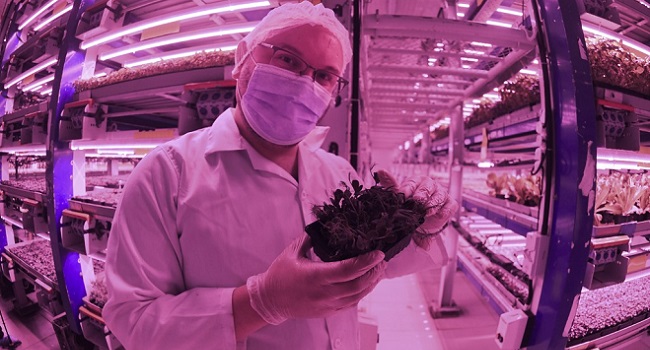
the UAE’s al-Badia Farms’ in Dubai, an indoor vertical farm using
innovative hydroponic technology to grow fruits and vegetables all
year round, is pictured on August 4, 2020. – Dubai, like the other
six emirates that make up the UAE, is heavily dependent on imports,
which make up 90 percent of its food needs according to official
statistics. Produce arrives from all over the world by air and at
Dubai’s state-of-the-art port, stocking supermarkets with a range
that compares favourably to those of any Western capital. Karim
SAHIB / AFP.
(adsbygoogle = window.adsbygoogle || []).push({});
Saudi Arabia, the world’s top oil exporter, has said it plans to
build up to 16 nuclear reactors, but the project has yet to
materialise.
Barakah was built by a consortium led by the Korea Electric
Power Corporation at a cost of some $24.4 billion.
More than 950 kilometres (nearly 600 miles) of 400 kV overhead
power lines had to be built to link the plant to the grid.
Barakah’s other three reactors are said to be almost ready for
operation.
Construction work has already been completed on Unit 2, and
Units 3 and 4 are respectively 93 percent and 86 percent
complete.
The UAE lies just across the Gulf from Iran which has a nuclear
power plant of its own outside the coastal city of Bushehr, as well
as a controversial uranium enrichment programme.
The UAE has repeatedly said its nuclear ambitions are for
“peaceful purposes” and has ruled out developing any enrichment
programme or nuclear reprocessing technologies.
It has also moved to dispel any concerns over safety,
underlining that the plant has welcomed more than 40 international
reviews and inspection missions.
Nearby Qatar, the target of a boycott by Saudi Arabia, the UAE
and others since June 2017, said last year the Barakah plant poses
a “flagrant threat to regional peace and environment”.
AFP
Read more https://swordpress.com.ng/2020/08/19/uae-connects-first-arab-nuclear-plant-to-power-grid/