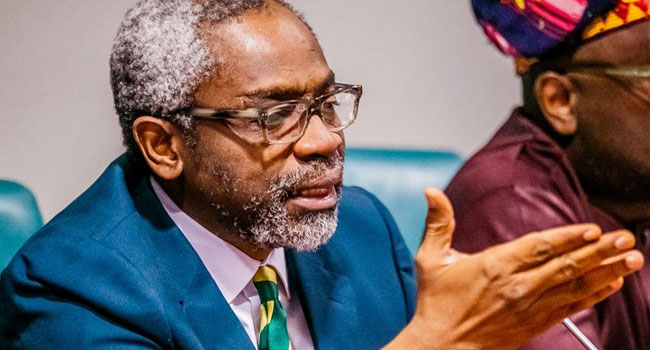
Representatives, Femi Gbajabiamila (File Photo).
The Speaker of the House of Representatives Rep. Femi
Gbajabiamila has assured that the 9th House will ensure a policing
system that works for all citizens in view of the recent #EndSARS
protests.
Gbajabiamila said to achieve the above, the House will carry out
a wholesale reform of the Nigeria Police from recruitment to
training and welfare of officers and men of the police.
Addressing stakeholders at the 9th House Legislative Agenda
Public Policy Dialogue Series with the theme ‘Policing and Human
Rights in Nigeria,’ the Speaker called on all well-meaning
Nigerians to make their inputs toward the enactment of the Police
Service Commission (Reform) Bill, 2020.
“Our reform objectives include wholesale reviews of police
recruitment and training procedures and practices,” he was quoted
to have said in a statement by his media aide, Lanre Lasisi.
“It also includes an obligation to drastically and rapidly
improve the welfare and wellbeing of police officers from
recruitment through to retirement.
“As we expect more from the men and women who carry arms and
take risks to protect us, we must also be ready to do right by
them, and by their families. They too are our citizens; they are
our brothers and sisters deserving of the best that our nation can
offer.
“I want to assure all of you in this room, all of you who are
watching today from wherever you are, the 9th House of
Representatives will do everything we can to deliver for the
Nigerian people a policing system that works for every citizen.
“We will talk, we will engage, we will change laws, and we will
amend the Constitution subject to the consensus of the Nigerian
people. We will do everything that we have the power to do so that
when the account of this moment is given, we will be counted for
making the right choices and doing justice by our people,” he
said.
According to the Speaker, the issue of Police Reform has been
one of the fundamental commitments of the 9th House since its
inauguration.
“This is because we recognise that the policing function is at
the very heart of any fully functioning state. It is through the
institution, mechanisms and resources of policing that the state
can protect the welfare and wellbeing of its citizens.
“Without the ability to offer this protection, the state loses
legitimacy and the authority that flows from there. A society that
cannot effectively police itself ceases to exist, and a government
that fails to protect its citizens has lost the right to continue
in office. We must avoid these unfortunate outcomes.
“This is why we must commend the present administration which
inherited a flawed policing system and is now taking giant steps to
reform the system through the recently enacted Police Reform Act,
2020 and several other measures. But the work is far from done, and
we must continue in these efforts.”
Gbajabiamila added that “effective policing is only possible
when the policing institutions are grounded in the rule of law,
when they are accountable and when the justice system in its
entirety is fair to all who have cause to appear before it. We
cannot have an effective policing system when the citizens do not
have faith that the Police will treat them fairly every time, no
matter the circumstance.
“We do not have an effective system of policing when the
relationships between communities and the Police are defined by
fear and mistrust. The Police cannot be effective when the
mechanisms for accountability and discipline are too weak to
identify, remove and prosecute rogue officers as a matter of
course.
“We will have succeeded in build ing modern and effective Police
when service in the Nigeria Police Force consistently attracts the
best and brightest in our country without objection.
(adsbygoogle = window.adsbygoogle || []).push({});
“When we think about policing reforms, we must resist the urge
to focus only on making new rules about police conduct, and
establishing new ways of holding officers accountable for failures
to meet the standards of behaviour that we expect from them.
Policing reform is more profound than that. Yes, we must begin by
holding officers accountable, but we cannot stop there.”
“This moment is also about our nation’s young people, a
generation that never witnessed military rule, who were born into
and have lived their entire lives in a democracy. Too often, and
for decades, that democracy has unfortunately fallen short of their
expectations.
In a remark, the Chairman of the House Committee on
Implementation and Monitoring of the Legislative Agenda, Rep. Henry
Nwawuba, said the 9th House has committed itself to seeking
collective and holistic ways to find lasting solutions to our
national needs.
Noting that his committee was set up to ensure that the House
meets its agenda and live up to its best aspirations and
objectives, Nwawuba said the dialogue was an innovative step in the
Bill process to get stakeholders’ buy-in even before the
presentation of the Bill on the floor of the House.
“We intend to collate the opinions, observations and ideas of
stakeholders and citizens to form part of the Bill so that the
House will consider. This interaction doesn’t usurp the legislative
process of the Bill,” he said.
Also, the Chairman of the House Committee on Police Affairs,
Rep. Usman Bello Kumo, said his committee would provide an enabling
environment for people to cross-fertilize ideas when the Bill gets
to them.
In a goodwill message, the United Nations Development Programme
(UNDP) Resident Representative in Nigeria, Mohammed Yahya, said the
PSC Bill is timely, noting that policing problem is not peculiar to
Nigeria alone as it obtains in the entire African Continent.
On his part, the Inspector General of Police (IGP) Mohammed
Adamu Abubakar, represented by the DIG research and planning,
Adeleye Olusola, requested for time to dissect the Bill before
coming up with a sound position.
The President of the Nigeria Bar Association (NBA), Olumide
Akpata, whose organisation is one of the bodies working with the
House on the Bill, said they were doing a lot to re-energize
relevant bodies of the NBA to face issues of human rights
violations squarely.
“This is one collaboration that we’re proud of. The issues that
confront our country and the Nigeria Police are issues that predate
most of us. With regards to human rights violations, I think it’s a
matter of orientation. In the proposed law, the issue of
orientation is being addressed,” he said.
Also speaking, the Chairman of PSC, Musiliu Smith, represented
by retired Justice Clara Ogunbiyi, commended the House for coming
up with the Bill, saying it would enhance the operations of the
commission, requesting for more time to study the draft law.
In his intervention, the Executive Secretary of the National
Human Rights Commission (NHRC), said majority of Nigerian police
personnel were ready and qualified to do their job, but that the
environment they operate on does not allow them to.
Lauding the House for the initiative, he said the Bill takes
care of the independence of the commission with security of tenure
and a broad membership.
Other speakers at the dialogue such as a youth advocate, Bobo
Ajudua, and the Director, Centre for Democracy and Development,
Idayat Hassan, commended the House for the initiative and made some
suggestions.