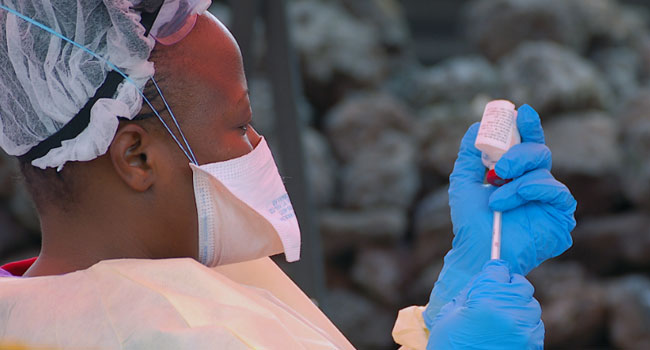
Congo is to introduce a second vaccine next month to combat the
Ebola virus, which has killed more than 2,100 people in the
country, /AFP
COVID-19 has been a shot in the arm for vaccine research
with several viable jabs in production less then a year after the
disease emerged.
Yet four in 10 Americans, and six in 10 French people say they
will not get vaccinated against the virus, even if the shot is
free.
We look at the history of vaccines over the last two centuries,
with scepticism about them never far away.
1796: Eureka!
Deadly and highly contagious smallpox, transmitted through open
sores that scarred millions for life, ravaged populations for
centuries until English doctor Edward Jenner notices that milkmaids
who got cowpox never get smallpox.
In 1796 he inoculates a child with the harmless version of the
disease to stimulate an immune response. Despite repeated exposure,
the child never falls ill. Vaccination is born.
1853: Poxy policy
The smallpox vaccine becomes mandatory for all British children
in 1853, but this provokes an immediate backlash. Many object for
religious reasons or see the policy as infringing of individual
liberties.
A conscience clause is added to the law in 1898 to allow people
to opt out.
1885: Pasteur and rabies
French scientist Louis Pasteur develops a rabies vaccine from a
more benign strain of the disease. It appears successful when he
gives it to a child bitten by a rabid dog. Vaccine sceptics however
accuse Pasteur of trying to develop “laboratory rabies” to increase
his profits.
1920s: TB, diphtheria, tetanus
A vaccine against typhoid is developed at the end of the 19th
century, followed by several crucial shots in the 1920s: the 1921
Bacille Calmette-Guerin (BCG) vaccine against tuberculosis and
shots against diphtheria in 1923, tetanus in 1926 and whooping
cough in 1926.
It is also in the 1920s that aluminium-containing agents are
first used in vaccines to increase their efficiency — an ingredient
that will spark vaccine scepticism later on, especially in
France.
(adsbygoogle = window.adsbygoogle || []).push({});
1944: Flu vaccine
The first vaccine campaign against the seasonal flu targets US
soldiers fighting in Europe in 1944-45, with a new shot developed
each year.
In the 1950s, when polio vaccination was a US government
priority, megastar Elvis Presley lent himself to the cause, getting
the shot live on the primetime “Ed Sullivan Show”.
In the 1970s a campaign to innoculate Americans against a
supposedly devastating strain of swine flu grounds to a halt,
however, when the pandemic fails to materialise and some 450 of
those vaccinated unnecessarily develop Guillain-Barre syndrome
which can cause paralysis. The incident continues to fuel vaccine
scepticism.
1980: Smallpox wiped out
The last natural case of smallpox is diagnosed in Somalia on
October 26, 1977 and the World Health Organization (WHO) declares
the illness officially eradicated in 1989 thanks to a global
vaccination campaign.
A similar campaign to eradicate polio has been hugely
successful, wiping it out in Africa. The disease lingers on in
Pakistan and Afghanistan because some religious leaders claim the
shot is a plot to sterilise Muslim children.
1998: Fake study, real damage
In 1998 a study published in the prestigious Lancet medical
journal suggests a link between the MMR (measles, mumps and
rubella) vaccine and autism.
The main plank of it, however, had been falsified by its author
Andrew Wakefield who was later barred from the profession. Yet the
debunked study is still cited by “anti-vaxers”.
2009: H1N1 debacle
In 2009 an H1N1 — or swine flu — outbreak sets off alarm bells
around the world. Although related to the infamous 1918 flu strain,
the virus turns out to be far less consequential, killing just
18,500 people.
The waste from millions of unused vaccines prompts criticism of
the WHO’s handling of the outbreak.
In addition, Sweden, where more than 60 percent of the
population were vaccinated, was traumatised when hundreds of people
who got the jab were later diagnosed with narcolepsy.
Read more https://swordpress.com.ng/2020/12/08/vaccines-200-years-of-progress-and-scepticism/