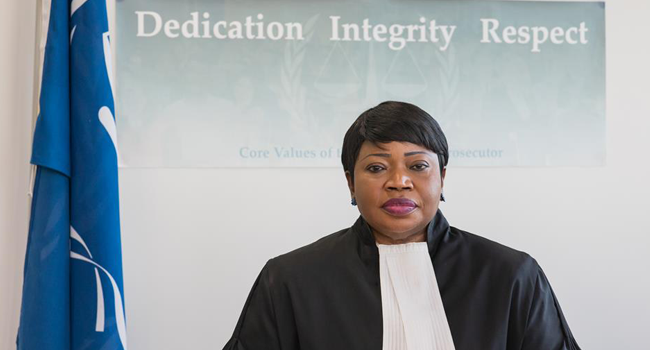
Court’s prosecutor, Fatou Bensouda.
The International Criminal Court’s prosecutor said
Friday she had enough evidence to open a full probe into ongoing
violence in Nigeria by both Islamist insurgents and security
forces.
Fatou Bensouda’s announcement comes as violence continues to
wreak havoc in the northeast, where at least 76 people were
slaughtered by Boko Haram jihadists two weeks ago.
“Following a thorough process, I can announce today that the
statutory criteria for opening an investigation into the situation
in Nigeria have been met,” Bensouda said in a statement, issued at
the ICC’s headquarters in The Hague.
ICC prosecutors opened a preliminary investigation into the
situation in Nigeria in 2010 but Bensouda now wants permission from
judges to proceed to a full-blown formal probe.
Gambian-born Bensouda specifically referred to acts committed by
Boko Haram, whose 11-year insurgency in the country have claimed
the lives of at least 36,000 people.
Around two million others have been displaced, according to UN
figures.
Boko Haram and its splinter groups have committed “acts that
constitute crimes against humanity and war crimes” including
murder, rape, sexual slavery, enslavement, torture and cruel
treatment, Bensouda said.
But while the “vast majority” of crimes were committed by
non-state perpetrators “we also found a reasonable basis to believe
that members of the Nigerian Security Forces committed acts
constituting crimes against humanity and war crimes”, Bensouda
said.
This included murder, rape, torture, and cruel treatment as well
as enforced disappearance and forcible transfer of the population
and attacks directed at civilians.
‘Ample time’
A full investigation by the ICC, set up in 2002 to try the
world’s worst crimes, could eventually lead to charges over the
violence in the oil-rich African nation, which has been fuelled by
the Boko Haram insurgency.
Bensouda said Nigeria has made some effort to prosecute “mainly
low-level captured” Boko Haram fighters, while military authorities
told her they have “examined, and dismissed, allegations against
their own troops”.
“I have given ample time for these proceedings to progress,”
keeping in mind the ICC’s complementarity principle, which means it
would only get involved in investigations and prosecutions if a
member state was unable or unwilling to do so, she added.
“Our assessment is that none of these proceedings relate, even
indirectly, to the forms of conduct or categories of persons that
would likely form the focus of my investigations,” Bensouda
said.
Farm workers massacred
Boko Haram’s main group claimed responsibility earlier this
month for the massacre of some 76 farm workers in an area outside
Borno state’s capital Maiduguri, in which dozens of labourers were
mowed down by gunmen on motorbikes.
Farm workers were also tied up and had their throats slit in the
attack believed to be seeking revenge on villagers for seizing the
group’s fighters and handing them over to the authorities.
The massacre provoked widespread international condemnation
including by the head of the Catholic Church.
“I want to assure my prayers for Nigeria, where blood has
unfortunately been spilled once more in a terrorist attack,” Pope
Francis said at the Vatican during a weekly general audience
earlier this month.
Meanwhile, state security sources said 10 Nigerian troops were
killed on Monday in clashes with IS-linked jihadists in Borno
state.
Fighting erupted when a team of soldiers stormed a camp of
Islamic State West Africa Province (ISWAP) in Alagarno village in
Damboa district.
Alagarno, which lies 150 kilometres (90 miles) from
regional capital Maiduguri, is a stronghold of ISWAP, which split
from the Boko Haram jihadist group in 2016 and rose to become a
dominant force.
ISWAP has increasingly been attacking civilians, killing and
abducting people on highways as well as raiding villages for food
supplies.
Violence in Nigeria has spread to neighbouring Chad, Niger and
Cameroon, prompting a regional military coalition to fight the
militant groups.
READ THE ICC PROSECUTOR’S FULL STATEMENT:
Today, I announce the conclusion of the preliminary examination
of the situation in Nigeria.As I stated last year at the annual Assembly of States
Parties, before I end my term as Prosecutor of the International
Criminal Court (“ICC” or the “Court”), I intend to reach
determinations on all files that have been under preliminary
examination under my tenure, as far as I am able. In that
statement, I also indicated the high likelihood that several
preliminary examinations would progress to the investigative stage.
Following a thorough process, I can announce today that the
statutory criteria for opening an investigation into the situation
in Nigeria have been met.Specifically, my Office has concluded that there is a reasonable
basis to believe that members of Boko Haram and its splinter groups
have committed the following acts constituting crimes against
humanity and war crimes: murder; rape, sexual slavery, including
forced pregnancy and forced marriage; enslavement; torture; cruel
treatment; outrages upon personal dignity; taking of hostages;
intentionally directing attacks against the civilian population or
against individual civilians not taking direct part in hostilities;
intentionally directing attacks against personnel, installations,
material, units or vehicles involved in a humanitarian assistance;
intentionally directing attacks against buildings dedicated to
education and to places of worship and similar institutions;
conscripting and enlisting children under the age of fifteen years
into armed groups and using them to participate actively in
hostilities; persecution on gender and religious grounds; and other
inhumane acts.While my Office recognises that the vast majority of criminality
within the situation is attributable to non-state actors, we have
also found a reasonable basis to believe that members of the
Nigerian Security Forces (“NSF”) have committed the following acts
constituting crimes against humanity and war crimes: murder, rape,
torture, and cruel treatment; enforced disappearance; forcible
transfer of population; outrages upon personal dignity;
intentionally directing attacks against the civilian population as
such and against individual civilians not taking direct part in
hostilities; unlawful imprisonment; conscripting and enlisting
children under the age of fifteen years into armed forces and using
them to participate actively in hostilities; persecution on gender
and political grounds; and other inhumane acts.
(adsbygoogle = window.adsbygoogle || []).push({});
These allegations are also sufficiently grave to warrant
investigation by my Office, both in quantitative and qualitative
terms. My Office will provide further details in our forthcoming
annual Report on Preliminary Examination Activities.
The preliminary examination has been lengthy not because of the
findings on crimes – indeed, as early as 2013, the Office
announced its findings on crimes in Nigeria, which have
been updated regularly since. The duration of the
preliminary examination, open since 2010, was due to the priority
given by my Office in supporting the Nigerian authorities in
investigating and prosecuting these crimes domestically.
It has always been my conviction that the goals of the Rome
Statute are best served by States executing their own primary
responsibility to ensure accountability at the national level. I
have repeatedly stressed my aspiration for the ability of the
Nigerian judicial system to address these alleged crimes. We have
engaged in multiple missions to Nigeria to support national
efforts, shared our own assessments, and invited the authorities to
act. We have seen some efforts made by the prosecuting authorities
in Nigeria to hold members of Boko Haram to account in recent
years, primarily against low-level captured fighters for membership
in a terrorist organisation. The military authorities have also
informed me that they have examined, and dismissed, allegations
against their own troops.
I have given ample time for these proceedings to progress,
bearing in mind the overarching requirements of partnership and
vigilance that must guide our approach to complementarity. However,
our assessment is that none of these proceedings relate, even
indirectly, to the forms of conduct or categories of persons that
would likely form the focus of my investigations. And while this
does not foreclose the possibility for the authorities to conduct
relevant and genuine proceedings, it does mean that, as things
stand, the requirements under the Statute are met for my Office to
proceed.
Moving forward, the next step will be to request authorisation
from the Judges of the Pre-Trial Chamber of the Court to open
investigations. The Office faces a situation where several
preliminary examinations have reached or are approaching the same
stage, at a time when we remain gripped by operational challenges
brought on by the COVID-19 pandemic, on the one hand, and by the
limitations of our operational capacity due to overextended
resources, on the other. This is also occurring in the context of
the pressures the pandemic is placing on the global economy.
Against this backdrop, in the immediate period ahead, we will need
to take several strategic and operational decisions on the
prioritisation of the Office’s workload, which also duly take into
account the legitimate expectations of victims and affected
communities as well as other stakeholders. This is a matter that I
will also discuss with the incoming Prosecutor, once elected,
as part of the transition discussions I intend to have. In the
interim, my Office will continue to take the necessary measures to
ensure the integrity of future investigations in relation to the
situation in Nigeria.
The predicament we are confronted with due to capacity
constraints underscores the clear mismatch between the resources
afforded to my Office and the ever growing demands placed upon it.
It is a situation that requires not only prioritization on behalf
of the Office, to which we remain firmly committed, but also open
and frank discussions with the Assembly of States Parties, and
other stakeholders of the Rome Statute system, on the real resource
needs of my Office in order to effectively execute its statutory
mandate.
As we move towards the next steps concerning the situation in
Nigeria, I count on the full support of the Nigerian authorities,
as well as of the Assembly of States Parties more generally, on
whose support the Court ultimately depends. And as we look ahead to
future investigations in the independent and impartial exercise of
our mandate, I also look forward to a constructive and
collaborative exchange with the Government of Nigeria to determine
how justice may best be served under the shared framework of
complementary domestic and international action.
The Office of the Prosecutor of the ICC conducts independent
and impartial preliminary examinations, investigations and
prosecutions of the crime of genocide, crimes against humanity, war
crimes and the crime of aggression. Since 2003, the Office has been
conducting investigations in multiple situations within the ICC’s
jurisdiction, namely in Uganda; the Democratic Republic of the
Congo; Darfur, Sudan; the Central African Republic (two distinct
situations); Kenya; Libya; Côte d’Ivoire; Mali; Georgia, Burundi
Bangladesh/Myanmar and Afghanistan (subject to a pending article 18
deferral request). The Office is also currently conducting
preliminary examinations relating to the situations in Bolivia;
Colombia; Guinea; the Philippines; Ukraine; and Venezuela (I and
II), while the situation in Palestine is pending a judicial
ruling.
For further details on “preliminary examinations” and
“situations and cases” before the Court,
click here,
and here.
OTPNewsDesk@icc-cpi.int
Source : Office of the Prosecutor
Read more https://swordpress.com.ng/2020/12/12/icc-prosecutor-seeks-investigation-of-nigeria-for-war-crimes/