Emptiness, lack of character and a
fundamental unwillingness to take responsibility lurk at evil’s
core.
by
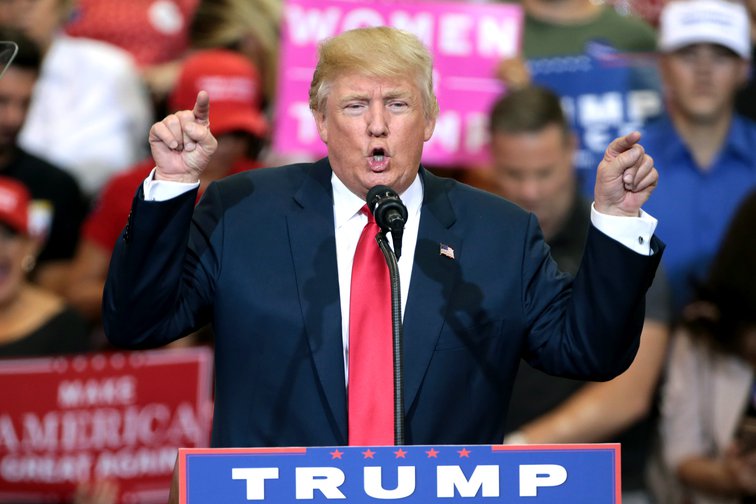
Despite our best intentions, Trump’s name is on everyone’s lips,
yet I have no interest in the sordid details of his psyche. His
pathologies are a matter of indifference. It’s clear to me that
he’s a violent, dangerous lunatic. His desperate attempts to win
attention and adulation likely stem from abuse he suffered as a
youth.
Whatever action Trump takes is almost guaranteed to be idiotic –
not just run-of-the-mill idiotic but epically, spectacularly so.
Commenting on his actions reduces you to his level. Regardless of
how many words you use, the verdict is clear: “Trump…bad.” But this
gets us nowhere. Without action to shift the balance of political
forces towards a society that eradicates the roots of Trumpism,
decrying the symptoms of the underlying disease is an exercise in
righteous futility.
However, thinking about Trump does teach us something useful:
profound evil can coexist with deep mediocrity. Trump is
responsible for an incredible amount of suffering and death, but
when I watch him on television, I feel a surprising lack of affect.
No outrage, no fury. Occasionally, a Trump meme makes me laugh. How
can that possibly be? Where does my cognitive dissonance come
from?
We could chalk it up to my privilege, my insulation from the
direct consequences of Trump’s actions. Or to psychological
burnout, psychic defense mechanisms, or a pervasive cynicism
verging on nihilism. All those factors may play a role in mediating
my response to Trump’s televisual assault on our senses, but I
think there is something more fundamental at work.
Beneath the bullying, blustering, and casual cruelty; beneath
the mangled syntax and rhetorical excess; beneath the torrent of
lies, the shocking vapidity and astonishing stupidity, one senses a
radical vacuum. Trump perfectly mirrors an age of spectacle,
presenting us with deconstructed fascism. His incessant harangues,
evacuated of all substance, are a stream-of-consciousness scream of
rage and discontent. He says something. He contradicts it. He
performs as a demagogue yet lacks the true air of command. He is a
postmodern wannabe dictator.
His attention span is minimal, yet he has none of the
traditional gifts of the leader, like extraordinary stamina, a
herculean work ethic, strategic vision, and the keen selection of
capable advisors. He is a bloviating buffoon, careening from one
absurdity to the next, anticipating what nonsense Fox churns out
about him next.
There is a peculiar disconnect between the evils his
administration has directly wrought – internment camps on the
southern border, incitement of racist and anti semitic violence,
hundreds of thousands of senseless coronavirus deaths, instances of
corruption too numerous to list – and the hollowness of the man and
his sycophants. Trump and his officials are violent, but their
violence is slippery and elusive.
Evil has at least two aspects. There is the evil of individuals:
hideous, painfully personal acts of violence committed by specific
people. And then there is systematic evil: the enormity of cruel
systems which deprive people of their liberty, their human rights,
and their very reason for being. These systems’ refusal to
entertain any appeal to humanity is perhaps what distinguishes them
most of all. But the particular terror of evil is the way the
evildoer’s humanity – their frailty, foibles, and bodily existence
– is eradicated.
We think of evil as something profound. We’re raised on movies
that portray villains as titans, masters of planning and human
will, perverted supermen. We may find them horrific or despicable,
but we don’t usually view them as ignorant or laughable, at least
not until the climax when villains get their comeuppance and are
revealed to be secretly weak: blundering, blubbering babies cloaked
by braggadocio and bravado.
The monstrous paradox of modern evil is twofold. Systems are far
more diffuse than a single super-villain, and harder to defeat.
It’s not a question of a single bad apple who can be removed.
Individual agency has been drastically minimized by far-flung
bureaucratic and economic systems. When the Pentagon, ICE, and the
Department of Homeland Security are tasked with committing
atrocities against people in the global South, undocumented
immigrants or protesters, there is little room for maneuver for
objectors within those bureaucracies who wish to resist.
Individuals who are forced to participate in the economy may
object when global capitalism kills millions of people by depriving
them of human rights such as quality healthcare, clean air and
water, safe and plentiful food, and a guaranteed basic income, but
they are relatively powerless as individuals to change the
conditions under which the system operates. Considering evil as
something that’s executed by individuals against other individuals
doesn’t equip us to address systemic, structural violence.
(adsbygoogle = window.adsbygoogle || []).push({});
What’s more, treating evil as if it consists only or chiefly of
acts of commission rather than in acts of omission means that we
are poorly positioned to recognize the evil of the Trump
administration’s coronavirus negligence. Neglect has never been
treated with the same seriousness as affirmative action. Of course,
given the imbalances in power that exist within political,
economic, and social hierarchies, individuals do still matter. But
we’re not ready to recognize that evil individuals often don’t
match the simplistic, psychopathic, and cartoonishly maleficent
profile that we’ve been trained to recognize.
Hannah Arendt, the theorist, philosopher, author, and originator
of the phrase “the banality of evil,” teaches us that before Adolf
Hitler attained frightening amounts of power, his physical tics
were widely derided, and even regarded as comical. Writing about the Nazi war criminal Adolf
Eichmann, Arendt remarked on “the dilemma between the unspeakable
horror of the deeds and the undeniable ludicrousness of the man who
perpetrated them.” Later, in 1965, she observed that:
“the greatest evil perpetrated is the evil committed by
nobodies, that is, by human beings who refuse to be
persons…wrongdoers who refuse to think by themselves what they are
doing and who also refuse in retrospect to think about it, that is,
go back and remember what they did (e.g., repentance), have
actually failed to constitute themselves into somebodies.”
Trump’s clownish antics and the abnegation of responsibility so
characteristic of his administration are perfectly consonant with
this vision of the evildoer. Emptiness, a lack of character, and a
fundamental unwillingness to take responsibility for oneself lurk
at evil’s core.
Systematic evil may subsume individual evildoers in a chain of
command and obedience, but the individuals involved have usually
forfeited their personhood from the start. In The Origins of
Totalitarianism, Arendt – reflecting what we know of the Trump
administration’s lackeys – writes of “new mass leaders whose
careers reproduce the features of earlier mob leaders: failure in
professional and social life, perversion and disaster in private
life.” Although Trump doesn’t seem to be a completely totalitarian
leader, Arendt describes his need for publicity and his reliance on
his followers’ affections to ratify his existence to a tee when she
describes such leaders as:
“nothing more nor less than the functionary of the masses he
leads; he is not a power-hungry individual imposing a tyrannical
and arbitrary will upon his subjects…he depends as much on the
‘will’ of the masses he embodies as the masses depend on him.
Without him they would lack external representation and remain an
amorphous horde; without the masses the leader is a nonentity.
Hitler, who was fully aware of this interdependence, expressed it
once in a speech addressed to the SA [the Nazis’ paramilitary
gang]: ‘All that you are, you are through me; all that I am, I am
through you alone.’”
In the same way, Trump is inextricable from the mob he has
spawned. He lives for their applause. Without it, he is lost, but
he doesn’t know why he seeks their plaudits. He enriches himself
and his cronies, but his riches far exceed the sum that anyone can
spend in a lifetime. Trump and his friends seek power, but to what
end? Corporations’ profits are already sky-high, and they are
destroying the planet that produces their profits and gives wealth
its meaning. Even if neo-fascists achieved complete dominion over
the United States they have no grand plan for what they would do
after that. This is what Arendt meant when she wrote of evil
that:
“It can overgrow and lay waste the whole world precisely
because it spreads like a fungus on the surface. It is
‘thought-defying…because thought tries to reach some depth, to go
to the roots, and the moment it concerns itself with evil, it is
frustrated because there is nothing. That is its
‘banality.’”
Nothing meaningful justifies the Trumpian incarnation of evil,
just as nothing meaningful underlay its predecessors. One hopes
that his desperate existential quest won’t drag us all even further
into the depths. Mocking Trump is a predictable response – he is a
tempting target for derision. But ridicule can’t mean inaction. We
have been warned: evil can come in masquerade.

Members of the Presidential Committee on Correctional Reforms
have called for a strategic and holistic approach to the
implementation of the Reforms of Correctional Centres in
Nigeria.

Their position was made during programme organised by the
Nigerian Institute of Advanced Legal Studies (NIALS) in November
2020, which were part of the last quarter activities between
October and December 2020, presented in the institute’s news
digest.

Speaking, the Director General of NIALS, Professor Muhammed
Tawfiq Ladan, who was also a member of the committee called on the
federal government to implement the Correctional Service Reform
Bill in 2019, which is one of the success stories of the committee
after 10 years of struggle.
Ladan also called for the implementation of the National Justice
Policy adopted in 2019 by the Federal Executive Council, which has
one thematic area on Prison Reform and Decongestion and have been
implemented in three states.
The NIALS, in another programme, called for the regulation of
social media due to the dangers associated with fake news and hate
speeches in the country.
Stakeholders, however, said the regulation must strike a balance
between the fundamental rights of citizens as guaranteed in the
1999 Constitution and other regional and international
instruments.
Speaking at the forum, Prof Ladan drew attention to existing
laws, which can be used to address the challenge, without
legislating on a new Bill.
On her part, the General Manager, Nigerian Television Authority,
News 24, Asabe Abubakar opined that “Everyone has a responsibility
to combat the scourge of fake news by verifying information.”